Picture “Mississippi Burning” (1988), the multi-Oscar-nominated film in which Gene Hackman and Willem Dafoe played F.B.I. agents investigating the disappearance of three civil rights workers in 1964.
Now tweak that scenario a bit. Imagine that one of the F.B.I. agents is Black. Wayne Strider (Yahya Abdul-Mateen II) has just moved from Chicago to his native Mississippi, where the bureau has stationed him in a file room. Suddenly, he is not only assigned to a case, but also given a bad-cop partner of sorts.
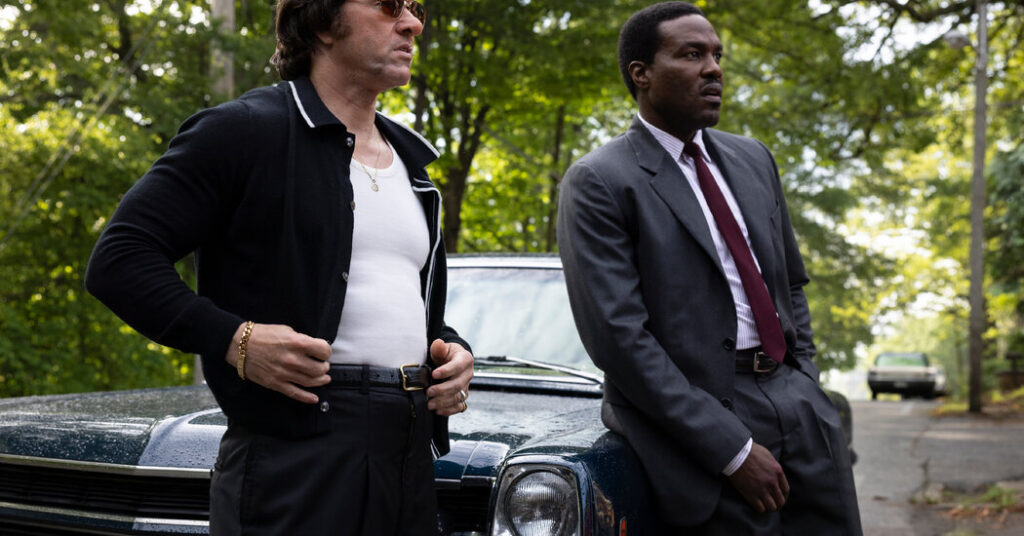
Technically, Greg Scarpa (Mark Wahlberg) isn’t law enforcement at all. He is an active, foulmouthed mafia hit man recruited from Bensonhurst, Brooklyn, to help the F.B.I. work in the shadows. He also provides “By Any Means,” directed by Elegance Bratton, with its crowd-pleasing revenge violence and incongruous moments of fish-out-of-water humor.
Scarpa is not too keen on the Rev. Dr. Martin Luther King Jr. He prefers Malcolm X, whose exhortation to seek freedom, justice and equality “by any means necessary” is a hair closer to his favored approach of busting heads. Strider asks him what he would do, about the Ku Klux Klan and its enablers, if he were Black. “I’d kill them all,” Scarpa replies. “Every last one.”
What Bratton has made is at once an earnest civil rights picture and a largely untroubled, occasionally gleeful endorsement of gangland enforcement tactics. The movie establishes its clashing tones immediately: It opens with somber black-and-white news footage, followed by a scene of Scarpa torturing a prospective snitch. The three words of the title appear rhythmically — “BY.” “ANY.” “MEANS.” — timed to the thwacks of his baseball bat.
Strider and Scarpa are investigating the killing of Vernon F. Dahmer Sr. (Giancarlo Esposito), a county-level N.A.A.C.P. leader who sought to aid Black voter registration and died when his home in Hattiesburg, Miss., was firebombed in 1966. Strider is fictional, but Dahmer was real, and so was Scarpa, an F.B.I. informant who may or may not have played a role in the case that inspired “Mississippi Burning.”
That film did its own hand-wringing over the necessity of bending the law to enforce it, and “By Any Means” leans fully into its own reactionary impulses. The movie, written by Sascha Penn, is structured at least in part as Strider’s personal journey to accept the necessity of playing rough.
Bratton’s last feature, “The Inspection,” based on his own experiences in the Marines, concerned a gay recruit finding his place in an aggressively homophobic boot camp. One of the things that the director and Abdul-Mateen show well here is Strider’s code-switching. The character adapts briskly from tough-mindedness to learned fear, depending on the situation. (He is reluctant to enter a gun shop even with Scarpa as security.) Strider’s Chicago-raised wife (Nicole Beharie) doesn’t quite get it, but a potential witness (well played by LisaGay Hamilton) understands that the Klan’s influence pervades every aspect of life in Hattiesburg.
Maybe it does take the methods of organized crime to counter power that ingrained. But “By Any Means” can’t declare itself: It might have approached the material as either film noir or straight-up exploitation, but its sincerity exists uneasily with its head smashing, and the buddy-cop elements feel out of place. Wahlberg, sporting a cartoonishly broad accent and aviator sunglasses, appears to be trying to outdo Viggo Mortensen’s mugging in “Green Book.” Scarpa may be a fish out of water, but that’s no reason for Wahlberg to act as if he’s in an entirely different movie.
By Any Means
Rated R for violence and language, including racial slurs. Running time: 1 hour 47 minutes. In theaters.
The post ‘By Any Means’ Review: Bending the Law to Enforce It appeared first on New York Times.