Prime Minister Pedro Sánchez of Spain for the first time on Thursday questioned why Moroccan authorities had allowed tens of thousands of migrants to cross a border into the Spanish territory of Ceuta in North Africa in July. But he reiterated that his government had seen no evidence that Morocco had “designed or executed” the surge.
“What caused the lack of control during those central hours of Thursday, July 30?” Mr. Sánchez said in an address to Parliament, referring to what he said were the 10 hours at the peak of the surge.
“That is something that obviously must be determined,” he said. “Whether there was incapacity or inaction needs to be clarified.””
Mr. Sánchez’s remarks came as he faces mounting pressure over his handling of the situation in Ceuta.
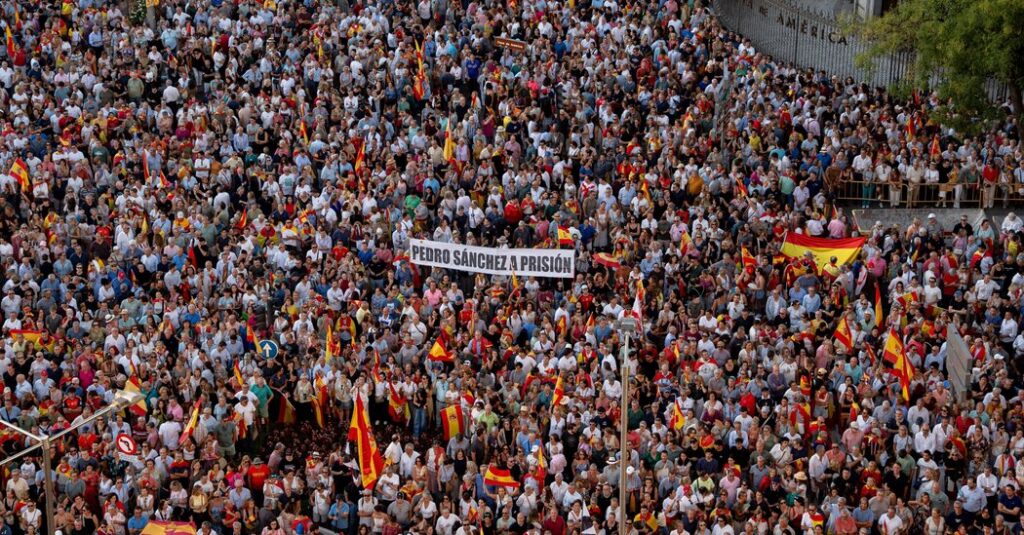
On Wednesday, hundreds of thousands filled plazas across Spain to show support for the tiny exclave. About 90 percent of the newly arrived migrants in Ceuta returned to Morocco within 72 hours, but at least 5,000 still remain. In recent weeks, migrants have set up camp on the beach and frustrations have spiked among locals, many of whom say they feel abandoned by their government.
This week, opposition politicians latched onto a police report suggesting Morocco had allowed or even orchestrated the surge and they accused Mr. Sánchez of failing to defend Spain.
“The operation originated in Morocco, was permitted by Morocco, and there are indications that Morocco coordinated it and that the government knew because it was warned about it,” said Alberto Núñez Feijóo, the conservative opposition party leader.
The situation in Ceuta is one of Mr. Sánchez’s most significant challenges since he first took office in 2018.
He has faced natural disasters, corruption trials, a nationwide blackout and a deadly train crash. But the crisis in Ceuta drew global attention and gave right-wing populists material to depict what they called their nightmare scenario.
It also threatened to undermine Mr. Sánchez’s vital relationship with Morocco, which is necessary to regulate migrant flows, and his reputation as a progressive, pro-immigrant standard-bearer ahead of general elections next year.
On Thursday, in his first remarks to Parliament about the crisis, Mr. Sánchez said that he had summoned the Moroccan ambassador to Spain last month in protest, after Morocco’s justice minister said that it had a “historic right” over Ceuta and Melilla, two territories that have belonged to Spain for centuries.
Expressing pride in humanitarianism and respect for international law, Mr. Sánchez questioned whether his critics would have shot at the migrants — 141 of whom died in the crossing, mostly from drowning — to keep them from entering.
But Mr. Sánchez’s opponents have been emboldened by the police report, which was leaked to the Spanish media earlier this week and which accuses Moroccan authorities of “guiding” migrants across the sea border and of sending security agents among them.
The report, obtained by The New York Times and authenticated by the Interior Ministry, was prepared by a branch of the national police focusing on border control and is based on public interviews and on a review of social media images and footage.
It does not include any conclusive new evidence about Morocco’s involvement in the border crossings but concludes that the surge was not “accidental.”
The report, which the Spanish government dismissed as a rehashing of publicly-available information, argued that human traffickers would not have been able to gather so many people. Spain and Morocco have blamed the surge on a viral social media misinformation campaign by smugglers.
Moroccan authorities did not immediately react to Mr. Sánchez’s remarks on Thursday and have not publicly commented on the police report. Abdellatif Ouahbi, Morocco’s justice minister, said in a televised interview last month that Moroccan forces had exercised restraint in managing the crowds surging into Ceuta in order to avoid bloodshed.
The report included descriptions of uniformed guards apparently telling migrants how to cross. It also pointed to photos of middle-aged men with “short, well-groomed hair” wearing “polo shirts in neutral, inconspicuous colors,” alleging that they were undercover Moroccan security agents. The men acted in ways that “do not correspond to those of the mass of people,” the report asserted.
Spain’s national police chief, Francisco Pardo Piqueras, said in a letter to the Interior Ministry that the report does not attribute “the planning or execution” of the migratory crisis to Morocco, according to a ministry statement this week. But the report has fueled suspicions nonetheless.
“It was Morocco, we are convinced,” Natalia Gómez, 56, said at a demonstration on Wednesday in Madrid, standing next to her mother, who held a Ceuta flag and sign of Mr. Sánchez behind bars from her wheelchair.
Pedro Fernández, 54, cited the police report as evidence of a Moroccan invasion. “And if the prime minister says he isn’t aware of this,” he said, “then he should resign!”
In Parliament, Mr. Sánchez said it was “absurd” to suggest he had advance warning of the surge and listed measures he said would accelerate the processing of migrant cases and support residents of Ceuta. “Nothing will be sufficient until normality returns,” he said.
Carlos Barragán and Aida Alami contributed reporting.
The post Spain’s Leader Questions Morocco Border Control During Ceuta Migrant Surge appeared first on New York Times.