To hear Ronald D. Johnson tell it, the United States and Mexico have entered an era of blissful cooperation. Johnson, a former Army and intelligence officer who took up his post as U.S. ambassador to Mexico in the spring of 2025, has chronicled on his social-media feeds joint efforts to incapacitate drug cartels, tackle the screwworm pandemic, halt illegal immigration, imprison wildlife traffickers, dismantle criminal finance networks, and expand soybean exports. That’s just over the past two weeks.
For Johnson, the U.S.-Mexico relationship is defined by “close coordination,” “decisive action,” “information shared,” and “the security of both our nations.” His hashtag of choice is #TogetherWeAchieveMore. Johnson’s Mexico is one in which the country’s security chief, nicknamed Batman, has made remarkable strides against criminal networks.
Other members of the Trump administration see things differently. Stephen Miller’s Mexico has a cartel-dominated government that has obstinately refused to cooperate in the fight against drugs and illegal immigration. It’s a place where terrorist organizations “kill, extort, kidnap, or murder anybody who gets in their way,” as he said in a July speech. Miller’s Mexico is one in which the U.S. military might need to do what an ineffectual Mexican government cannot.
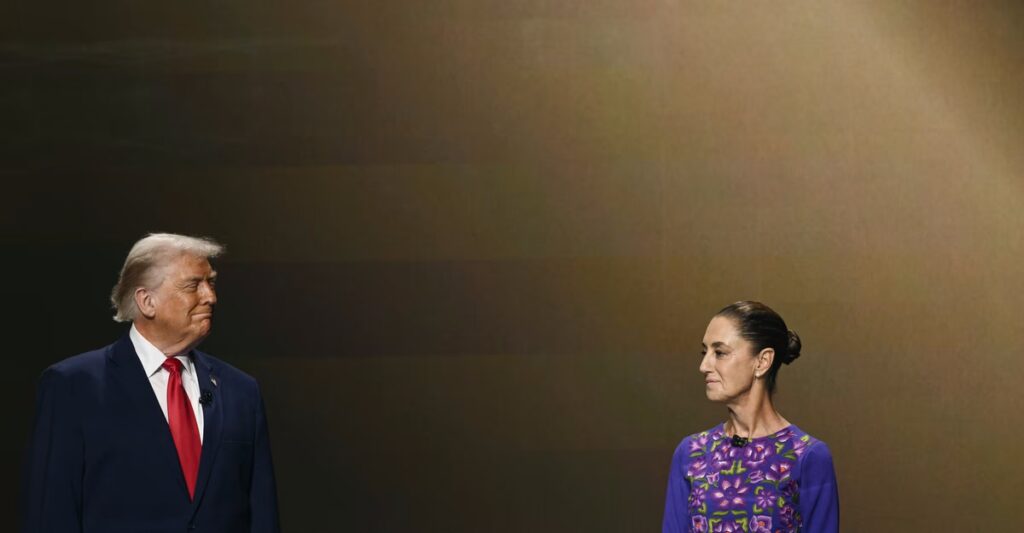
Perhaps no other bilateral relationship has exposed so publicly the stark disconnects within the Trump administration. Mexican officials say they have become accustomed to bipolarity—a “doble discurso,” they call it—in their interactions with the U.S. government. Some meetings suggest that things are going swimmingly. Others seem to telegraph the possibility of an American air strike. “Sometimes they say one thing, and other times they say another” was how Mexican President Claudia Sheinbaum explained the vacillation during a press conference in August.
Last week, after Johnson’s run of public praise, U.S. officials revived a periodic critique against Mexico in meetings in Washington between Secretary of State Marco Rubio and the Mexican foreign minister, Roberto Velasco: Mexico isn’t doing enough to stop its own citizens from migrating to the United States. More than half of the people apprehended by U.S. Border Patrol in July were Mexican. U.S. officials asked why Mexico couldn’t halt the flow of its own citizens.
To Mexican officials, it felt like an unfair demand, given how much they had already offered the U.S. on immigration enforcement. Although overall apprehensions at the U.S.-Mexico border are up slightly from last year, they are down roughly 90 percent from 2023, thanks in part to Mexican cooperation. And although Mexican authorities have made it much more difficult for migrants from other countries to approach the border, deterring Mexicans presents a different sort of challenge. Detaining Mexicans moving through their own country “would be a violation of Mexican law,” the country’s former immigration chief Tonatiuh Guillen López told us. “It would pin the state against its own citizens.”
Johnson had posted on X that the Rubio meeting “reflects our commitment to work together to stop illegal migration.” But the secretary’s office struck a different tone, suggesting that Rubio wasn’t satisfied with what he had heard. Rubio, a post-meeting readout from the department explained, had “called for decisive action to end illegal immigration, stop the trafficking of fentanyl and other illicit drugs into the United States, and dismantle foreign terrorist organizations and cartels and deprive them of arms.”
Asked about the inconsistency in messaging about Mexico, the White House echoed Miller’s sentiments. “As President Trump has said, and as the U.S. government has repeatedly and clearly communicated, it is unacceptable that foreign terrorist organizations control vast territories across Mexico, including the entire region that directly borders the United States,” the White House spokesperson Lauren Bis told us in a statement.
The United States’ most important trade agreement could get caught in the tug-of-war over whether Mexico is doing enough to further U.S. interests. As the United States, Mexico, and Canada work through the annual review of the trilateral USMCA trade deal, Miller has privately floated the possibility that the U.S. could use the occasion to pressure Mexico into doing more on immigration enforcement, one U.S. official said. Although the focus of the USMCA review has been more on granular disputes over supply chains and the origins of raw materials, the U.S. could decide to withdraw from the deal entirely. If that happened, the economic blow to all three countries would be substantial.
U.S. law-enforcement officials based in Mexico gush about the kind of close security coordination that they’re seeing now, but that hadn’t existed for more than a decade. Since Sheinbaum’s election in 2024, Mexico has acted on U.S. intelligence to take down top cartel leaders; it has extradited more than 100 alleged criminals to the United States; it has detained thousands of migrants en route to the U.S. border and permitted thousands of non-Mexican deportees from the U.S. to be sent to southern Mexico. Sheinbaum’s predecessor openly considered stripping Drug Enforcement Administration agents of diplomatic immunity; now those agents have supported a series of major security operations.
[Read: A reverse Ellis Island]
“On security cooperation, what we’ve seen is a massive improvement under Sheinbaum. We’re getting things that were blocked for years-–from extraditions to action against cartels,” one recently retired U.S. official who had been based in Mexico told us.
But for another group of U.S. officials, those actions are grossly insufficient. Miller in particular has lobbied for unilateral U.S. action against Mexican cartels. When he meets with Mexican officials, he typically complains about the country’s inaction. During Fox News interviews, he has used Mexico City, along with Baghdad, as examples of the world’s most dangerous cities. Sheinbaum has responded by saying she asked her foreign minister to send “this White House official the data concerning Mexico City, which perhaps he is not aware of.” (Mexico City has roughly the same homicide rate as Portland, Oregon.)
In recent weeks, U.S. diplomatic and trade officials have grown worried that the USMCA, negotiated during Trump’s first term, could be blown up if some of the president’s advisers get their way. U.S.-Canada relations are already strained over bilateral disputes; now negotiators fear that the broader pact could become a casualty of Trump’s immigration and cartel crackdowns.
Peter Navarro, a senior adviser to Trump on trade and manufacturing, has cast doubt on the deal, arguing that it needs major changes or should be scrapped altogether. Mexico is the United States’ largest trading partner—another point that Johnson makes frequently, but something that Navarro and other members of the Trump administration seem to view as a liability.
The deal enables a regional supply chain in which parts of a final product are sourced and assembled across the three countries. If the USMCA were to be abandoned or weakened, manufacturing costs throughout North America would rise dramatically. But the stakes of any USMCA renegotiation go well beyond the future of a trade pact. If the administration uses the deal to gain leverage over immigration and security policy, it would blur the line between trade policy and national security, and put the basic rules governing North American commerce at the mercy of disputes far outside trade. For Mexico, that could make the USMCA review less a negotiation over tariff rates than a test of how far the government is willing to bend to Washington’s demands. Mexico is already watching the U.S.-Canada rupture closely as it prepares for its own talks with Washington.
Trump allies have long touted his unpredictability as an asset, and Mexican journalists and security analysts are now debating whether the incoherence within the administration is perhaps part of a broader strategy. “Ambiguity is the tool. As long as Mexico doesn’t know for sure what will trigger the Pentagon and what will satisfy the DEA, it continues to hand over information,” Ghaleb Krame, an analyst and a former Mexican official, wrote in an August Substack post.
[Read: Claudia Sheinbaum’s impossible dilemma]
Other Mexican intellectuals argue that it’s Sheinbaum—the leader of a populist, leftist political party—who has revealed her own doble discurso in her dealings with the Americans. She “employs an anti-imperialist discourse for domestic consumption, while being discreetly and selectively subservient to the United States,” Ricardo Pascoe Pierce, a former Mexican congressman and ambassador, wrote in the newspaper El Heraldo de México. Sheinbaum has been particularly critical of the treatment of Mexican immigrants by U.S. immigration authorities, asking U.S. state attorneys general to investigate the deaths of 17 Mexican nationals in ICE detention or enforcement operations. But that anger has apparently not affected Mexico’s cooperation with the U.S. on security or immigration enforcement.
Johnson was the first U.S. ambassador in Trump’s second term to have an official Truth Social account. There and on X, he is careful to tag the president in his posts, signaling Mexico’s progress and growing cooperation. Johnson, who declined an interview request, has good reason to make sure the White House is aware of his messaging: Trump himself has embodied the kind of duality in his remarks about Mexico that ripples across his administration. He has called Sheinbaum “terrific” and “elegant,” with “a beautiful voice.” He has also said, repeatedly, that “the cartels rule Mexico.”
Johnson’s efforts to convey to Trump the payoff from Mexican cooperation may be working. Even though Miller has promoted a unilateral strike on Mexico-–presumably targeting a cartel hideout or fentanyl lab-–no such attack has occurred. U.S. officials in Mexico know that unilateral action would have an immediate chilling effect on bilateral cooperation, and they hope that it can be deterred. They have privately told their Mexican counterparts that anticartel efforts will be coordinated jointly.
[Read: A planeload of informants]
Even some of the U.S. officials most critical of Mexico seem to recognize the value of the country’s assistance. DEA Administrator Terry Cole in July called the Mexican government and cartels “one and the same.” But a month later, at a presentation in Argentina, he told a story about Mexico’s security chief, Omar Garcia Harfuch, calling to inform the Americans that Mexican security forces had killed Nemesio Oseguera Cervantes, known as El Mencho, arguably the most dangerous drug trafficker in the region. Cole sat next to Harfuch as he recounted the story and described the joint celebration after El Mencho’s death. “Omar and I share information daily,” he said.
It was another disorienting twist for those following U.S.-Mexico relations, trying to parse what exactly the Trump administration makes of its southern neighbor. Former U.S. officials told us that part of the apparent inconsistency in White House messaging is related to Mexico’s own internal contradictions: a country with a $2 trillion licit economy where organized crime controls large swaths of territory; a government that attacks cartels even as some of its own members are accused of aiding organized crime. The U.S. government has always had difficulty capturing that nuance in its messaging. Now it doesn’t even seem to be trying.
The post The Trump Administration Can’t Decide How It Feels About Mexico appeared first on The Atlantic.