When the Yangtze River flooded in 1998 and inundated villages in central China, Jiang Zemin, the Communist Party’s general secretary, was on the scene, bullhorn in hand, to encourage local relief efforts. Ten years later, his successor, Hu Jintao, stood among the rubble after an earthquake rocked Sichuan province, in the country’s southwest. Last week, after floodwaters caused by a collapsing glacier tore through the Himalayas between Nepal and China, leaving more than 1,100 people dead and thousands more missing, the party’s current general secretary, Xi Jinping, stayed largely and safely in Beijing.
In the United States, where politicians have to worry about the needs and feelings of voters, elected representatives are expected to be more visible and engaged in national crises. In 2021, Republican Senator Ted Cruz earned public condemnation when he was caught absconding to Mexico while Texas suffered a deep freeze and power outages. As a Communist dictator, Xi doesn’t have to fret over public-approval ratings. Yet his absence signals a bigger problem for China: Xi has become so powerful that he has lost touch with the country he governs.
Despite being professed Marxists, China’s leaders rarely interact with the working class. But Xi at least used to try to seem like a man of the people. In 2013, about a year into his tenure, Chinese media made a big deal out of his visit to a steamed-bun restaurant in Beijing; the state-owned China Daily praised him for showing his “common touch.”
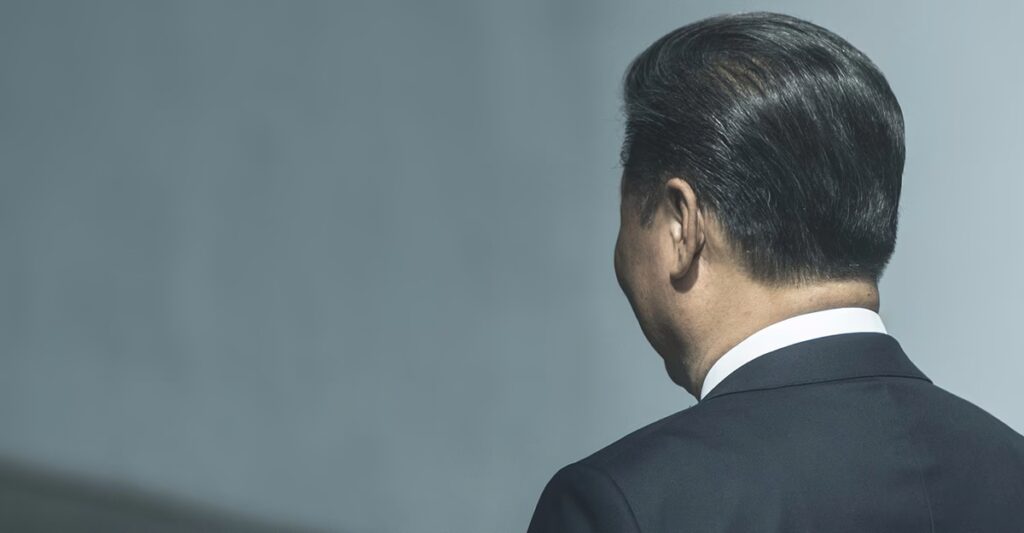
Today, there’s nothing common about Xi Jinping. He has amassed greater personal power than any other Chinese leader since Mao Zedong, the Communist regime’s founder, who died half a century ago. To justify his outsize role in China’s government, Xi’s tireless propagandists portray him as something grander than a party boss: a philosopher king, whose doctrine of wisdom, called Xi Jinping Thought, is meant to be both studied and obeyed. He is the great global statesman, guiding foreign policy into a new era of peace and prosperity. His various “global initiatives” outline his vision for a reformed world order.
[View: The aftermath of Nepal’s flash floods]
Mere mortals such as Jiang and Hu had to stomp around muddy disaster zones to prove their worth. But Xi “does not need to go to steam-bun shops to pretend he is with the people any longer, or, for that matter, to be visible when a major disaster has happened,” Steve Tsang, the director of the SOAS China Institute at the University of London, told me. “He no doubt thinks and therefore acts as if he is above all.”
In Xi’s calculus, the Himalayan communities destroyed by the floods are hardly worthy of his attention. The area in question is part of Tibet, a region that borders Nepal and was once independent. Xi has demonstrated a persistent hostility toward China’s minorities, who, in their stubborn resistance to Chinese civilization, threaten his vision of national unity. A new law that took effect in July aims to transform Tibetans, Uyghurs, Mongolians, and other minorities into properly loyal citizens by forcing them to adopt the majority Han Chinese culture. Until the Tibetans fall in line, “there is not really a compelling reason for him to visit them just because a disaster struck,” Tsang argued.
From Xi’s perspective, appearing at the scene of the floods would have involved more risk than reward. A purportedly all-knowing and all-seeing leader can’t make mistakes or even be associated with bad news, so Xi has good reason to avoid potentially tarnishing himself with an uncertain rescue operation. The politically safer option involves managing the crisis from afar while dispatching others to get their hands dirty. Beijing is also carefully controlling the information coming from the disaster zone. International journalists are already barred from Tibet, so any news about the disaster and the relief effort is from Chinese state sources. The state-run news agency Xinhua duly announced on Friday that Xi chaired a meeting of the party’s powerful Politburo to “deliberate and make arrangements on rescue and relief efforts.”
[Read: The autocrat’s dilemma]
The China-focused research firm Trivium noted that Xi’s response to the floods was in keeping with his usual approach to disasters, which is to visit long after the crisis has passed and the rebuilding has begun. Xi is “keeping himself above operational risk” and is focused on “owning the recovery rather than the chaos,” Trivium’s report said. Xi may at some point decide to show up on the ground, but probably well after the initial chaos has subsided.
The stories and images from the floods have moved hearts, but Xi has bigger things to think about than a mudslide on the far edge of his empire. One of his priorities has been to reshape Chinese culture by merging the party’s beloved Marxism with traditional Confucianism. Although that effort appears to have had little traction with the public, Xi himself seems to have taken these ideas to heart. He may speak like a socialist, but he governs more like an emperor, deserving of national veneration and shielded from scrutiny. But many emperors were remote figures, removed from the real world behind the walls of the Forbidden City, and reliant on courtiers for news from outside. As Xi’s absence from the flooding disaster demonstrates, he, too, has become detached from the daily struggles and sentiments of his citizens—and unresponsive to the nation’s mounting economic and social problems as a result.
How the Chinese people feel about Xi’s response is impossible to know. Assiduous censors deter candor and cleanse social-media platforms of any direct criticism. Perhaps life in an authoritarian political system breeds a practical indifference, given that people have no influence over who rules them anyway. But with a spare few hours on the ground among those who just lost everything, Xi could have at least shown that he cares. His loyal public has surely noticed that even that was too much.
The post What the Floods Say About Xi Jinping appeared first on The Atlantic.