Gang violence in Haiti is so bad that Antoine Rodon Bien-Aimé, a candidate for the Haitian Senate, has been campaigning via speakerphone and video calls to community meetings.
Elections — the first in a decade — are scheduled for Dec. 13, but kidnappings and killings are pervasive. Mr. Bien-Aimé, a former deputy in the legislature, rattled off the names of various neighborhoods around the capital where he cannot meet voters.
“We can’t go and campaign on the field,” he said. “We are scared. I am scared to drive. I am scared to go out of the house, because I’m scared to be kidnapped.”
Mr. Bien-Aimé is one of a growing chorus of voices who believe the Haitian government, under pressure from the United States, has rushed to hold elections at any cost. Critics argue that too many swaths of the Haitian electorate have been forced from their homes and would be unable to cast ballots.
With major highways in the control of armed groups, it will be difficult to move not just candidates, but also ballots. Entire communities risk being cut off from the vote.
Many people believe the election date is essentially fiction — a goal that even Haitian officials do not believe possible.
But as Haiti enters its second decade without elections to fill a single government office, the push for a return to democracy is real.
While many people argue that you can’t hold elections without security, government officials and some experts strongly argue the opposite: that Haiti will never be safe if it doesn’t start electing its own leaders.
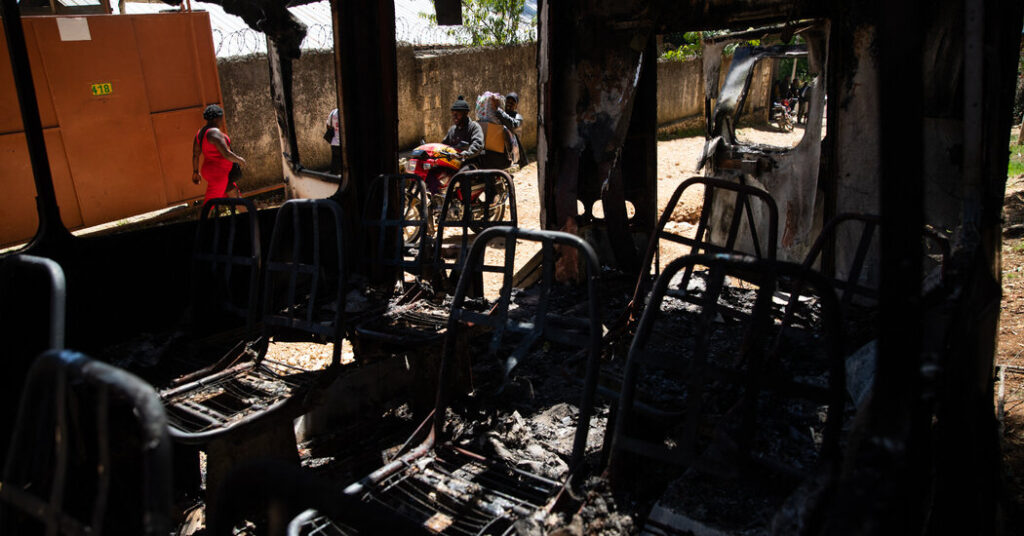
Still, many Haitians face a reality that is all too dangerous, as a massacre in a well-heeled community in the outskirts of the capital last week reminded many.
“We want to go to elections,” Mr. Bien-Aimé said. “But we want to go to well-prepared, good elections.”
Why hasn’t Haiti had elections in so long?
Haiti last held elections in November 2016, when Jovenel Moïse, a banana exporter, was elected amid delays and accusations of widespread fraud. He was assassinated in July 2021, and then the gang violence that had always been common in Haiti quickly spread. In early 2024, it exploded into a kind of war.
Armed groups that had fought each other for years, sometimes doing the bidding of corrupt politicians, joined forces. They attacked police stations, prisons, hospitals and neighborhoods. The prime minister was forced out and the airport was closed for months.
More than 1.5 million Haitian people have fled their homes, and nearly 250,000 of them are living in squalor in impromptu displacement sites, such as public schools.
The United Nations said 3,050 people, including those targeted by law enforcement, were killed in the first half of this year.
Gangs control some 70 percent of Haiti’s capital, Port-au-Prince, and have spread to other regions outside the city, including the rural Artibonite Valley.
With the security situation so volatile, elections were postponed several times. The race to elect the legislature is now six years overdue.
Are December elections feasible?
Although the government insists that it is moving forward with Dec. 13 election, most experts believe that date borders on fantasy.
The United States has spent hundreds of millions of dollars on security efforts in Haiti, and experts say Washington has been a big factor in pressing Haitian officials to move forward. After months of delays, the Haitian government formed an electoral council, published the required election decree and came up with the December date.
“It won’t be a Cadillac election,” Michael Kozak, a former senior U.S. State Department official, told a House committee last month, while he was still in his post. “But if it’s a good, you know, F-150 election, that’s going to be solid. They need an elected government. It doesn’t need to be perfect.”
But many critics say it’s preposterous to hold an election that disenfranchises the cities where most voters live. Only candidates who can afford helicopters would be able to fly over gang checkpoints on major highways to canvas regions outside the capital. Millions of people have to register to vote, a process the government is unlikely to be able to pull off in time.
Lemoine Bonneau, a former newspaper columnist who is now a politician, said the government seems poised to simply abandon dozens of decisive neighborhoods where it will be impossible to set up polling stations.
“So, electors are going to vote in Upper Artibonite Valley, and in Lower Artibonite they won’t go to the polls?” he said. “In the 10 communities in the West Department, there will be no elections, and there will be no lawmakers there?”
Senators who secure just 15 percent of the vote could wind up winning a race to represent the West Department, where Port-au-Prince is, because only the people in safe areas voted, a possibility Mr. Bonneau called “scandalous.”
Patrice Dumont, a former senator who has not yet registered to run in the elections, said a history of substandard elections is a reason Haiti has gotten so bad, and they can’t be done halfway.
What does the Haitian government say?
Some critics accuse the prime minister, Alix Didier Fils-Aimé, of secretly wanting to stall elections because that would allow him to stay in power longer.
Mr. Fils-Aimé did not respond to requests for comment. He has publicly said that people are clamoring for elections, and that insecurity should not be a reason to boycott the race.
Jerry Tardieu, a former congressman who hopes to run for president, agreed.
“This prolonged transition is taking its toll on the Haitian people,” he said. “The truth is that, for a long time, Haiti will not have the ideal conditions for peaceful elections like we have had in the past. If we wait for these conditions, there will not be elections in Haiti for a very long time.”
Jacques Desrosiers, the president of Haiti’s Provisional Electoral Council, said in an interview that he “remains convinced” that Dec. 13 is a doable date, but he acknowledged that the country needs better security.
Mr. Derosiers said liberating the main roads from gang control would be key, because it would significantly reduce the government’s logistics costs.
“We also need state presence restored in certain communes to facilitate electoral operations, even at a minimum level,” he said. “We have the commitment of law enforcement and government authorities, who have pledged to work toward creating this acceptable climate.”
He stressed that the electoral council was counting on help from law enforcement and international partners to help make that happen.
What can security forces do?
This year, a multinational, U.N.-backed mission meant to go after the gangs, called the Gang Suppression Force, arrived in Haiti.
Although the gang suppression force has people from Chad, El Salvador, Guatemala, Jamaica, Mongolia, and Sri Lanka, experts say it currently has only about 20 percent of its intended 5,500 members.
The Haitian government has also contracted with the American private military contractor Erik Prince to help conduct drone strikes in gang-controlled neighborhoods.
The drone task force has yet to announce the capture or killing any major gang leader.
A person close to the task force operations who was not authorized to speak publicly, said the group has helped reduce the gang foothold in the capital from 90 percent of the city early last year to 70 percent now.
The government plans to take more territory with the help of the gang-suppression force and increased police recruits. The team was recently able to enter Village de Dieu, the stronghold of a gang leader known as Izo, for the first time in five years. Earlier this year in January, it wounded Jimmy “Barbecue” Chérizier, a notorious gang leader whose home and base was destroyed.
Alexandre Carrie, 34, who recently registered to vote at a school in Pétion-Ville, a suburb outside the capital, agreed that the election must go on. But the government must find a way for the people in gang-controlled areas like Croix des Bouquets and Cité Soleil to participate, he said.
“There are honest people who live there; it’s not just criminals,” he said. “As soon as the government provides security and the criminals give the people a chance to hold the elections, I think everything will be fine.”
He added, “The country has reached its limit; we can’t continue to sink.”
The post How Do You Run for Office in a Gang War? appeared first on New York Times.