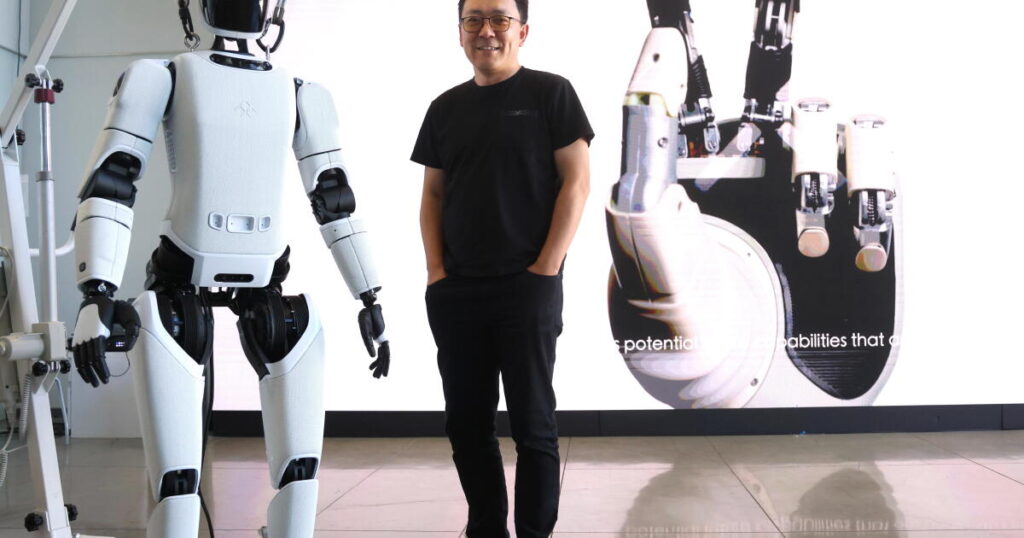
After its multibillion-dollar bid to become the next Tesla failed, El Segundo’s Faraday Future is pivoting to humanoid robots.
The company says it is applying the expertise and infrastructure it gained through its electric vehicle journey to become a front-runner in the global robot race.
Skeptics say they are still uncertain whether its robots, which can dance, will change its narrative. Its share price has tumbled more than 99% from peaks in 2021 as it has struggled to attract enough buyers for its $300,000 electric vehicles.
At the company’s headquarters on a recent Tuesday, a mini robot waved its arms and moved its feet to a Dua Lipa song. A full-size bot swung its hips and karate kicked to an electronic beat. It was an impressive display, but the company says the AI-powered humanoids are capable of much more.
The robots will be assembled in California and used for education, housework, warehouse jobs and more, said Chris Chen, Faraday Future’s co-chief executive of robotics.
“The robot has to be useful or helpful to people,” said Chen, who has been with the company for more than a decade. “We are not trying to build a single robot. We are trying to build a holistic physical AI infrastructure.”
Faraday Future needs a new business to build buzz because its EV venture has failed to live up to the hype. The company sold only 16 FF 91 EVs from 2023 to 2025, according to Autoweek. Analysts don’t expect much better performance from the FF 91 2.0, which is available for preorder with a sticker price of $300,000.
Faraday Future’s shares peaked with excitement about its EV plans in 2021 and have been sliding since then. They were last trading below $2 on Wednesday. It had to perform a reverse stock split in July to avoid being delisted from the Nasdaq stock market. A reverse split is when a company reduces its number of traded shares to increase the value of each share
The company announced second-quarter earnings last month, reporting a net loss of $39 million as it didn’t sell enough EVs or robots.
“It comes as no surprise that they have decided to chase the next shiny object of robotics just as Tesla and so many Chinese companies have done,” said Sam Abuelsamid, a mobility analyst at Telemetry. “I really don’t see any of these being particularly useful in education, and the home market is also likely to be minimal.”
Faraday Future says its expensive battery-powered luxury vehicles were never meant for the mass market, and it is developing a more affordable electric van that could be delivered as early as next year.
The company was founded in 2014 with high ambitions and the backing of a Chinese billionaire. It originally set up shop in 2015 in an industrial corner of Gardena, near a pet cemetery. It recruited former Tesla employees and worked out of a former Nissan office, intending to give Tesla some competition.
“You have to be a little bit brave to do something like this,” Richard Kim, former head of design for the company, said at the time. “We are going to make intelligent vehicles. We’re building a brand.”
More than 10 years later, the brand has moved its headquarters to El Segundo and is still searching for its identity.
The company also has a 1.1 million square foot 1.1-million-square-foot factory in Hanford, Calif., where it invested nearly $4 billion to produce its EVs. It now plans to produce the robots there with parts imported from China.
Faraday Future now has five robots for sale, with two more coming soon. A full-sized humanoid bot called the All-New Futurist starts at $89,900, and a miniature humanoid robot called Master starts at $37,990. The FX Navi, a four-legged bot built for young students learning how to code, costs $1,990.
Though hundreds of humanoid robotics companies operate in China, Faraday Future hopes to become one of the trailblazing robotics companies in the U.S. along with Agility Robotics, Figure AI and Tesla, which is building a full-sized robot named Optimus that is not yet for sale.
Last month, the Trump administration banned Chinese imports of power inverters and new humanoid and four-legged robots. In a news release, Faraday Future said it would seize the opportunity created by the new policy and accelerate its “Built in USA” and “Assembled in USA” programs.
The company will still import parts from China in compliance with the latest Federal Trade Commission rules.
In the U.S., Faraday Future says it has a leg up on the competition in the world of embodied AI because its bots are ready for delivery. The company has sold around 400 units so far and aims to deliver 2,000 units this year.
Faraday Future’s trajectory mirrors Tesla’s — they’re both tech-focused EV companies that are transitioning to AI and robotics as the EV market cools.
Faraday Future is building a robot specifically designed for industrial work, called Faber, but the Master and Futurist models can fill many roles, Chen said. They can be used for performances and presentations, child care, companionship and customer service assistance at places such as car dealerships and salons. Aegis, one of the company’s four-legged bots, is being tested for security and perimeter control purposes.
“We’re not trying to compete with Tesla,” Chen said. “I think the market is big enough, and we just focus on the different use case scenarios.”
As it builds bots to perform tasks traditionally done by humans, Faraday Future expects pushback over disrupting the labor market by replacing receptionists, caretakers, factory workers and others with its robots, which cost less than many people’s annual salaries.
Chen said that the company’s robots will supplement human manpower, not replace it.
“It’s about robots improving human work efficiency and creating new job opportunities,” he said.
The post From $300,000 EVs to dancing bots: The El Segundo firm sliding into Tesla’s slipstream appeared first on Los Angeles Times.