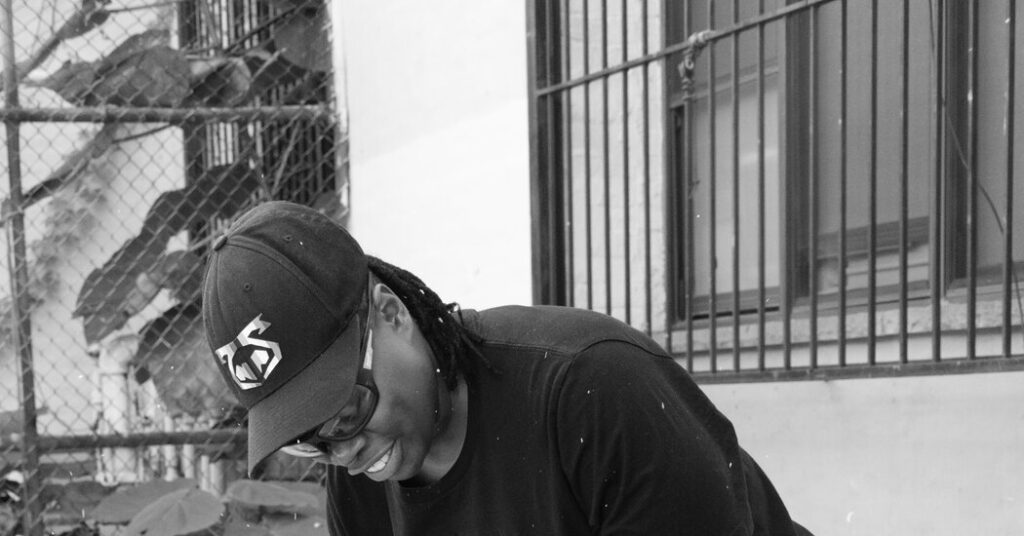
The sculptor Leilah Babirye keeps a precious certificate framed on the worktable in her studio in Brooklyn, above a shelf holding chain saws.
It was issued by the Buganda kingdom — the largest of several traditional jurisdictions that predate the modern-day state of Uganda and continue to exercise social and cultural sway — identifying Babirye as a loyal subject. A band around its edge shows the animal or plant symbols for the roughly 50 lineage clans that comprise Buganda society. Babirye’s is the ngabi, a kind of antelope.
“It’s a very important thing to have in the house,” Babirye, 41, said of the certificate, which she obtained through royal representatives in the United States.
Babirye arrived in New York in 2015, and received asylum, in light of anti-homosexuality legislation in Uganda and outing campaigns in the news media in which she, as a young artist, was a target. But whereas the Ugandan government criminalizes her identity, she has no issue with the traditional kingdom, which has a history of gender fluidity.
Her art presses at this paradox, and through it, broader stakes of queer existence and belonging. The pieces hover at the edge of figuration, in the form of tabletop busts or tall statue-like sculptures that evoke African masks but are distorted, doubled or deconstructed, sometimes to Cubist levels of abstraction. The wood or ceramic bodies are adorned or extended with found objects — nails, tire tubes, bottle caps, kitchenware — evoking a slur in Uganda that likens gay people to discards. She gives them names and clan designations.
In New York, Babirye’s work has been shown at Socrates Sculpture Park and the Brooklyn Bridge Park, as well as with Gordon Robichaux gallery. She recently had a solo exhibition at Yorkshire Sculpture Park, in England, and another responding to the African collection at the de Young museum in San Francisco, pointedly titled “We Have a History.”
Now, the Institute of Contemporary Art in Boston is presenting “Embaga ya Naki ne Naki (Wedding of Naki and Naki),” featuring five tall works standing like ancestral guardians around 16 new pieces arrayed in a circle. The theme is a queer wedding, with two characters conjoined in the centerpiece sculpture and the others as their guests.
The exhibition, Babirye said, is even more explicitly Ugandan than usual, with the diagram of Buganda clan symbols now framing the main wall text in the gallery.
It is also, she added, her most celebratory.
“I’ve addressed who we are,” she said. “This is us. You’ve got to accept us, whether you want us or not. But we also have a life as queer people. Homosexual people can imagine weddings. It’s beautiful, it’s happiness. As an artist on this level right now, I’ve always told my people: We’ve cried so much. It’s about our pain. How about us representing ourselves in a joyful way?”
Upbeat suits Babirye, who is funny and direct, apt to call a pause midway through a long interview for a shot of tequila. On the day that her show opened last week, she convened lunch at an Ugandan restaurant in Waltham, Mass., where activists and supporters stopped by. (The Boston area has a substantial Ugandan community; Babirye goes there for events and groceries.)
Ruth Erickson, the ICA’s chief curator, observed that Babirye’s can-do verve manifests in her art. “She’s not somebody who gets brought down by the world,” Erickson said. “She finds a positive way through it.”
It begins with a chain saw and a blowtorch. Wood is Babirye’s original medium, which her growing success has enabled her to develop at increasing scale. She works with reclaimed lumber, for its dryness and durability.
The process is intuitive. “I don’t work with any sketches, because whatever you want to do is out there,” she said. Blow-torching darkens the wood and reveals its veins. She spends quiet time with each piece considering which additions it requires. “They get cranky,” she said of the works, if the braided tire tubes or stacked bicycle chains or flattened tin surfaces aren’t right. “They start complaining.”
In Uganda, she said, friends called Babirye “Burns,” after her blowtorch proclivities. And her techniques also reflect the lineage of her alma mater, the prestigious art school of Makerere University in Kampala, said the Ugandan writer and curator Serubiri Moses, who has long followed her practice. With his fellow curator Kevin D. Dumouchelle, Moses included her this year in an exhibition of African L.G.B.T.Q. artists at the National Museum of African Art in Washington.
The Makerere sculptors have long worked with burned wood, Moses said. But, he added, whereas many East African artists have academic careers, “Leilah has created her own path.”
As an undergraduate, Babirye’s decision to study art, defying her businessman father, was prompted by a visit to the art campus, where she came across the sculptor Lilian Mary Nabulime at work with power tools. The school taught fundamentals — Henry Moore, Henri Matisse and Alberto Giacometti made strong impressions, Babirye said — but encouraged experimentation. Nabulime became her mentor.
But when Babirye returned for a master’s degree, faculty members disapproved of her project. “You had to come in with a thesis,” Babirye recalled, and hers was blunt: “I want to look at the problems that L.G.B.T.I. are facing in this country.” Babirye went on: “My professors were like, OK, we understand that you like women. How about if you just call it erotica, and you can look at women and private parts if you want to do that?”
At what she called an “interrogation” before the faculty, Babirye tried to explain the stakes with a primer on queer identities. “They all left the room,” she said. She left the program.
She continued making art nonetheless, working with found materials, and appearing in a few group shows in the region. Despite repression, queer life persisted, she said. One time, she recalled, people gathered in a bar for an illegal gay wedding. The police raided; she fled by a side exit.
In 2014, however, the situation became untenable when she was listed in a tabloid campaign, Babirye said. Death threats followed, including one slipped under the door to a cabin serving as her hide-out. “I realized I had to leave,” she said. (Although the 2014 act was struck down on a technicality, a new anti-homosexuality act has been in force since 2023.)
Networks of solidarity, along with her own resourcefulness, have buttressed Babirye’s New York experience. She arrived, initially, for a residency for L.G.B.T.Q. artists on Fire Island, setting up durable connections to other Black and queer artists. Veteran activists and lawyers helped to guided her asylum case. The African Services Committee, in Harlem, became a second home.
At the same time, she was collecting cans in the street to redeem for cash — to get by, but also with her eye for found materials. Soon she was making bike deliveries. At one point, she commuted from the Bronx — where she lived in an apartment shared by mostly cabdrivers — to a work space in Brooklyn. A work of woven plastic bags that she braided on the subway appeared in her first gallery show, in 2018.
Babirye’s work is now in major institutions, including the Whitney Museum of American Art. In 2022, her striking pair of wood sculptures, “Agali Awamu (Togetherness),” on the Brooklyn waterfront, raised her visibility. The invitation from Adriano Pedrosa, curator of the 2024 Venice Biennale with its emphasis on queer identities, followed soon after. She still stays frugal, she said: “I don’t need money because I’ve learned how to live with nothing.”
For Natasha Becker, curator of African art at the de Young and author of an essay in the ICA exhibition catalog, Babirye fits into African art history while also “breaking all the rules,” not least because most historical African sculptures were made by men. “Her chain saw is a metaphorical way of cutting through prejudice, through hard materials and hard social norms,” Becker said.
At the same time, Babirye’s community role “puts her in a rich history of queer activism all over the world,” Becker said. Like Zanele Muholi, the South African photographer and self-described “visual activist,” Babirye has “a capacity for carrying multitudes,” Becker added.
In Boston, Babirye was beaming, in the spirit of the party that her installation portrays. She explained the titles of the sculptures representing guests, some named for her mother or other relatives, others more ambiguously, to allow everyone to relate.
The smaller scale, she said, focused her attention on detail — a gown of woven beer-bottle tops, for instance, in homage to the Ghanaian sculptor El Anatsui; a grand headdress of kitchen graters and whisks. “I’m thinking, what if we have some London people flying in, wanting to look like a queen?” she said.
Something has softened. Her old mentor recently visited her in the Brooklyn studio; Babirye gave her chisels and other tools to take back. Even her father has reached out, she said, though she is letting that one wait.
It might not be reconciliation, exactly, but it’s something to celebrate.
She said this show feels “joyful,” compared with past ones animated by anger. “I feel like it’s coming from the growth of doing this over and over,” she said. “And also healing.”
Leilah Babirye: Embaga ya Naki ne Naki (Wedding of Naki and Naki)
Through Jan. 18, 2027. Institute of Contemporary Art, Boston, 25 Harbor Shore Drive; 617-478-3100, icaboston.org.
The post Chain Saws and Joy: A Sculptor’s Evolution appeared first on New York Times.