No one goes to the Cannes Film Festival just to be whelmed. Still, this year’s edition felt unusually quiet until the penultimate day of competition, when the Spanish directors Javier Calvo and Javier Ambrossi stormed the south of France with “La Bola Negra,” ready to shake the sleepy festival out of its stupor.
An emotional, century-spanning epic interweaving the lives of three gay men in Spain, the passionately mounted “La Bola Negra” played like gangbusters at its premiere, earning a 20-minute standing ovation that ranked among the longest in the festival’s history.
“What could we do to make it longer?” mused Calvo. “Maybe a wig reveal?”
Two days later, just before Ambrossi and Calvo received the festival’s best director award (shared with the “Fatherland” filmmaker Pawel Pawlikowski), Netflix won a bidding war for the U.S. rights to “La Bola Negra.” Over the next few weeks, the film will relaunch at fall festivals ahead of its Oct. 16 release in cinemas, where it will stay exclusively for 46 days — the longest theatrical run the streamer has ever granted.
With superlative craft elements making it a strong contender for double-digit Oscar nominations, some expect Netflix to position the film as an awards-season spoiler to “The Odyssey,” Christopher Nolan’s presumed best picture front-runner.
“Are we having our own ‘Barbenheimer’?” Calvo joked recently over shared fries at the Chateau Marmont in West Hollywood.
“How would you call it, ‘La Bola-ssey’?” asked Ambrossi.
Inspired by an unfinished Federico García Lorca story, “La Bola Negra” opens in 1937, when Sebastián, a small-town trumpeter conscripted by the Fascists during the Spanish Civil War, falls for a captured freedom fighter, Rafael. Their story intertwines with two more: In 1932, the closeted Carlos fears rejection by the town’s elite as rumors of his sexuality spread, while in 2017, an aimless writer, Alberto, discovers a family inheritance that connects him to Sebastián and Carlos in surprising ways.
Though “La Bola Negra” (“The Black Ball”) is shot like an old-school epic, it has a distinctly modern sensibility: One playful segue from the war-torn past to the mundane present is signaled by a Grindr notification ping. Still, it’s bracing to see gay stories, so often confined to intimate indies, told on such a vast canvas. The directors said they made “La Bola Negra” for under $15 million in Spain, but if Hollywood studios were to make such a large-scale drama, with its meticulous period detail and technically audacious wartime sequences, it would have cost at least $100 million. Which is exactly why Hollywood would never make it.
And maybe no one else could have. In a remarkably short time, Ambrossi and Calvo have become Spain’s most celebrated gay auteurs since Pedro Almodóvar, himself an associate producer on “La Bola Negra.” Best known for writing and directing award-winning TV shows like “Veneno,” about a trans sex worker turned media sensation, the pair also became famous in Spain for their longtime romance, showcased on reality television and social media.
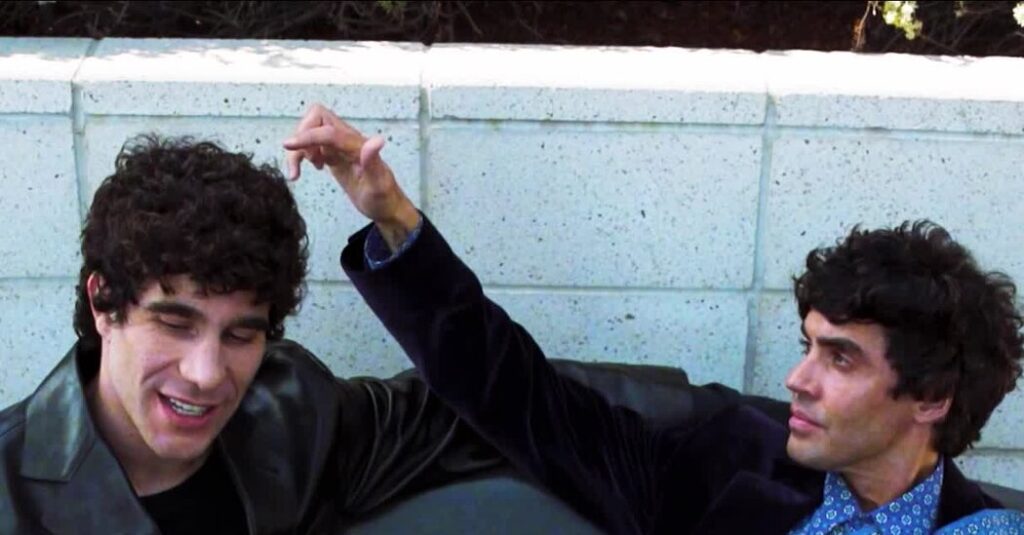
Their home country has come to see them as a single public persona, colloquially called “Los Javis,” and the similarities go beyond their shared first names. At the Cannes premiere of “La Bola Negra,” they made a strikingly coordinated duo, each sporting Emporio Armani tuxedos, late-May tans, and dark, tousled curls. When I met them in August, their differences were more apparent: Ambrossi, 42, had the elfin face and people-pleaser personality, while the 35-year-old Calvo was the taller, brooding cinéaste.
Stateside, in-the-know queer audiences may be most familiar with them as judges on the Spanish edition of “RuPaul’s Drag Race.” But Hollywood has begun to catch on to the directors, who are fluent in English: After watching their 2023 religious thriller series, “La Mesías,” Glenn Close asked them to direct her in a film adaptation of the musical “Sunset Boulevard.”
They spent a week listening to the music from “Sunset Boulevard,” Calvo said, “which is beautiful, and imagining her with a dead monkey. But I can’t make a Billy Wilder remake, it’s against my religion.”
Still, Close was enamored with them from their first meeting. “The minute they walked in the door, I fell in love,” she said. “They’re both gorgeous, to begin with. But they have a light inside of them — a sense of joy and possibility and excitement. You would have to be a statue not to react to that.”
Though the cast of “La Bola Negra” is primarily made up of young Spanish actors unfamiliar to American audiences, Ambrossi and Calvo found room for Close to cameo and added another big star in Penélope Cruz, who plays a cabaret singer. In a phone interview, Cruz said she knew the film would be major from the start, based simply on her connection to Los Javis.
“I don’t even know if they’re aware of how big this is,” Cruz said. “Without giving a lecture of any kind, it arrives in a moment where it’s kind of a necessary film.”
If “La Bola Negra” connects in the way Netflix intends, it will offer the biggest opportunity yet to introduce Los Javis to American audiences. But while directing the film that could make them global superstars, both men became convinced it would be their swan song.
“In the middle of shooting, we were like, we have to finish this relationship,” Ambrossi said. “We were ready for ‘La Bola Negra’ to be our last movie.”
TO BETTER UNDERSTAND Ambrossi and Calvo’s faith in big-swing concepts like destiny, consider that before they ever met — when both were young actors in Madrid, wondering what more the world might have in store — the universe already seemed to be nudging them together.
In his late teens, Calvo was known for playing a gay student on the high school soap “Física o Química,” and Ambrossi was cast as his boyfriend, though scheduling conflicts forced him to give up the role he’d later play in real life.
“We were meant to be together,” Ambrossi said.
They first became friends through overlapping social circles. Eventually, after exchanging flirty Facebook messages, they became something more. On their first date, Calvo bragged that he had a photographic memory, so Ambrossi hid the restaurant menu and asked him to recite the prices. Calvo did it perfectly.
Just don’t ask him to reprise the trick, he said: “I can’t do that anymore, I’ve partied too much.”
When they began dating, their creative collaboration was almost instantaneous. “The secret of being a duo is admiring what he does better than you instead of being jealous,” Calvo said. But though their long partnership has been defined by an unabashed queer sensibility, they had never tackled a real gay love story until “La Bola Negra.”
A few years ago, Calvo was thumbing through the play “La Piedra Oscura,” which would inspire the film’s Sebastián-and-Rafael story line, and promptly burst into tears. “It touches some wound that is hidden and that we have been ignoring,” Calvo said. “We are so self-centered in our privileged problems that we don’t think about what our grandparents lived, the secrets they had, the loves they missed. And even more, our gay grandparents.”
He passed the play to Ambrossi, who began imagining the biggest possible adaptation. “I don’t know why, because the play is so small,” Ambrossi said. But Calvo was similarly inspired: “I thought, let’s make the war movie straight guys dream to make, but with this little gay soldier.”
Inspired by films like “Apocalypse Now,” Ambrossi and Calvo designed a demanding 12-week shoot that largely eschewed C.G.I. in favor of real locations across Spain, sometimes filming through rain and snow. From newcomer to veteran, almost everyone was asked to put themselves in a challenging situation.
Close performed much of her role in Spanish, which the 79-year-old hadn’t spoken before. “It’s not in my nature to say, ‘No, I can’t do that,’” she chuckled. Inspired by her directors, she spent months taking intensive Spanish lessons. “You just want to be there for them, and if they believe you can do it, then you can.”
With the help of Los Javis, Cruz faced an even more daunting situation: Just before performing one of her elaborate song-and-dance numbers, her doctor warned that she might have an aneurysm, though she wouldn’t know for sure for another two days. Cruz hadn’t planned to tell anyone, but on the second day of shooting, while awaiting her prognosis, she called the directors into her trailer.
“I said, ‘Guys, I need to give you a hug and pray because I don’t know what’s happening. I need somebody here to know it and it’s going to be you,’” Cruz recalled.
The directors offered to postpone her scenes, but Cruz insisted that with their support, she could still perform. For six hours, Ambrossi and Calvo rehearsed the number with hundreds of extras and a double for Cruz. Then, on the first take, Cruz herself stepped in. The extras, who weren’t told she was in the movie, roared so loudly it shook the set.
“It was such an incredible adrenaline high that I was able to put into the number,” said Cruz, who was ultimately fine. “I will remember it for the rest of my life.”
The ability to bring something personal to such heightened circumstances is paramount for Ambrossi and Calvo, who often sprinkle their casts with first-time actors like Guitarricadelafuente, a popular singer-songwriter, who plays Sebastián. “We try to get them into a crazy journey where they detach from reality and suddenly they are in the fiction,” Ambrossi said.
“We make them believe,” Calvo said.
Still, as the shoot continued, both men felt they couldn’t keep demanding emotional truth from their cast without finally facing it themselves.
IN THE 2017 SECTION of “La Bola Negra,” Alberto (Carlos González) shares an apartment with Juan Pablo (the comedian Julio Torres), though the nature of their relationship is hard to pin down. There’s affection, but a palpable distance underlines almost every exchange. For most of the movie, I couldn’t tell whether they were platonic roommates or longtime boyfriends still living together out of habit.
That ambiguity was deliberate: Calvo and Ambrossi scripted the couple’s uncertainty to reflect doubts they had begun to feel about their own relationship. “We wanted to do that to understand ourselves,” Ambrossi said. “Doing that opened a door we needed to face, that we were not in love anymore.”
After so many years together, their relationship had simply run its course, though both were afraid to admit things had changed. They were Spain’s most high-profile gay couple, after all, and a breakup could put everything they had built together in jeopardy.
Still, after shooting a late scene in “La Bola Negra” in which one character declares his passion for another, they realized their relationship was already over. “It’s a movie about love,” Ambrossi said, “and when you try to put real love in front of a camera, suddenly you realize you don’t have it.”
The public announcement of their breakup, made just after ”La Bola Negra” wrapped production, sent the Spanish rumor mill into overdrive. Had their fetching lead, Guitarricadelafuente, come between them? “Didn’t happen, he has a partner,” Calvo said. Would they continue filming “Drag Race España” together? “We already shot the next two seasons, so we have a lot of time to think about it,” Ambrossi said.
And then there were rumors that Los Javis had rekindled their relationship after Cannes. That speculation was half-right: Though they went to Cannes planning to part ways, their festival experience was so powerful that they recommitted to working together as collaborators.
“We won best director at Cannes — we have to explore that,” Calvo said. “It was a realization that we shouldn’t lose this. We’re a good team.”
At the Chateau Marmont, it felt like little had changed. The two men still finished each other’s thoughts, and twice, Ambrossi leaned over to brush stray bits of fluff from Calvo’s face. “I love him more, I love him better,” Ambrossi said. They’re already hard at work writing their next project together, which they teased will be half-Spanish, half-English and based on real events.
Close predicted that Los Javis will soon be inundated with big studio offers. “They’re in the jaws as we speak and I hope they don’t get crushed,” she said. “I hope they stay true to themselves and are able to say no to a lot of money.”
Whatever comes, Ambrossi and Calvo predict it will be easier to handle now that their personal lives and careers no longer commingle. “The weird thing is to be boyfriends who work together,” Calvo said. “The normal thing is the other thing, right?”
Then again, what’s normal worth? Ambrossi and Calvo didn’t get here by doing things the usual way, and there’s something compelling about how they navigate their post-breakup collaboration. Citing Lorca, Calvo offered a fitting analogy.
“Federico used to say poetry is when you mix words that wouldn’t make sense together, but somehow, there was no other way,” Calvo said. “They had to be together.”
The post Lovers and Auteurs, Their Breakthrough Film Was Almost the End appeared first on New York Times.