When clients go to Sybil Ottenstein for therapy, they tend to arrive with answers. Many of them have seen shrinks before. They can tell her which events from their past were formative, and point to the ripple effects in their current life. They’re like detectives, she told me, with all the dots connected on their corkboard of evidence. Intellectually, they’ve cracked the case. The problem is that they don’t feel any better.
That’s why they’re seeking something different from Ottenstein: somatic psychotherapy. Traditional talk therapy could be seen as a top-down approach. You identify problems in your thinking, your habits, or your life, and hope that by working through them, you can resolve physical manifestations of emotional issues—the chest palpitations of anxiety, the stomachache of stress. Somatic therapy, by contrast, works from the bottom up. Ottenstein typically starts her sessions by asking clients to slow down and pay attention to corporeal sensations: “What does it feel like in your chest? In your throat?” As they talk, she encourages them to stay in their body, to let themselves feel whatever is coming up. People cry. They yawn. They scream. They stretch. They dance.
The word somatic, according to Merriam-Webster, merely means “of, relating to, or affecting the body.” But recently, it’s been popping up everywhere, appended to a variety of practices that involve tuning in to physical symptoms in order to ameliorate psychological ones. Somatic therapists like Ottenstein have noticed a significant bump in interest; one of the major somatic-therapy training programs reported that its applicants more than doubled from 2020 to 2023. Other practitioners offer somatic dance, somatic yoga, somatic workouts. (The terms seem a touch redundant.)
[Read: How did healing ourselves get so exhausting?]
On Instagram, hundreds of thousands of posts appear with the hashtag #somatic. A “somatic exercise” trainer who goes by the “Workout Witch” (nearly 2 million followers) teaches small, repetitive movements meant to discharge negative feelings—curl your head down for “sorrow/despair,” pull your right ear for “overwhelm”—and promises that “trauma can be released from your hips.” All over my feed, fit young women are humming, hitting their sternum, pinching their nose bridge, and bouncing their knees all the way to inner peace.
[Read: These Millennials can’t get out of their head]
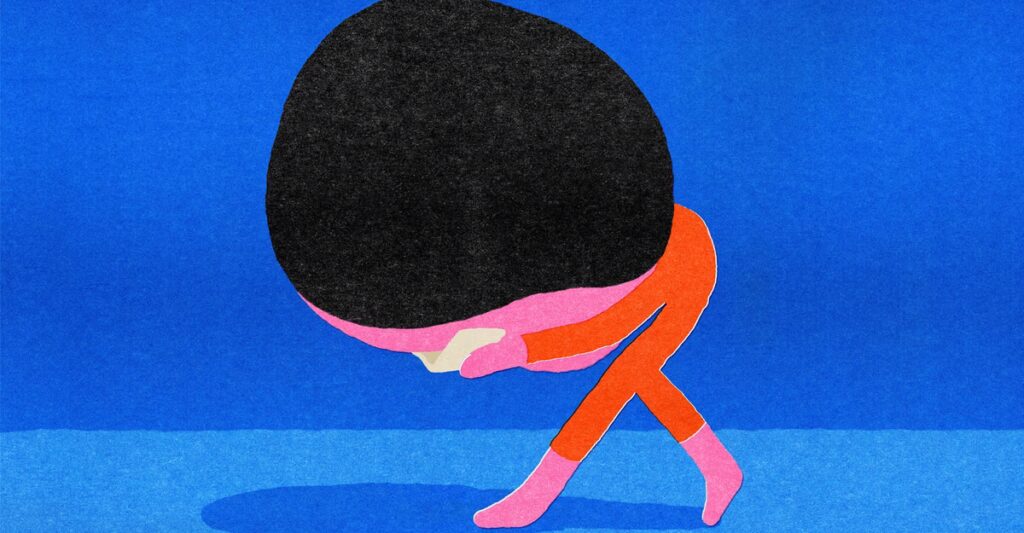
Much of the time, as with many other wellness ventures, someone stands to make money. At one somatic-workout class I attended, where a staffer told me that the goal was to “move stagnant energy out,” the lobby featured a gift-shop corner with jewelry, T-shirts, and $65 “body gloss” from a brand called Oui the People. But clearly, plenty of Americans are willing to pay for the promise of a psychic cleanse. Practitioners refer to “stuck energy,” to “trapped emotions,” to “resetting” a nervous system caught in fight-or-flight mode. “We have all these ways of just storing that gunk inside,” Ottenstein told me. I pictured, uncomfortably, a thick, black goo running through my veins.
Somatics—the whole roomy umbrella of practices—might seem like an odd fit for the information age, when people are more accustomed to finding answers on the internet than within themselves. But that could be precisely the draw for thinkers and analyzers who are tired of ruminating in anxious circles, who spend their days in front of a laptop and nights scrolling an iPhone. For millennia, people have yearned to break out of the confines of their bodies; they’ve searched—through religion, spirituality, drugs—for transcendence. Now, for some, the existential quest is inverted: Instead of seeking to escape their prison of flesh and bones, they want to reinhabit it.
The origin of somatics is difficult to pinpoint, though it’s certainly not recent. Some credit Wilhelm Reich, a student of Freud’s, who theorized in the early 1900s that patients held tension in their bodies—“muscular armor”—as a subconscious defense against trauma, leading to aches, pains, and inflammation. But it wasn’t until the 1970s that the field began to formalize, developed in part by the American philosophy professor Thomas Hanna, who defined somatics as the study of “the body as perceived from within.” That same decade, a UC Berkeley biophysics doctoral student, Peter Levine, developed “somatic experiencing”: a therapeutic method based on the idea that people, like other animals, react to trauma with a flight, fight, or freeze response, powered by a burst of adrenaline. After the source of danger is gone, Levine argued, they have pent-up “survival energy” to unleash: They need to physically shake it off. He pointed to videos of impalas, quaking and buckling after surviving a cheetah attack. When humans go through something upsetting, Ottenstein told me, “we go to work the next day.”
This idea—that trauma is held in the body, and thus must be physically remedied—was once fairly niche. In recent years, though, it has been jolted into prominence. The psychiatrist Bessel van der Kolk’s book The Body Keeps the Score, which argues for somatic treatments of PTSD, was first released in 2014 and was not an immediate hit. In 2021, it reached the No. 1 spot on the New York Times best-seller list for paperback nonfiction. And although it has been accused of resting on shaky science, it has continued to dominate the charts for years.
Van der Kolk wrote about violent assaults, wartime atrocities, severe childhood abuse—circumstances that many readers hadn’t directly experienced. Yet The Body Keeps the Score seemed to resonate anyway. When it gained momentum, lots of Americans had spent the previous year safe in their homes, baking bread and taking Zoom calls. (“When people say the pandemic has been a collective trauma,” van der Kolk told The Atlantic that year, “I say, absolutely not.”) Most had also, however, been detached from the rich sensory experience of interacting with the external world. Now here was a book about people who’d felt estranged from their own body—and then, through simple movement, play, and touch, found their way back to their surroundings, and to themselves.
[Read: The self-help that no one needs right now]
In the years since, most people have emerged from pandemic isolation. Yet the share of Americans who say they frequently experience stress, which has been rising for decades, has continued its upward trend. Talk therapy remains popular, but it’s not always affordable or accessible—and much of the time, it doesn’t take physical symptoms into account. Meanwhile, many medical doctors don’t consider psychological causes of physical ailments. Stress in particular is “like this mythical creature,” Aditi Nerurkar, a physician at Harvard Medical School, told me. “And we don’t have a lot of time. We have to focus on your hemoglobin. Did you get a mammogram? Did you get a pap smear? What is your cholesterol?”
No wonder, then, that somatics is a flourishing industry. Many Americans already distrust medical institutions; maybe they want to bypass the dismissive doctor, or the therapist who wants to rehash every daddy issue but can’t seem to fix anything. So they turn to this strange constellation of New Age–y courses, TikTok sages, and licensed counselors. Some offerings target people with capital-T Trauma; others claim to be for just about anyone. Many present themselves as alternatives to more traditional paths to mental well-being. The question is whether they can really help the frazzled masses.
Somatics does get a lot of things right. Plenty of bodily sensations are, at root, psychological. Some communication does need to happen between the brain and the rest of the body. That’s how you know to respond to danger: The amygdala triggers the nervous system to increase your heart rate, deliver more blood to muscles, and release a flood of adrenaline. When I spoke with Nerurkar, she rattled off an incomplete list of physical symptoms that might result from stress: headaches, dizziness, nausea, vision changes. When she was in residency training, she said, she experienced what felt like a “stampede of wild horses” across her chest and was convinced that she had a heart problem—until her doctors, having conducted a battery of tests, recommended that she seriously consider chilling out.
And many components of somatic practice have evidence to back them up. Interoception, or awareness of one’s own physical signals, really can be important for well-being—perhaps because it increases people’s sense of attunement with their body, connection with the present moment, or agency over otherwise vague and inscrutable sensations. Mindfulness meditation, which involves interoception, has been shown to decrease stress and anxiety and even reduce physical pain. Yoga and breathing exercises can decrease amygdala activation and lead to better concentration, memory, and executive function.
But the somatics packaging of these techniques is alluring partly because of the emotional liberation it promises. Somaticists tend to describe a clear path: identify a physical signal, connect it to its psychic cause, then let it go. If the nervous system overactivates, surely you can just reset it. If the body holds trauma, surely the body can relinquish it.
These were always just metaphors, though, and imperfect ones. The amygdala doesn’t have a reboot button. There is no viscous gunk of emotional pain to flush out. The Body Keeps the Score has been somewhat debunked; critics have argued that van der Kolk incorrectly described certain studies, and that he seems to have made up others entirely. (Responding to the writer Emi Nietfeld’s critique in Mother Jones, van der Kolk said that at times he drew on unpublished data.) Trauma experts have pushed back on his wholesale condemnation of talk therapy, which can be, according to a mountain of evidence, very helpful for treating PTSD. There’s also something ironic in how certain somaticists—ostensibly advocates for the mind-body connection—talk as if the two are separated by a nearly unbridgeable gap: the physical burden of trauma unreachable through thinking or conversation, and perhaps not even accessible to conscious awareness.
[Read: Why we’re still talking about the ‘trauma plot’]
So somatics isn’t a miracle cure. And it’s probably right to be skeptical of influencers who seek to collect on people’s need to feel at home in their body. But that doesn’t mean somatics can’t be helpful. Much of it, after all, turns out to be pretty straightforward. Movement is good, generally. Breathing is good. Stepping away from your screen—stretching your limbs, remembering you are real and tangible and mortal—is good.
When I signed up for that somatic-exercise class, I expected that I might leave rolling my eyes , but I secretly hoped I’d walk out lighter, more alive and connected to myself and the world. What I found was something in between. The actual workout couldn’t have been more basic: It consisted largely of squats, jumping jacks, crunches, some yoga—downward dog, child’s pose. Occasionally the instructor would remind us to check in with our bodies: “What are you being invited into? And I don’t mean the burpee.” Or: “Let the chin enter the conversation.” Otherwise it hardly seemed uniquely somatic, or uniquely anything.
Then again, I had the post-workout endorphin glow. I’d left my apartment and shut my phone in a locker. An hour later, I exited the studio somewhat baffled. But walking out onto a busy Manhattan street, I felt a little more conscious of the sun on my cheek, the solidness of the ground pushing against my feet. This was silly, I thought. And also: Maybe I’ll come back.
When you buy a book using a link on this page, we receive a commission. Thank you for supporting The Atlantic
The post How ‘Somatics’ Became the Solution to Modern Life appeared first on The Atlantic.