In the wake of a hiring surge last summer, an official in charge of evaluating new recruits to U.S. Immigration and Customs Enforcement issued a dire warning.
The Trump administration, he wrote in a memo, was cutting corners, violating the law and fast-tracking unqualified, “improperly vetted” candidates into ICE’s ranks, part of a dangerous move that exposed the agency — and its law enforcement operations — to “grave national security risks.”
Citing an “unprecedented lowering of standards,” the career ICE official said that “systemic breakdowns” had allowed applicants to receive job offers before they had passed basic fingerprint, identity or credit checks in a preliminary vetting process. Political appointees had unjustly skirted background investigations and received national security eligibility.
The official, a unit chief who directly oversaw more than 100 employees who evaluated thousands of ICE applicants, was so troubled by what he saw that he outlined these concerns not to his superiors, but in a formal whistle-blower complaint to the Office of Inspector General in the Department of Homeland Security.
In the complaint, he asked for an independent, outside investigation into the matter. He was later interviewed twice by officials with the inspector general’s office and his concerns have become part of an ongoing audit into vetting practices.
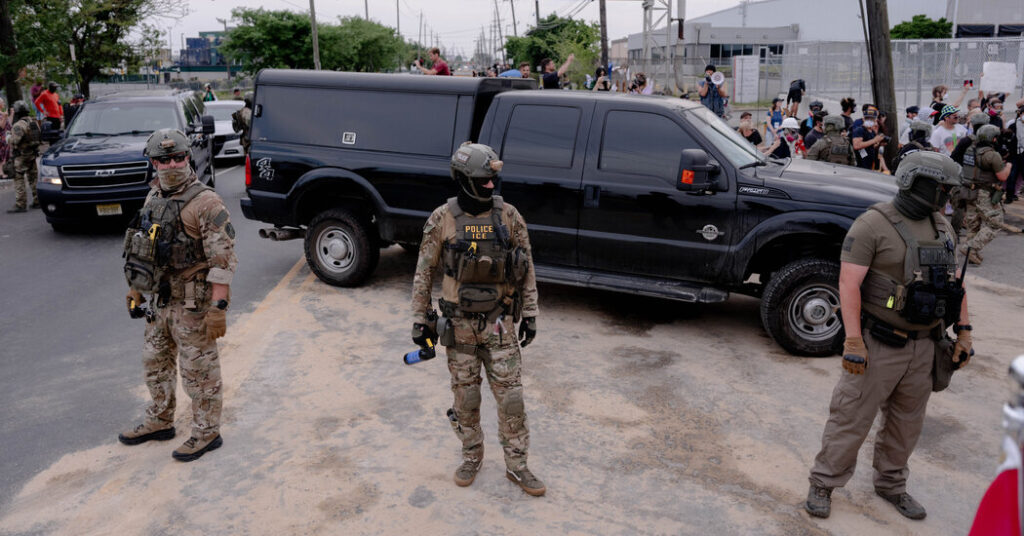
The complaint, which has not been previously reported, underscores the rising worries about the suitability — as well as the tactics — of scores of agents who have been rapidly deployed across the country within the last year. It also outlines the extent to which ICE weakened its standards, and points to dissension among the upper reaches of the agency as it was pressed last year to carry out President Trump’s immigration crackdown.
The whistle-blower, a 17-year ICE veteran who spoke to The New York Times on the condition of anonymity because of the sensitive nature of his claims, said the agency had cut corners in its rush to fill the ranks.
“We chose as an agency to be more convenient rather than thorough,” he said, describing the agency’s decision to reduce scrutiny of recruits in order to expedite hires. “By doing so, there was a potential to put lives at risk and to jeopardize national security.”
The whistle-blower complaint was obtained via a public records request. The concerns within it broadly mirror those made by other current and former ICE employees who said that the agency had abandoned best practices as it rapidly scaled up. An ICE lawyer who worked at the agency’s training center resigned earlier this year and went public as a whistle-blower, citing concerns about a “deficient, defective and broken” training program.
In response to questions, an ICE spokesperson said in a statement that the agency “diligently applies the proper personnel vetting regulations, including guidelines for national security, and evaluates all available information for every applicant based on these factors.”
The agency declined to comment about the whistle-blower, who retired from the agency in July, or his complaint.
The scrutiny of ICE’s hiring practices has intensified in recent weeks, spurred in part by the fatal shooting of Johan Sebastián Durán Guerrero, a Colombian immigrant, in Biddeford, Maine, on July 13.
The two ex-wives of the ICE agent David Brouillette, one of whom identified him as the person who fired the fatal shots, have accused him in interviews and court records of being abusive. In a filing for a protection order in December 2019, one ex-wife wrote that he had broken her door down, destroyed her belongings and dumped her clothes over a bridge.
The women also have said Mr. Brouillette, a former military serviceman and Veterans Affairs police officer who was hired amid the recruiting surge last year, had post-traumatic stress disorder related to his deployment in Afghanistan. A local official in Maine told The Portland Press Herald that Mr. Brouillette sought jobs with the Hallowell Police Department in 2024 but was denied because there were “too many red flags.” Mr. Brouillette could not be reached for comment.
After the shooting, Tom Homan, the White House border czar, said that the D.H.S. investigation into the episode will include whether the agent was properly vetted before being hired.
A White House spokesperson referred questions to D.H.S.
A Rush to Recruit
The concerns in the August 2025 whistle-blower complaint exposed shortcuts in the agency’s preliminary vetting process. No credit checks. Fingerprints unconfirmed. Final job offers absent preliminary vetting.
Before the surge, a recruitment team made documents available to a unit within ICE’s Office of Professional Responsibility for each new hire, including fingerprints and a security form with extensive questions. The vetting team would then initiate a preliminary check, running each applicant’s name through law enforcement databases and searching for criminal violations or other major red flags. Some recruits would be sent for a polygraph test if concerns arose.
These recruits then underwent a full background check, conducted by outside contractors, to determine whether the candidate was trustworthy enough to have access to sensitive computer systems, federal facilities and classified information. It wasn’t unusual for this to occur while recruits were in training.
The preliminary vetting process, which took seven to 10 days, was upended last summer. The vetters were told to make determinations on recruits without having the full security form, fingerprints or any polygraph testing, according to the former unit chief and a former federal official familiar with the process who was granted anonymity to speak freely about it.
That meant new hires were heading to training without having their identities, criminal histories and other basic information checked and verified, the unit chief said.
The agency also sped up its training program, cutting it from roughly 10 weeks to six. This resulted in agents reporting to their full-time positions while their full background checks were pending.
Meanwhile, recruits with prior law enforcement experience were able to take online courses rather than complete on-site training. They faced even less scrutiny in their background checks.
In July, the agency said, it increased the length of its training program for academy classes, and it instructed past graduates to attend additional training.
Ryan Schwank, the former ICE lawyer who worked at the agency’s training center, testified before Congress this year that new recruits appeared unfit for service.
“We were concerned about ICE recruiting a loose cannon or somebody who was just mentally unfit for the role,” Mr. Schwank said in a recent interview. “We knew that kind of person would get through. But the thing that I think kept some of the other instructors up at night was the possibility of organized crime getting access to the agency or penetrating the agency.”
Mr. Schwank, who taught recruits during the surge, said that’s exactly what happened. Last fall, several students were removed from the academy in Georgia in the middle of training because officials determined that they were all linked to a criminal gang. Mr. Schwank began work at the training academy last September and left the agency in February.
In a statement, an ICE spokesperson said “ICE has received NO credible evidence that any of its trainees were linked to a common criminal gang.”
In the interview, Mr. Schwank said it was rare for students to fail out of the academy before the surge, but that about half of his students flunked out after the hiring push. This was after the academy made its tests open book and no longer failed students who made fatal errors during enforcement simulations.
By this spring, hundreds of new recruits hired amid the surge had already been removed from the force, according to the former federal official who was granted anonymity.
The hiring surge was set in motion in part by the passage of Mr. Trump’s domestic policy bill last summer. Congress allocated $30 billion in new money for ICE to hire 10,000 new ICE agents, more than doubling the number of deportation officers.
Concerns About Political Appointees
The unit chief who filed the whistle-blower complaint said he chose to alert the D.H.S. Office of Inspector General because ICE leadership had created these issues and he thought an outside, independent investigation was necessary.
In addition to the vetting concerns, he also mentioned in the complaint that Trump administration political allies had received favorable treatment and obtained security clearances even though troubling information about them had surfaced in background checks. He cited Corey Lewandowski, a former top adviser to D.H.S.
The concerns about Mr. Lewandowski had been outlined in a memo written last year by the D.H.S. head of security and was viewed by the whistle-blower, who told The Times that a higher-up had asked him to vet Mr. Lewandowski for an ICE credential. The red flags in the memo included allegations that Mr. Lewandowski had been paid years earlier for work by a Chinese government agency, according to the whistle-blower and a report last year in the Daily Mail. That allegation has not been substantiated outside of that memo.
In a statement, Mr. Lewandowski denied he was ever vetted by ICE. He said he had “never worked for the Chinese Communist Party – Full Stop.”
In a follow-up statement, a spokesperson for Mr. Lewandowski said any suggestion that he “received favorable treatment in connection with his security clearance is categorically false.”
Ten days after the unit chief filed his whistle-blower complaint — and a few days after the Daily Mail article published — a lawyer from the department’s Office of General Counsel reached out to him. This lawyer, who was not from the inspector general’s office, asked to meet the whistle-blower at an agency field office in Texas, separate from where he typically worked.
The whistle-blower believed he was being interviewed about his security worries, but a different focus of the inquiry became apparent: Had the unit chief talked to the news media about his concerns?
The lawyer grilled him over four hours and seized his laptop, according to the former unit chief and his lawyer. The full contents of the meeting, they said, are protected under a nondisclosure agreement, a common practice for internal investigations.
“My client was of the belief this investigation by the agency’s attorneys was in good faith to vet his disclosure,” said Kevin Owen, a lawyer for the whistle-blower. “Instead they threatened him and put him on leave.”
It remains unclear how D.H.S. officials came to target the unit chief.
The agency said it couldn’t comment on personnel matters with people no longer there.
The former unit chief said the inspector general’s office first reached out to interview him in February, about six months after the complaint was filed. Investigators interviewed him again in April for an audit into vetting, he said.
In a statement, the office said it had to delay some of its work due to government furloughs. The office in April opened an audit into the process for giving out security clearances to political appointees.
The inspector general’s office said it couldn’t comment on its investigations, but the agency noted that it did not reveal the name of the whistle-blower to anyone outside of its office.
Meanwhile, the whistle-blower remained on leave for 10 months for what D.H.S. said were “allegations of serious misconduct,” the unit chief and Mr. Owen said.
The alleged misconduct went unspecified, they said, and he was eventually reinstated with no punishment or finding of wrongdoing. He retired immediately after, in July.
He said D.H.S. officials had never told him specifics for why he was on leave for such a long time.
In an effort to learn more, he submitted a records request to ICE for documents related to his case.
The former unit chief said the stress of the investigation weighed heavily on his mental health. He checked himself into a treatment program that lasted several months.
The man, a longtime Republican who voted for Mr. Trump in 2020 and 2024, said he grew disillusioned with the agency as it acted in haste to fulfill the president’s immigration enforcement mandate. He said he has always supported ICE’s mission, but was troubled by the way the agency was taking shortcuts in vetting recruits.
“It’s a betrayal of the public trust and everybody’s trust,” he said.
Danny Hakim contributed reporting. Sheelagh McNeill and Kitty Bennett contributed research.
The post ICE Skipped Basic Checks in Rush for Recruits, Whistle-Blower Says appeared first on New York Times.