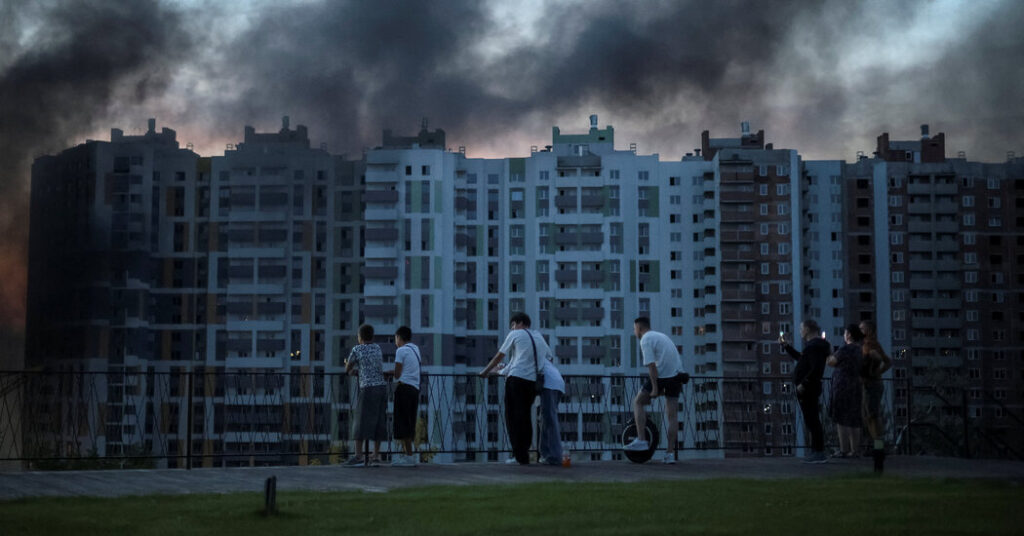
They are both torching warehouses filled with food or online-shopping orders near major cities. They are blasting ports and ships carrying vital exports of grain. And they are smashing energy networks that keep the lights on and vehicles fueled.
Russia and Ukraine, in cities far from the front line, are waging an intensifying tit-for-tat air war that is bringing more pain to the populations of both countries than at any other point since the early months of the full-scale war launched by Moscow in 2022.
With the front largely frozen, each side is using growing arsenals of missiles and drones to exact vengeance and to try to pummel the other into submission. In the most recent example, Kyiv, the Ukrainian capital, has been under constant bombardment from Russian drones over the past few days, tormenting residents with nearly continual air-raid alerts.
Still, there is no evidence that the escalation will weaken either country’s determination to fight on. Human suffering will only grow this winter, analysts say, as both Russia and Ukraine seek leverage in U.S.-backed settlement negotiations that are expected to resume after achieving little this year.
Ukraine can’t give up, and Russia doesn’t want to, analysts say.
“It’s a question of how much pain can Russia take compared to Ukraine — and Russia can take a lot of pain,” said Rob Lee, a military expert at the Philadelphia-based Foreign Policy Research Institute who travels frequently to the front line.
This new period of eye-for-an-eye assaults accelerated in late June, when Ukraine opened a 40-day campaign against Russia that President Volodymyr Zelensky said was aimed at “compelling it to end the war.”
Since he threw down that gauntlet, Ukrainian long-range drones have hit more than 30 warehouses of major online shopping companies, mostly those used by Wildberries, the Russian equivalent of Amazon. The strikes have disrupted Russian commercial logistics, inflicted heavy losses on small merchants and killed several warehouse workers.
Ukraine has also continued its attacks on Russian oil refineries and fuel logistics. About 70 percent of Russian gas stations ran out of gasoline or diesel last month, sparking the country’s worst fuel crisis since the collapse of the Soviet Union in the early 1990s. The Kremlin scrambled to fix the situation, allowing lower-grade gas and diesel to be sold. But through mid-August, there were two-hour lines at every station in Moscow that still had gas.
In addition, Ukrainian strikes on infrastructure in the Sea of Azov and the broader Black Sea basin have hamstrung agricultural exports by Russia, the world’s largest exporter of wheat, and have left the occupied Crimea Peninsula isolated.
“Their economy will start collapsing — it already is,” said Olena Ivashko, 48, a Ukrainian grocery worker who has had four male relatives killed fighting in the war. “Until they start eating each other alive, they will not understand that there is a war. They didn’t understand what war was until they started standing in lines for gasoline.”
The Russian economy is not in danger of imminent collapse, even as growth has slowed to almost a standstill and the budget deficit has ballooned. But the attacks deep inside Russia have made the war feel closer to Russians than ever before, and Russian civilians are dying in such strikes at the highest rate since the war began.
Pyotr, a book editor in the Russian capital, said that this summer the “first cracks appeared on the surface of Moscow’s well-being.” Yevgeny, a motorcycle enthusiast, described sleepless nights every time he saw a warning about a potential drone attack. Both men asked that only their first names be used to protect their security.
After Ukraine’s 40-day campaign ended, President Vladimir V. Putin of Russia said that Kyiv had opened “Pandora’s box” by trying to damage the Russian economy and would pay the price. As has been the case throughout the war, the Russian assaults that followed have inflicted more suffering on Ukrainians than anything that Russians have endured.
Russian ballistic and supersonic missiles are now hitting Ukrainian cities almost at will, largely because Ukraine is running low on U.S.-made Patriot interceptor missiles. New Russian jet-powered drones that can reach speeds of more than 370 miles an hour perform surveillance and smash into targets. Ukrainian civilian casualties are higher than at any other point since the initial five weeks of the war, and they are much higher than Russian casualties.
Moscow’s Black Sea attacks have crippled crucial ports in the Odesa region and have threatened to cost the Ukrainian economy more than $2 billion in agricultural exports in the second half of 2026. More than 300 Ukrainian gas stations have been damaged or destroyed by Russian attacks over the past six months. Dozens of warehouses, including those supplying grocery stores, and a number of shopping centers have been struck. About 13 million books have been charred in Russian strikes, according to the Ukrainian Publishing Association.
The escalation is likely to continue, analysts said. After pounding Ukraine’s power grid to within an inch of its life last winter, Russia has vowed to hammer it again.
The Russian Defense Ministry warned last month that Kyiv was “in for a deep freeze this winter.” On Tuesday, Mr. Putin said he had instructed his armed forces “to deliver massive strikes against Ukraine’s energy facilities.” Russia could also try to target Ukraine’s water supply, analysts said.
Speaking after a summit in Kyrgyzstan on Tuesday, Mr. Putin also seemingly threatened to expand the war to Ukraine’s Western allies. “If someone tries to drag us down the food chain, to gobble us up, to devour us, they may end up getting punched in the teeth,” he said.
Ukraine, too, may keep escalating. It is developing its own powerful ballistic missiles and says they could be ready by this fall. If that happens, the war would enter a different stage, analysts said.
In his own address on Tuesday, Mr. Zelensky warned airlines that Russian airspace was “becoming completely unsafe” because of Ukrainian drones, a threat that Mr. Putin described as “state terrorism.”
Where it will end is anyone’s guess. The C.I.A. director, John Ratcliffe, flew to Moscow last week to try to persuade Russia to cut a deal before the country’s military and economic situation got any worse.
Moscow’s answer to the visit was clear. The Kremlin spokesman, Dmitri S. Peskov, said the U.S.-led peace negotiations were in a “deep pause.” As if to punctuate this statement, between Thursday and Monday, Kyiv came under an air-raid alert 58 times and faced multiple volleys of missiles and drones.
Serious peace talks are not likely until next spring or summer, experts and diplomats said. The lead U.S. negotiators, Jared Kushner, President Trump’s son-in-law, and Steve Witkoff, Mr. Trump’s special envoy and longtime friend, are supposed to visit Ukraine soon to jump-start talks, Ukrainian officials say. But such a visit has been rumored at least four times this year and has not taken place.
Russia has given no indication it is ready for talks. Mr. Putin is angry, Ukrainian officials and Western diplomats said, that Russian troops have not yet seized all of the eastern Ukrainian area known as the Donbas. Russian troops control a bit less than 20 percent of Ukraine, only slightly more than they did three years ago.
As the air war intensifies, each country adjusts. By last week, lines had shortened at Moscow’s gas stations. School started in much of Ukraine on Tuesday even as Russia fired more missiles and drones, though 10 percent fewer first graders showed up in Kyiv schools than did last year.
“We’ve already gotten used to things being destroyed,” said Aliona Chystiakova, 45, who recently faced empty shelves at a grocery store because of the Russian attacks. “They’re shelling us, they’re trying to destroy us, but somehow we keep floating back to the surface, and there’s nothing they can do about it.”
The post A Spiral of Escalation for Russia and Ukraine, With No End in Sight appeared first on New York Times.