If you’ve followed the Supreme Court’s recent presidential power cases, you know there’s no mystery surrounding the Court’s eventual decision in Trump v. Slaughter, a case asking if President Donald Trump may fire several high-ranking federal officials who are protected from being terminated by federal law.
All six members of the Court’s Republican majority are devout acolytes of the “unitary executive,” a legal theory that claims the president may fire nearly anyone who leads a federal agency. The specific question before the Court in Slaughter is whether the Constitution permitted Trump to fire Rebecca Slaughter, who previously served as one of five commissioners on the Federal Trade Commission.
The Republican justices already concluded, albeit in a temporary order, that Trump may fire Slaughter in an order handed down in September. Though the justices heard oral argument in the Slaughter case on Monday morning, that argument is largely political theater preceding the Court’s inevitable decision that Slaughter may be fired permanently.
While on its face the Slaughter case is a case about presidential power, a few key justices signaled that they are comfortable giving Trump the power he seeks in this case because the Court will itself remain a check on the president.
The Court’s Republican majority, in other words, plans to remake the separation of powers among the three US branches of government into a kind of hierarchy. Under this new vision, Congress’s power to create “independent” agencies that enjoy some insulation from the president must yield to a more powerful executive. And the executive’s authority over these agencies must, in turn, yield to a more powerful Supreme Court.
Slaughter lets the Republican justices achieve a goal they’ve sought since the 1980s
Ninety years ago, in Humphrey’s Executor v. United States (1935), the Supreme Court held that Congress may sometimes create federal agencies, led by multimember boards, that act with a degree of autonomy from the president. Although the leaders of these agencies are typically nominated by the president and confirmed by the Senate, federal law forbids the president from firing these agency leaders simply because he disagrees with their policy views. By law, FTC commissioners may only be fired “for inefficiency, neglect of duty, or malfeasance in office.”
The “unitary executive” theory, meanwhile, claims that Humphrey’s Executor was wrongly decided. Proponents of this theory point to a line in the Constitution that states “the executive power shall be vested in a President of the United States of America.” As Justice Antonin Scalia wrote in an influential 1988 dissenting opinion, this line “does not mean some of the executive power, but all of the executive power” belongs to the president. And thus Trump must have the power to fire any agency leader who wields power that is “executive” in nature.
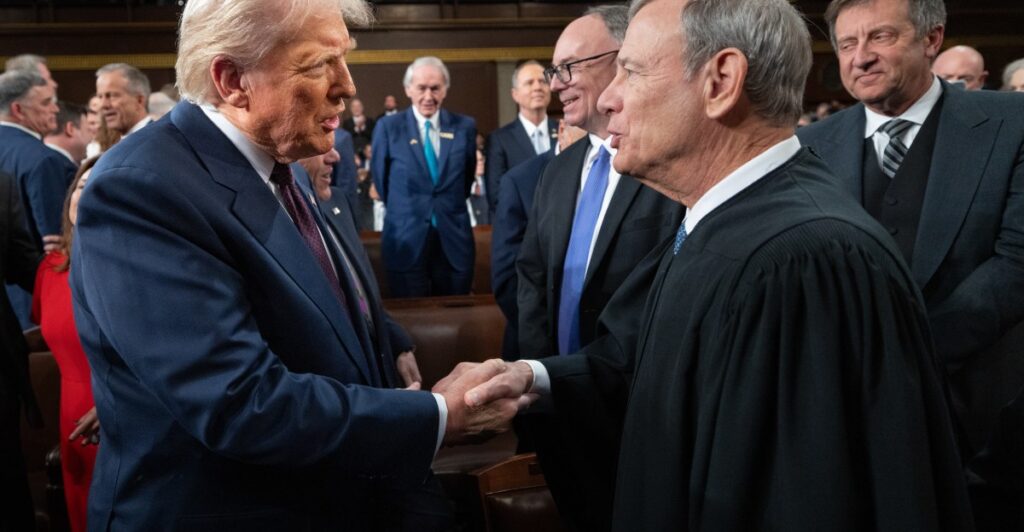
Monday’s oral argument in Slaughter left little doubt that all six of the Court’s Republicans — all of whom have signed onto decisions embracing this unitary executive theory in the past — share Scalia’s view of the Constitution. Chief Justice John Roberts even referred to Humphrey’s Executor as a “dried husk.” The Court’s GOP majority really hates that nine-decade-old decision.
That said, some of the Court’s Republicans did express concerns about the implications of the unitary executive. In May, for example, the Court signaled that it will exempt the Federal Reserve from the unitary executive, preventing Trump from firing its leaders, because “the Federal Reserve is a uniquely structured, quasi-private entity that follows in the distinct historical tradition of the First and Second Banks of the United States.”
While it’s not entirely clear what those words mean, Justice Brett Kavanaugh apparently takes them very seriously. During the argument, he told Solicitor General John Sauer that he has “concerns” about giving Trump full control over the Fed.
The Fed has the power to temporarily stimulate the economy in ways that can cause serious economic damage down the road. So, if the president could fire Fed governors, he could pressure them to boost the economy during an election year, giving the president a temporary political advantage with consequences that may not be felt until after the president leaves office.
Similarly, Justice Samuel Alito asked about so called “Article I courts,” such as the US Tax Court or the United States Court of Appeals for the Armed Forces, which adjudicate cases just like any other judicial body, but that are technically not part of the judicial branch (which is created by Article III of the Constitution). Must the president have the power to fire judges on these courts, even if he does so to pressure them to change their interpretation of the law?
In a related vein, Roberts asked whether a hypothetical agency that spends most of its time adjudicating individual cases, but that occasionally wields “executive” power, must be fully controlled by the president.
A major reason why it is difficult to determine which agencies should be under the president’s full control under the unitary executive theory is that the Constitution does not define key terms like the word “executive.”
Recall that this theory derives from a line in the Constitution giving all “executive power” to the president. There is considerable evidence, however, that the framers did not have a firm grasp on what powers are “executive” in nature when they wrote the Constitution. And they certainly did not draw the lines in the same place that the Court’s current majority does.
The Republican justices have held, for example, that the power to prosecute crimes is a “quintessentially executive function.” But, in the early United States, federal prosecutions were often led by private attorneys or by lawyers appointed by judges. Indeed, the latter still happens today. Current US law sometimes gives federal district judges the power to appoint federal prosecutors.
So even if you accept the premise of the unitary executive — that Trump must have full control over all officials who do “executive” things — no one really knows what sort of government functions qualify as “executive.”
This might seem like a difficult problem for the Court’s unitary executive stans to overcome, but several of the Republican justices offered a simple solution to this problem: They can just rule however they want in Slaughter, because if another case comes up in the future where they want to limit the president’s power, they can just rule differently in that case.
How the justices are likely to use Slaughter to enhance their own power
Alito proposed one simple step the Court could take to preserve the Court’s power to protect the Federal Reserve or the military’s appeals court: It could simply not decide those issues in Slaughter. At one point, he asked Sauer to suggest language that the Court could insert into its Slaughter opinion that would leave harder questions arising under the unitary executive unresolved.
Of course, as Justice Elena Kagan pointed out, kicking the can down the road in this way can’t work forever. “Logic has consequences,” in the Supreme Court, Kagan said in response to Alito. And if the Court hands down a theory of the Constitution that should apply equally to both the FTC and the Fed, the Court is supposed to apply that theory equally to both agencies.
So long as Trump is president, this shift in power may not matter.
Both Justice Neil Gorsuch and Kavanaugh, however, floated a separate solution to this problem: If a future president ever does something the justices don’t like, the justices can just veto it.
For what it is worth, Gorsuch and Kavanaugh seemed to disagree slightly about how they should exercise this veto. Gorsuch wants to revive something called the Nondelegation Doctrine, which the Court briefly used in 1935 to veto two laws giving broad power to President Franklin D. Roosevelt, before abandoning Nondelegation for the next nine decades. Kavanaugh, meanwhile, would rely on the “major questions doctrine,” a legal doctrine that permits the justices to veto any presidential decision they decide is too consequential.
This major questions doctrine is brand new and has only ever been used against one president: Joe Biden.
But, regardless of whether the Court revives a dead doctrine or relies on something they recently invented, the practical implications of Gorsuch and Kavanaugh’s approaches are the same. They would give the president full control over who leads federal agencies, but also give themselves a veto power over anything the president does with those agencies.
So, while Slaughter appears to be a case about presidential power on its surface, this Court appears likely to use it to grow its own power. Trump will almost certainly win the power to fire Slaughter. But on the condition that the Supreme Court is the president’s boss.
So long as Trump is president, this shift in power may not matter. The Republican justices have largely acted as rubber stamps for nearly anything Trump wants to do. But Trump won’t be president forever. And Gorsuch and Kavanaugh’s approach will give this Court massive authority to sabotage a future Democratic president.
The post How the Supreme Court is using Trump to grab more power for itself appeared first on Vox.