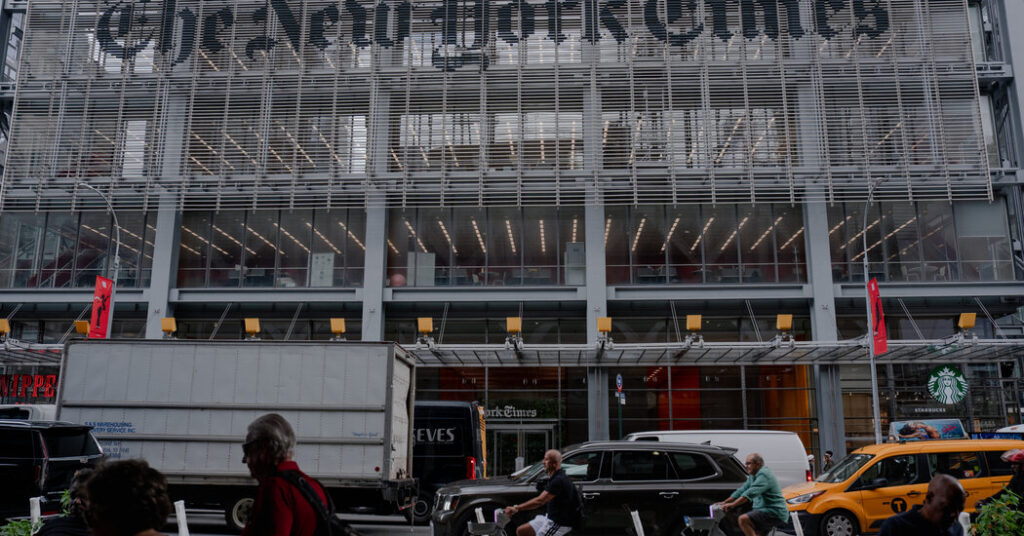
The Justice Department told a Manhattan federal court that it was in the national interest for the judge to find that OpenAI did not violate copyright law when it used articles by The New York Times and other publishers to develop artificial intelligence systems.
The filing late Tuesday was the first time the Justice Department weighed in on the use of copyrighted material by A.I. companies, which has led to several lawsuits, including one brought by The Times.
The Justice Department argued that developing A.I. was critical to national security, and that training A.I. systems sufficiently transformed the written works to new material allowed under copyright law. It said the benefits of A.I. “far outweigh any competitive harm.”
The government’s intervention is an escalation in the landmark litigation that could determine whether OpenAI violated the law when it was developing its A.I. systems and had harmed the news industry and other content creators.
Stanley Woodward Jr., the associate attorney general for the Justice Department, called the filing “a historic statement of interest” in a statement posted on social media, adding that President Trump had made clear that “AI dominance is critical to promote national security, prosperity, and economic mobility for all Americans.”
Graham James, a spokesman for The Times, said in a statement that the Justice Department was siding with a handful of “trillion-dollar A.I. companies” at the expense of American creators.
“The administration’s proposal to let companies take that content without permission or compensation would undermine the sustainability of the human-created content that a healthy society depends on, and which A.I. needs to function,” he said.
Representatives for OpenAI did not respond to a request for comment. Microsoft, OpenAI’s partner and a defendant in The Times’s lawsuit, declined to comment.
The Times sued OpenAI and Microsoft in late 2023, claiming that the tech companies illegally used copyrighted material to develop and deploy ChatGPT and other advanced A.I. systems. Other publishers also sued, and many of the cases were consolidated last year in the U.S. District Court for the Southern District of New York.
OpenAI and Microsoft have denied the claims and have argued that they transform the written works into new material, which would be allowed under copyright law. Judge Sidney H. Stein has given both sides until this Friday to submit motions for summary judgment.
The Times’s lawsuit is one of many amid a wave of legal action against A.I. companies over copyright claims.
This week, a group of musicians sued Suno, a start-up that creates songs using A.I., claiming that the firm used musicians’ voices and imitated their styles without permission. In May, Anthropic agreed to a record $1.5 billion settlement paid to authors and publishers after a judge ruled it had illegally downloaded and stored millions of copyrighted books.
The Trump administration, including the Justice Department, has broadly sought to support the growing A.I. sector in the United States, and it has generally been skeptical of efforts at the state and federal levels to regulate the industry.
In recent months, administration officials have also discussed the possibility of taking direct stakes in A.I. companies, according to people familiar with the discussions.
Devlin Barrett contributed reporting from Washington.
The post Justice Dept. Sides With OpenAI in New York Times Copyright Suit appeared first on New York Times.