For nearly a year and a half, the Trump administration prepared its case. Political appointees inside the State Department combed through old files and databases. Civil servants received notice that their personal emails would be examined. Darren Beattie—the founder of a far-right conspiracist website, then the undersecretary of state for public diplomacy—sent out a request for files on anyone who had communicated with or written about the Global Engagement Center, a now-dissolved agency that once worked to expose propaganda campaigns by Russia, China, Iran, and other countries around the world.
[Read: The white nationalist in charge of Trump’s public diplomacy]
The request, seen last year by the MIT Technology Review, was far-reaching. Beattie was seeking information on Bill Gates; the commentator Bill Kristol; Chris Krebs, a former U.S. cybersecurity official; a German government minister; the analyst Renée DiResta, formerly at Stanford University, as well as others associated with a research project called the Election Integrity Partnership; and, as it happens, me.
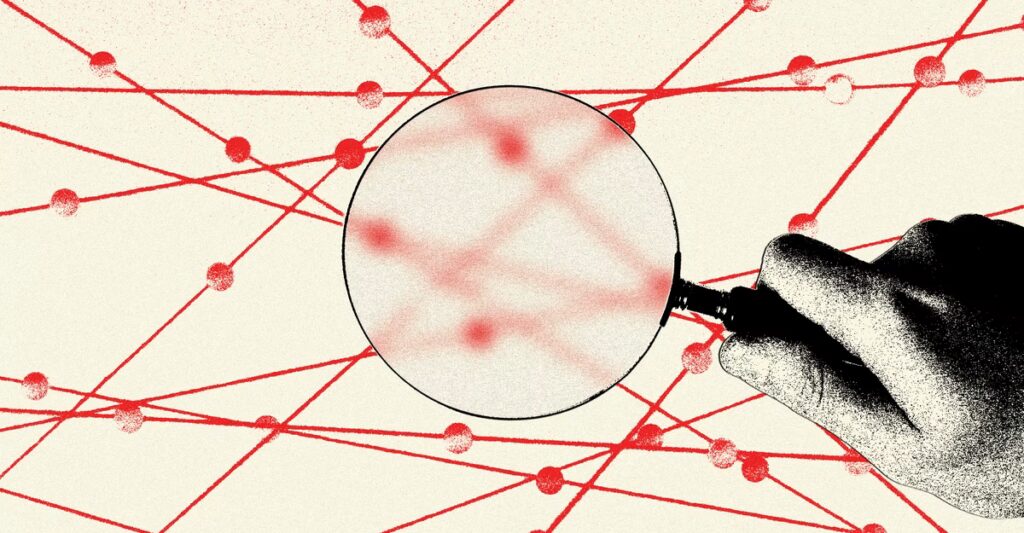
This unprecedented investigation was meant to expose the Biden administration’s “censorship-industrial complex,” a shadowy network allegedly dedicated to the mass suppression of American free speech. Since 2020, internet trolls have accused Biden-administration officials, social-media companies, and university researchers of weaving a nefarious plot to censor conservatives. Since 2025, MAGA ideologues have been using this alleged plot as an excuse to dismantle government programs, stifle research, intimidate American citizens, and even distort American foreign policy.
And yet for the past year and half, neither Beattie nor anyone else has actually managed to prove that the plot ever existed. Like a soap bubble that vanishes with the touch of a hand, the “censorship-industrial complex” belongs to that mystical category of things that disappear when you examine them too closely.
The failure to produce evidence is not for lack of trying. During the Biden administration, MAGA allies and politicians filed multiple lawsuits with the goal of exposing alleged censorship. None has done so. One of them, brought by the Missouri attorney general, made it all the way to the Supreme Court before justices asked for underlying evidence that the government had censored anyone. The answer was no. Another, brought against the Stanford research project by America First Legal—Stephen Miller’s team—failed in July, when a judge found the suit had no standing, no jurisdiction, and, after a discovery process requested by the plaintiffs, no evidence. There was no proof, in other words, that the Stanford research had resulted in anyone being censored. Other cases against the Biden administration were simply settled by Trump’s Department of Justice without finding any evidence of “censorship” either.
[Renée DiResta: My encounter with the fantasy-industrial complex]
Now the Trump administration’s most dedicated ideologues have also failed, spectacularly, to prove the existence of a “censorship-industrial complex” inside the State Department. After months of searching, Beattie’s successor as undersecretary for public diplomacy, Sarah Rogers, recently decided to publicize the unimpressive results of the inquiry into the Global Engagement Center. But instead of writing a report admitting that the documents that surfaced contained nothing of interest, she leaked them, selectively, to an internet troll known as DataRepublican.
Here is where the story becomes especially convoluted, and I will simplify as best I can. “DataRepublican” is the X pseudonym of Jennica Pounds, who has a history of misreading data and connecting dots to describe nonexistent conspiracies. But the plan went wrong: Upon receipt of raw documents from Rogers, including screenshots without context, Pounds decided that Rogers was a “Deep State” operative and refused to release them. Subsequently, it emerged that Pounds herself has been secretly employed by the Pentagon, which presumably makes her a deep-state operative too. But that’s another story.
Because Pounds would not publish the documents, Rogers did so herself, in a long thread on X. As she must have known, they contained no evidence of conspiracy, no proof that anyone in the Biden administration censored millions or even dozens of social-media posts. Instead, Rogers, who is theoretically responsible for promoting good relations with people in foreign countries, went after a series of U.S. citizens. She found a GEC official who had about a dozen email exchanges with the Stanford project, almost all about Russian accounts. She posted a brief excerpt of the congressional testimony of Daniel Kimmage, a former State Department employee and GEC deputy coordinator, who truthfully explained that the center was set up to deal with foreign disinformation, not American media. Rogers wrote that “that was a lie,” without offering proof.
Rogers also included several misleading posts about the Stanford project, plucking a number from a table and implying that it meant the researchers had somehow targeted more than 400,000 tweets, when they in fact had merely noted their existence. More to the point, the Stanford team did so after the election, not in some kind of smoke-filled room but in an academic report that is still publicly available and that DiResta has cited repeatedly.
Rogers also criticized another very public, not remotely secret report, written jointly by the U.S., Britain, Canada, Germany, Slovakia, and the European Union, investigating “gendered disinformation,” a subject that sounds very “woke” until you realize that deepfake porn videos and orchestrated misogyny are tactics regularly used against female politicians such as Annalena Baerbock, a former German foreign minister, or Giorgia Meloni, the Italian prime minister. The Iranian regime uses them to harass female dissidents around the world. Democratic governments would be negligent if they did not try to understand them. But even if you are not bothered by the online harassment of women in politics, it’s still impossible to argue that the publication of a report (and its translation into nine languages) proves the existence of a secret censorship-industrial complex stifling Americans’ views. “Watergate it was not,” Orna Blum, a former State Department official, wrote last week.
[Anne Applebaum: America surrenders in the information wars]
And if the scandal wasn’t Watergate, Rogers is not Bob Woodward. She is a public servant who dumped raw data online, seemingly without asking whether anyone would be damaged or which American foreign-policy interests could be served, all in the name of proving nothing.
In the normal course of things the saga of the GEC documents would be, and should be, dismissed as a storm in a teapot. But unfortunately, the administration’s pursuit of a nonexistent censorship-industrial complex has already had real consequences for real people. In April 2025, Secretary of State Marco Rubio announced that he was closing the Global Engagement Center because it had “spent millions of dollars to actively silence and censor the voices of Americans they were supposed to be serving.” This was untrue, and even at the time there was no evidence for such an extraordinary statement. On the contrary, the GEC was the only institution in the U.S. government that was publicly tracking hostile international information operations, including by exposing websites in Africa or Latin America that appeared local but were in fact run by Moscow or Beijing. Rubio’s statement maligned the people who worked on these reports. Will the secretary of state now apologize to them? Compensate them? Rehire them?
The closing of the center also means that no one is now doing that work. Thanks to Rogers, Beattie, and a handful of others, the U.S. decided to blind itself to the reality that Russia, China, and Iran, with its viral animated Lego videos, all run deceptive campaigns that reach millions of people around the world. And now Americans do nothing to halt, explain, or counter them.
But it is not only American foreign policy that has been damaged. Following a series of expensive lawsuits as well as public harassment, Stanford shut down its internet-monitoring projects too. DiResta, one of the most prominent scholars in the field, left the university and was subjected to years of online harassment, an experience she has previously described in The Atlantic. Other research projects across the country also suffered, as funders and university provosts were, paradoxically, scared away by the Trump administration’s threats to curtail their free speech in the name of halting “censorship.”
The study of foreign online campaigns and the proliferation of conspiracy theories has now become difficult and controversial, for people both inside and outside the government. That doesn’t mean that these campaigns don’t exist. It just means that Americans don’t know about them, don’t understand them, and cannot track them.
As if this same conspiracy theory had not done enough damage, Rogers and others at the State Department are also putting the nonexistent censorship-industrial complex at the center of American foreign policy toward Europe now too. At a conference at the Hudson Institute last spring, Rogers said that a “censorship class” had already “scuttled to Europe” to pursue a supposed vendetta against Americans from across the ocean. At the same event, Senator Eric Schmitt of Missouri—who, in his previous role as the state’s attorney general, had brought one of the failed lawsuits against Stanford and supported legal challenges to the 2020 election—declared that “we are witnessing a deeply troubling assault on free speech” in Europe.
[Conor Friedersdorf: Europe’s free-speech problem]
These views, all of which derive from the same set of false stories, are actively shaping American policy in Europe. Late last month, the State Department put forth plans to spend $4 million to support right-wing media in Europe, including a consortium of “independent journalists” who would support the Trump administration’s view of the world. In recent months, the U.S. has imposed visa restrictions on Thierry Breton, a former EU commissioner who is now a private citizen, for his role in creating the Digital Services Act, a European law designed to protect minors, provide transparency around algorithms and targeted advertising, and ensure that behavior on the internet conforms to existing legislation. The U.S. also sanctioned four European researchers who campaigned for the digital-services law or against hate speech—essentially punishing them for their free speech, in the name of promoting free speech. Two of them, the leaders of a German organization called HateAid, called the visa ban “an act of repression by a government that is increasingly disregarding the rule of law and trying to silence its critics by any means necessary.”
Belatedly, even some part of the Trump administration appears to have quietly concluded that all of this has gone too far and that maybe, in fact, it would be useful for the U.S. government to understand how hostile governments seek to manipulate the internet. In May, the State Department put out a tender for software developers who could help analyze “foreign adversarial propaganda” and thus replicate the work once done by the Global Engagement Center. In August, a State Department contractor also posted a job opening for research analysts who can, among other things, “evaluate how foreign governments, state-sponsored organizations, terrorist groups, and other malign actors use social media and digital communications to influence public opinion and targeted audiences.”
As DiResta wrote this week, “they’re hiring people to do the very job they just spent 16 months claiming was a conspiracy.” So much time, energy, and money was wasted pursuing a fiction. Now more time, energy, and money will need to be spent to clean up the damage.
The post MAGA’s Imaginary Censorship-Industrial Complex appeared first on The Atlantic.