Margaret Keane’s big-eyed children gaze unabashedly at a girl sketched by Pablo Picasso, and cartoonist Rose O’Neill rubs elbows with Vincent van Gogh. One of Mary Cassatt’s families lives around the block from Cassius Marcellus Coolidge’s poker-playing dogs, Alphonse Mucha’s “Spring” poses near an Al Hirschfeld sketch of Scarlett and Rhett, while a self-portrait of Frida Kahlo stares down a mannequin wearing the Batman costume from “The Dark Knight,” and iterations of Mad Magazine’s Alfred E. Neuman appear in the most unexpected places.
It would be easy to describe the Lucas Museum of Narrative Art, which opens Sept. 22, as “unconventional,” a description the museum’s leaders seem to favor, though “oppositional” also comes to mind.
A collection that eyes 20th century mass media illustrators and cartoonists with a reverence historically reserved for art’s masters could be considered (and not just for obvious reasons) the rise of the resistance.
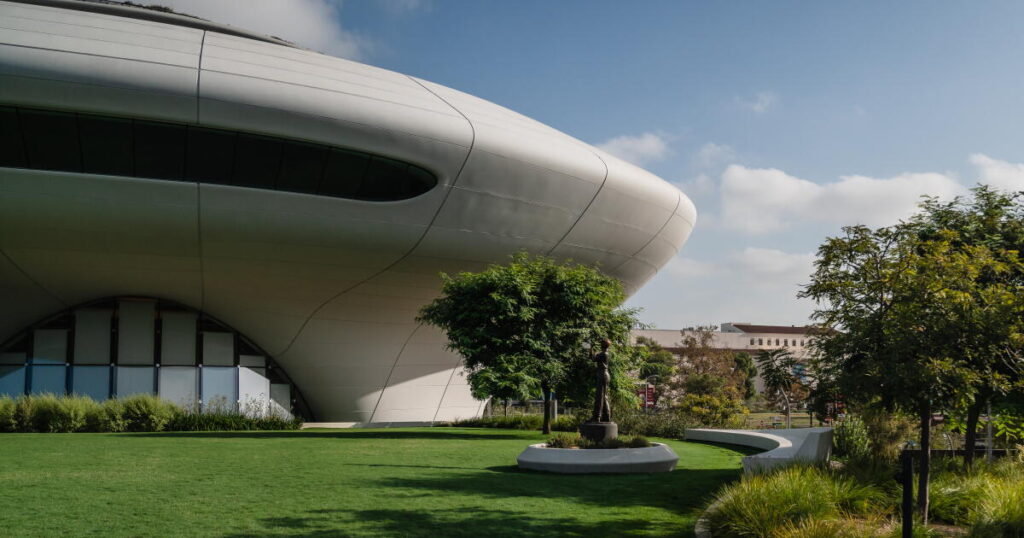
It certainly looks like no other museum on Earth. Architect Ma Yansong may have been inspired by the canopies of nearby plane trees, as he said in a recent preview tour, but the result is a 300,000-square-foot building that looks, as everyone knows by now, exactly like a spacecraft. One of the friendly ones, of course, a decommissioned mothership perhaps, here on a diplomatic mission.
Narratively, this makes perfect sense; George Lucas will always be best known for “Star Wars.” Architecturally too: In a town where the Getty’s hilltop compound can be reached only by tram; the Petersen Automotive Museum evokes speed with hundreds of hot-rod red steel ribbons; and the new Geffen arm of LACMA now spans Wilshire Boulevard like a questing amoeba — a spaceship is striking, but not out of place.
But if the building appears to predict a series of high-tech galleries, tricked out with holograms, audio spotlights or mixed reality rooms, the Lucas museum is surprisingly old-school. A large and impressive exhibit of “Star Wars” vehicles, costumes and other production treasures anchors the main gallery space (with a rope line already in place for the inevitable queue of fans) but those expecting a “Star Wars” museum may be disappointed.
An introductory ground-floor exhibit titled “the history of narrative art: Heroes, Myths, the Sacred” is as close as things get to modern tech. Though punctuated by a few actual or reproduced pieces of physical art, it mostly consists of a series of screens featuring high-resolution photos of prehistoric paintings from Spain’s cave of Altamira, as well as a procession of interiors, paintings, statuary and other works from far-flung places like the Louvre, the Vatican (including a room-size rendering of the Sistine Chapel), Versailles, the Hagia Sophia Grand Mosque and Pompeii.
The exhibit, which professes to illustrate storytelling through art in its earliest manifestations, is a jarring introduction to a museum that houses 1,300 original works. Like those immersive Van Gogh experiences, it’s kind of cool (and great for kids) but not actual art.
The actual art is a few stories up and something quite different.
There, following the enormous loop that defines the 100,000-square-foot interior, 30 galleries are filled with pieces either collected personally by Lucas and his wife and museum co-founder, Mellody Hobson, or purchased by the museum in keeping with their vision.
That vision leans heavily on popular 20th century cartoonists, illustrative artists and painters — including Norman Rockwell, N.C. Wyeth, Maxfield Parrish, Frank Frazetta, Thomas Hart Benton and Jessie Willcox Smith — as well as photographers and muralists.
Some of the spacious galleries feature a single artist (for Parrish fans, finally, a room of our own!), one is devoted to murals, another to architecture, but many are organized by themes rather than genre, period, place or, and this is important, prestige.
Thematic grouping of disparate work has become a popular, though not uncontroversial,trend. The Norton Simon Museum recently hosted “Gold: Enduring Power, Sacred Craft”; and the David Geffen Galleries at LACMA are, in part, mapped by the Indian, Atlantic and Pacific oceans, and the Mediterranean Sea.
The Lucas Museum chose themes that are more quotidian than bodies of water. Under titles including work, community, motherhood, sports and civic life, the diverse array of artists effectively underlines the essential nature of these experiences. Still, displaying O’Neill, the artist behind the Kewpie dolls (and this country’s first female published cartoonist) alongside a Van Gogh is not just an example of concept connection, it’s a statement that is equally inclusive and defiant.
For many, the refusal to acknowledge any kind of pecking order will feel fresh, fun, validating and/or thought-provoking. Others will undoubtedly find it infuriating, proof of a rapidly eroding culture in which art can be defined as good simply because someone likes it.
If nothing else, the galleries of the Lucas Museum appear designed specifically to make certain critics and connoisseurs roar.
Which is precisely what the great and much-missed former Times art critic Christopher Knight did, way back in 2017. When L.A. beat out San Francisco to become the museum’s home, Knight declared “narrative art”was “a made up category” designed to lend false coherence and gravitas to a wildly varied collection that mostly tracks “aspects of the birth and gestation of modern mass-media imagery.” He dubbed it “The Treacle Museum.”
It is certainly true that this particular spaceship carries a large cargo of American nostalgia. Many visitors will have first encountered some of the artists in vintage magazines, books and even advertisements, and much of the art is filled with wonder and hope. Many of the galleries are devoted to the type of work most often seen in “special exhibits” — children’s books, manga and the sci-fi/fantasy works of Frazetta.
Lucas is a believer in Joseph Campbell’s hero’s journey, an aspirational filmmaker who got to “Star Wars” via the success of “American Graffiti.” He started his art collection with an illustration of an “Alley Oop” comic, which now hangs in his museum, along with the work of comics and graphic story artists, including Charles Schulz (“Peanuts”), Garry Trudeau (“Doonesbury”), Hal Foster (“Prince Valiant”) and Mort Walker (“Beetle Bailey”).
He and Hobson have a particular taste in, and view of, visual art. As they have said in many places (including on the museum’s website), they are more interested in work that they believe evokes emotional connection and collective memory than, say, the evolution of Impressionism or the influence of Industrialism on the Arts and Crafts movement. Neither do they appear motivated to acquire pieces that bear no relationship to each other besides the designation “masterpiece.”
This is best exemplified by the predominance of Rockwell in the museum’s collection. A bit like Lucas (who never won a competitive Oscar), Rockwell was an enormously popular and influential artist who never achieved the critical stature or awards associated with “important” artists. (Rockwell himself commented on this in “The Connoisseur,” which is part of the Lucas Museum collection.)
It is also highlighted by the presence of one of Rockwell’s most important works, “The Problem We Live With.” Rockwell’s denunciation of racism, symbolized by U.S. Marshals escorting a 6-year-old Ruby Bridges to her newly integrated school, is showcased on a wall of its own, despite not belonging to Lucas or the museum. It is on loan from the Norman Rockwell Museum because, according to senior curator Ryan Linkof, Lucas could not imagine a Rockwell exhibit without it.
Lucas has said that his collection, and by extension his museum, represents “the people’s art,” a term that begs as much argument as “treacle.” Surely all art, from the “Mona Lisa” to the rooms of L.A.’s currently popular pop-up Hospital of Emotions, belongs to the people. Still, the subtext is clear — ”people’s art” refers, in certain instances, to artists who are more publicly beloved than critically acclaimed.
“Narrative art” remains a slippery term for a categorization of works, but the museum is certainly stepping boldly into art’s ongoing discussion: About what makes certain artists and their work good, bad, great or dismissable; what type of collection adds to the larger discourse, or deserves a billion-dollar building; what kind of experience visitors want from a museum and how those expectations should influence its curation — after all, even London’s Victoria and Albert Museum has, in recent years, devoted as much space to exhibits on video games than the style of Marie Antoinette.
The Lucas Museum purposefully and with no apology casts its net wide. “Star Wars,” comic book and fantasy fans may dominate the first wave of visitors, but it’s a museum that hopes to speak to everyone (even sports fans!). A captivating, welcoming and family-friendly space, with some jaw-dropping views, a cafe and a gorgeous rooftop fine-dining restaurant, not to mention an 11-acre garden, dotted with statuary and fountains. It is, in fact, on its own diplomatic mission: To make people think about art, and the world, a little differently than they did before they arrived.
Which is the narrative mission of museums in every galaxy.
The post Fresh or infuriating? Lucas Museum of Narrative Art defiantly breaks the rules appeared first on Los Angeles Times.