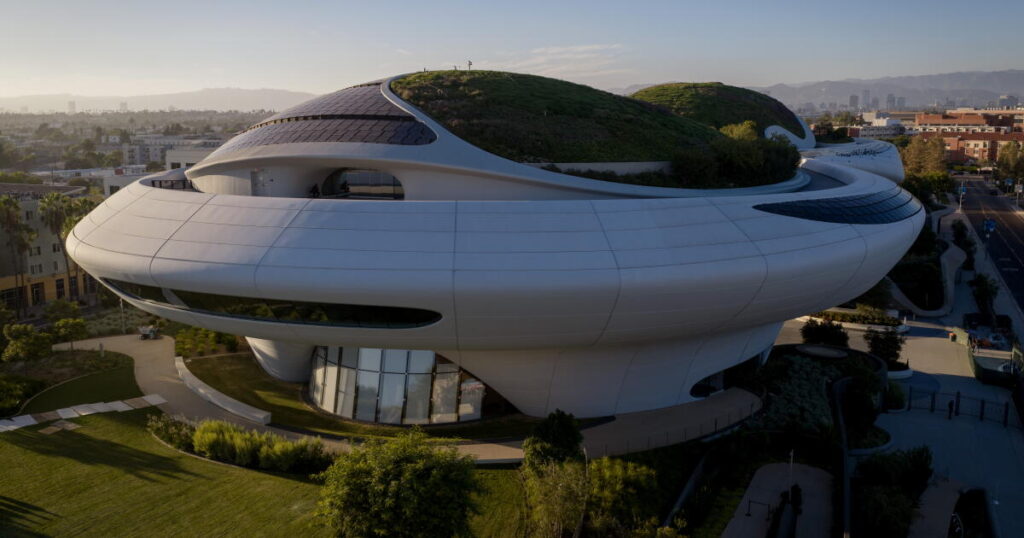
The first thing you notice when approaching the Lucas Museum of Narrative Art from afar is not its curved white shell or the bridge-like body that has long hovered in dreamlike renderings. You see green: a sloping crown of swirling grass rising above Exposition Park. For a moment, it looks as if a hill has appeared in the middle of Los Angeles.
That impression shifts, again and again, as you get closer. The long, glacial structure’s facade tightens, bends and twists. Its supports touch down like elephant feet, bolstering what could be a mammoth spacecraft, landing delicately next to the Los Angeles Memorial Coliseum. The building also reveals itself like a body: taut and contorting; bones and joints pressing up against skin. This evolving experience is theatrical enough that you can practically hear the music rising as you approach. But from certain angles, the edifice is just background, hard to register thanks to its sheer improbability; inviting a double take before you again grasp its startling futurism. It is a sneaky monument.
Designed by Beijing-based MAD Architects to house George Lucas and Mellody Hobson’s vast collection of narrative art, the more than $1 billion museum is among the boldest, most contradictory buildings this city has ever seen.
It’s synthetic yet organic, monumental yet welcoming, populist yet elitist. Its architecture conjures freedom and motion, but its galleries retreat into conventional rooms. It creates an extraordinary park, but fences and inaccessible surfaces weaken that generosity. It feels utterly foreign to its context, yet somehow it fits right in.
In other words, it is the epitome of L.A.
Contradiction lies at the core of this city: beauty and glamour set against belching freeways and heavy industry; Kim Kardashian and Spencer Pratt juxtaposed with Joan Didion and Charles Bukowski; one of the most ethnically diverse regions in the world dotted with homogenous enclaves like Bel-Air and Malibu. And our identity — built or otherwise — has always been tangled up with fiction: fantasy bungalows, Googie coffee shops, Egyptian movie palaces, giant doughnuts and outdoor malls made to look like small-town Main Streets. Story is our reality. Divorced from context is the context.
It only seems appropriate that this particular museum’s origin story is an epic in its own right. Lucas, launching his quest in 2010, cycled through proposed sites in San Francisco and Chicago — each meeting with hardened opposition — before landing on L.A. The city offered a site in Exposition Park, just down the street from USC’s School of Cinematic Arts, where Lucas first honed his craft.
Lucas’ selection of MAD to design his Chicago, and ultimately, Los Angeles museum, was a major plot twist. The firm’s fluid, natural-inspired structures are as fearlessly strange as the filmmaker’s previous building projects, including Skywalker Ranch, have been conservative. Founded by Ma Yansong, who is arguably the most recognized architect in China, MAD builds soaring, waterfall-shaped towers and boulder-like cultural parks, diving in and out of improbable man-made landscapes. In Chicago, MAD planned to create what looked like a billowing white mountain rising out of the pancake-flat plains of the Midwest.
The L.A. version retains Chicago’s core concept — a surreal, constructed landscape using thousands of tons of hidden engineering to conjure a shifting organic form. But it stretches it into a levitating, elongated shape: 700 feet long, 270 feet wide and five stories tall. The 300,000-square-foot building is carried by a dense web of steel beams, columns, trusses and outriggers, tightly skinned with more than 1,500 uniquely shaped, fiberglass-reinforced polymer panels. Its sides pinch inward near the ground before curving, mushroom-like, outward, making its upper body appear to float. These structural feats culminate at the building’s center, where arched steel beams span 185 feet over a public plaza — opening to Expo Park and the neighborhood — to frame a 90-foot-diameter oculus, floating four stories up.
Ma brings a happy zeal — and an artist’s eye for detail — to creating a sense of wonder, fantasy and futuristic freedom in a world limited by boring, rational constraints. That feeling courses through the structure, from its shifting, beckoning profile and gee-whiz glass elevators, to a grand waterfall, nicknamed “The Rain,” cascading from its north end. Softening curves embrace visitors and spark anticipation. Unique vantages — is that a giant hole in the roof? — alter any sense of normalcy. Oddness, and constant change, invite discovery — a kind of architectural storytelling that makes this an appropriate container for the narrative art inside.
Ma also employs built imagination as a tool to reclaim nature from our concrete jungle. He couldn’t have found a more appropriate site: 12 acres of surface parking that had severed much of its South L.A. neighborhood from Expo Park. The museum’s deep weaving of architecture and landscape is its most tangible triumph. Los Angeles has stories to spare — and it should share them. But what the city really lacks is softness, shade and rejuvenating green relief.
MAD, with the help of landscape architect Mia Lehrer’s Studio-MLA, has created a new piece of architectural topography which, counterintuitively, soars most when covered in dirt. Greenery becomes an artful layer, softening the building and giving it a sense of (literal) grounding that tech-adulating blobitecture often lacks. Wildflowers and sweeping fescue tangle atop the roof; soft pathways contour under, through and over built forms; green, tree-dotted slopes lend the museum’s striated podium a sense that it’s emerging, prairie-like, from the ground.
Flowing like a natural outgrowth from this elevated base, the superb park’s unique, interconnected sections take you on a rolling journey through California’s peerless mix of landscapes — foothills, valleys, mesas, canyons and meadows, all conjured over the museum’s underground parking. They are animated with flowers, grasses and trees, not to mention meeting spaces, fountains, hanging gardens and an amphitheater. From here the museum roof — half greenery, half solar panels — looms like a mountain, sloping down to the park via man-made foothills.
The museum plaza’s sweeping bridge creates a canopy of welcoming shade (inspired by Expo Park’s own trees), which the city — particularly this part — desperately needs. Its warped, gridded undersides conjure a “Close Encounters of the Third Kind” vibe (sorry, George) to give the plaza a dazzling, otherworldly energy.
Ma, like Lucas, evokes dreamlike scenography that heightens and shifts emotion through enveloping atmospheres. Despite a hail of criticism for the management of the museum — which has laid off more than 20 employees and seen its director, chief curator and director of public programs all leave — Lucas’ choice of Ma to design his museum seems apt.
Which is why it’s frustrating that the museum’s deepest disappointment resides where you might expect it to be most adventurous: inside its sprawling fourth-floor galleries. They feel safe in contrast to the exterior’s lunging arcs and muscular motion; MAD’s sense of daring and freedom limited to their periphery.
The architectural decisions here make sense in a vacuum. Long, parallel avenues organize the space into legible districts —lending order to the swirling movement — with the oculus serving as a useful center of orientation. Curved walls trace the building’s edges while exhibits are divided into 35 thematic spaces. Movable partitions and lighting grids allow the rooms and their extensive technical infrastructure to be continually rearranged.
But it feels too sensible. A safe, familiar exhibition system inserted into a gutsy, otherworldly context. Phenomenal energy, and the world outside, cocooned behind high-grade drywall. Art requires some neutrality to find its voice, but a building dedicated to the exploration of narrative shouldn’t stop exploring just when its storytelling begins.
The first-floor galleries, introducing visitors to narrative art via a hodgepodge of reproduced examples through the ages, are worse: a vague approximation of MAD’s sinuous language, performed with little of its finesse. This detachment from the overall concept makes you wonder if the museum’s constant turnover affected the teams working on interior and exhibition designs. Or if leadership got seduced by silhouette, movement and atmosphere, neglecting to marry the galleries to the overall concept.
Beyond these galleries the museum’s momentum returns, whisking you back to a realm of improbable mesmerizing encounters. Looking down from the steep glass enclosure wrapping the ethereal oculus is like peering down from a cliff. Smooth plaster tunnels extending from the gallery edges lead you, like portals to another world, to three respite-providing viewing points. Their sweeping glass, jutting forward, teleports you outside the site, cinematically reframing the immediate surroundings, and the city.
In the upper level‘s murals gallery, the roof’s steep, angular geometry can’t be suppressed, forcing the lighting grid to skew into a kind of mechanical sky — a unique spatial experience itself.
In the lobby, concave walls bend around you to create fluid motion; a sensation heightened by two banks of mysterious tubular glass elevators. These keep the space visually open while becoming a show in themselves: You can see visitors rising and falling, like commuters in “The Jetsons,” or take a ride yourself, the cavernous space constantly rearranging itself around you.
Two identical theaters flanking the lobby are galleries in their own right. Concentric circles of wedge-shaped acoustic panels diminish as they rise, creating a vortex overhead. Uplighting causes the dark panels to look like pillows, making the rooms feel soft and cosmic, as if the audience might be gently sucked into both the screen and the ceiling.
The education and research wing has its own entrance across the main plaza, with a yellow Naboo Royal N-1 Starfighter hanging from its lofty lobby ceiling. Its research library is a warm space anchored by a prow-like window wall, the garden extending to the horizon. But its dark wood and Arts and Crafts furniture — an ode to the library of Skywalker Ranch — is an awkward fit with Ma’s futurism.
Even that small miss captures another great symbiosis between Lucas and Ma. Both are craftsmen, interested in immediate emotional response over esoteric scholarly unpacking. Both draw on a kind of distant mythology, and forces (or just the Force) uniting humanity and nature, but conceal their intellectual machinery behind imagined worlds.
Lucas’ art collection, collapsing the distance between high and low brow, is a refreshing alternative to most museums’ academically approved fare. It taps into your core via fine art, sculpture and installation, but also comics, films, manga, children’s illustrations and animation. In the park, statues of Yoda and Jabba the Hutt layer the serene grounds with Lucas’ eccentric cinematic invention. Seeing Jabba from one of the museum’s overlooks made me laugh. This kind of showmanship, however corny, captures the democratic affection that people have for Lucas and his worlds.
This serves to highlight the museum’s other major disappointment: a spatial elitism that belies what is generally a populist museum. For now, you can’t wander over the museum’s sloping roof or walk atop most of its raised base, as the imagery of a walkable hill suggests. Rooftop event spaces that let you look over the city and stare down into the oculus are for now reserved only for private functions. The lovely Skywalker Grill’sterrace and planted overlooks, with views as far as downtown L.A., will be tied to that restaurant; mostly closed to those without a reservation.
While the museum effectively uses softness to connect its site, it does not reach out to its immediate surroundings in the same way. The lack of shade trees along the building’s perimeter are decidedly unfriendly. Much of the site meets the city through fences — and not very inspired ones at that. Even the softened base is fronted by dark gray walls, which are especially noticeable on the museum’s western, neighborhood side.
Like Disneyland, the Chinese Theater or any of L.A.’s invented wonders, the museum is most convincing when its fiction produces something real: energy, mystery, curiosity; shade, landscape, public space; welcome, accessibility and inclusiveness. It fails when it loses the link to its core generosity and creativity, in its galleries, on its walkable surfaces, and on its edges. And while the building is a breathtaking break from reality, a little more of L.A.’s improvised, scrappy texture might have made it feel less slick — grounding it in the city as well as the earth.
Still, this is not a building that should worry too much about fitting in. Strangeness has never been an issue in open-minded Los Angeles. Where the city can learn from Lucas is how the museum (mostly) creates coherence through landscape. Greenery has been the unifier in Southern California all along, yet we have chosen to disconnect this idyllic place with hardness and chaos.
Which puts a spotlight on the embarrassing disorder of Expo Park itself (despite valiant efforts from its current leadership, including a parking lot soon to be turned into a park near BMO Stadium). Across the street from the Lucas Museum, the greenery fronting the Natural History Museum is ripped up and trashed. Other approaches are scorched stretches of concrete begging to become soft, shaded connectors. Greenery is often stuck behind gates and around parking lots. Distinguished, and wealthy, institutions continue to behave like isolated compounds — a reflection of Los Angeles at large.
The Lucas Museum can’t make Exposition Park, much less Los Angeles, magically cohere. But descending from that fake hill reminds you of the museum’s most resonant narrative: the possibility of a softer, greener, more joined and generous city, alive to possibility. A fantasy made useful.
The post Lucas Museum of Narrative Art arrives as one of L.A.’s boldest, most contradictory buildings appeared first on Los Angeles Times.