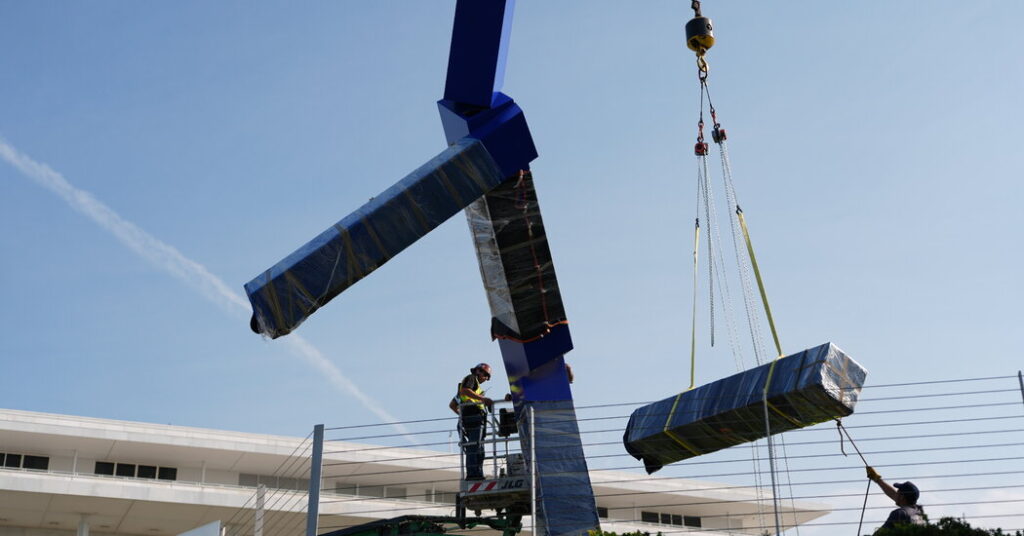
The John F. Kennedy Center for the Performing Arts began removing a major outdoor sculpture from the center’s grounds on Wednesday. The work, installed in 2019, was targeted for elimination after President Trump’s takeover of the center, according to internal documents obtained by The New York Times.
The Kennedy Center made no advance announcement of its plans to remove the towering, vivid blue metal sculpture of a stick-like human figure, called “Blue.”
On Wednesday morning, the limbs and torso of the figure were wrapped in protective material; an arm was the first to be removed.
The Kennedy Center confirmed in a statement on Tuesday that the sculpture was being deinstalled and that a foundation dedicated to the artist would determine its next location. It did not say the reason for the removal but noted that the deinstallation of artworks that had been donated or lent was common practice for conservation or preservation purposes.
A news release from around the debut of “Blue” describes it as a permanent sculpture for the grounds.
“We are deeply grateful to Joel Shapiro for the years ‘Blue’ has spent animating our campus and connecting visitors to his vision,” the statement said. “We are honored to have been stewards of his vibrant work and a part of his enduring legacy.”
Mr. Shapiro died in 2025. His daughter, Ivy Shapiro, who is president of his foundation, said in an interview that she thought her father would have been “alarmed” that the sculpture was being taken down from its intended location.
“In Joel’s mind, it was one of his greatest site-specific commissions, which celebrated joy, freedom and creativity,” she said.
Ms. Shapiro declined to discuss what she was told about the Kennedy Center’s reasoning for removing the sculpture. Her father had given it to the center as a gift, but she said that it was now owned by the foundation, and that she would like to see it installed at another public site.
The White House did not respond to a request for comment.
Josef Palermo, who was laid off in March as the curator of visual arts and special programming at the Kennedy Center, wrote in an essay for The Atlantic that he had been instructed to remove works from the center’s permanent art collection, and told that Mr. Trump’s renovations would include new art.
In an interview on Tuesday, Mr. Palermo recalled that “Blue” had been “targeted early on” and said he took issue with the lack of an announcement.
“The Kennedy Center,” he said, “is in effect holding these pieces in trust for the American people, and there should be a lot more transparency.”
The sculpture is on the grounds of the Reach, an addition to the Kennedy Center that opened in 2019. The sculpture was completed that same year by Mr. Shapiro, whose public art is found in cities around the world. One of his most prominent works is a tree-like bronze sculpture, called “Loss and Regeneration,” that is situated outside the U.S. Holocaust Memorial Museum in Washington.
“Blue,” which is visible from the Potomac and roads traversing the Kennedy Center, has become a local landmark. In a video about the work that was posted by the Kennedy Center around the time of its debut, Mr. Shapiro said he designed it so the figure would appear in different positions depending on the vantage point of the viewer.
“It’s about action and risk and performance and energy,” he said of the work. “It’s a celebration of possibility.”
The plans to remove the sculpture were met with anger from local activists protesting Mr. Trump’s politicization of the Kennedy Center, which have included installing his name over President Kennedy’s on the building’s facade. A federal judge ordered Mr. Trump’s name removed this year, and the president has been fighting ever since to restore it.
“First they came for the facade and now they come for the grounds,” reads a post on Instagram from Hands Off the Arts, composed of artists, former Kennedy Center employees and patrons of the center.
Mr. Trump has been critical of the Reach, a $250 million project that is the only addition to the Kennedy Center since its opening in 1971. The addition was largely funded by the philanthropist David Rubenstein, the Kennedy Center chairman who was replaced by Mr. Trump after the president installed loyalists on the center’s board.
In a court filing last week seeking to restore Mr. Trump’s name to the front of the Kennedy Center, lawyers for the president wrote that “just seven years ago, the Center named a substantial portion of its grounds, ‘The REACH,’ without a semblance of protest. Nobody had any idea what it even meant.”
The name is an acronym: Renew, Experience, Activate, Create and Honor, meant to reflect President Kennedy’s aspirational vision for the nation and the center’s goal of bringing the arts to a broad swath of Americans.
The post Kennedy Center Begins Removing Outdoor ‘Blue’ Sculpture appeared first on New York Times.