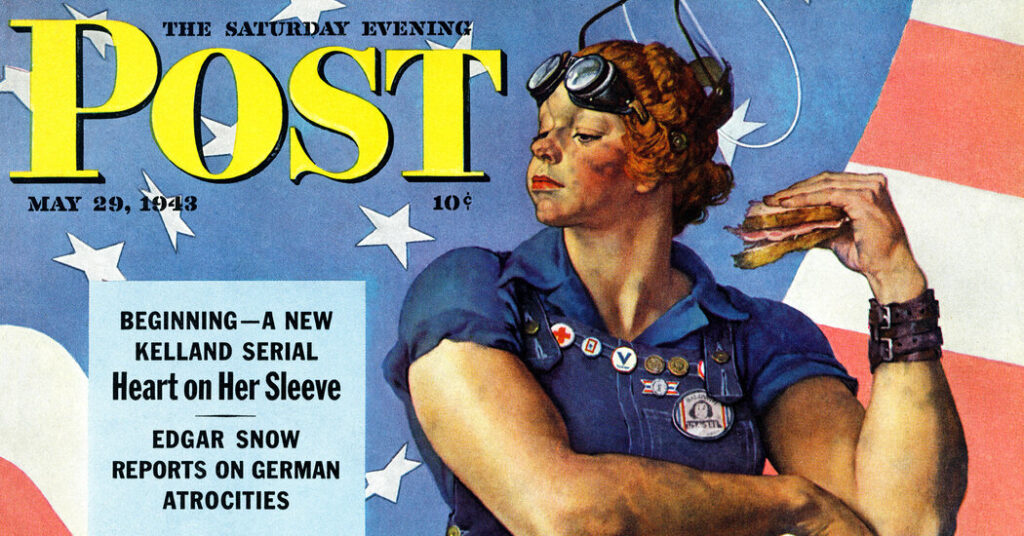
For more than two centuries, The Saturday Evening Post has chronicled American life in its pages, enshrining a homespun national identity and printing some of the nation’s greatest writers.
That’s changing next year.
The magazine’s January issue will be its last in print, according to Joan SerVaas, the president and publisher. In a letter to The Post’s 50,000 subscribers in the most recent issue, she attributed the decision to a combination of “rising production costs, declining advertising revenue and shifting reader habits.”
“We’ve been dealing with it for over a decade,” Ms. SerVaas said in an interview. “We continued hoping it would turn around or life would get better. Now we’re pretty sure it’s not going to get any better.”
The magazine, which debuted in 1821, will continue to publish new articles and fiction online.
Ms. SerVaas said she had decided to end the print edition because it was a financial drain on the Saturday Evening Post Society, which owns The Post. The archives, which will be preserved online contain news articles as well as poetry, fiction and art, including iconic images by Norman Rockwell.
The decision was painful for Ms. SerVaas, 72, whose father rescued The Post from financial ruin half a century ago. In 1969, the magazine stopped publishing after poor management decisions and fighting among shareholders left it destitute. Beurt SerVaas, a Midwestern millionaire, amassed a sizable stake in 1970 with his wife, Cory SerVaas, and sharply winnowed the magazine’s debt along with its staff.
Cory SerVaas, a journalist and a physician, revamped The Post, adding coverage on health and wellness issues. Imagining her parents’ reaction to her decision to discontinue the print edition, Joan SerVaas said, “I think about my mother a lot, because she would kill me. She would not be happy, but she would understand.”
Though many magazines have been depleted by the nosedive in print advertising, The Post has fallen from particularly stratospheric heights.
Its largest issue, a 272-page doorstop that published months after the 1929 stock market crash, weighed almost two pounds, according to a 1985 case study from Harvard Business Review. That issue alone generated $1.5 million — the equivalent of $29.2 million today — from 214 national advertisers, and required six million pounds of paper and 120,000 pounds of ink. Sixty 45-ton presses churned it out over three weeks.
In 1903, Jack London was serializing “The Call of the Wild” in its pages. Mary Roberts Rinehart covered World War I from the trenches. In the 1960s, Pete Hamill, a legendary New York journalist, chronicled Hollywood’s new era for The Post. Swaths of Joan Didion’s groundbreaking book “Slouching Towards Bethlehem” were first published by The Post.
There were also some low points. In 1942, a three-part series on Jewish Americans concluded with an article titled, “The Case Against the Jew,” resulting in the cancellation of subscriptions. The magazine apologized.
In 1967, a landmark lawsuit against The Post by Wally Butts, a former athletic director for the University of Georgia, helped solidify legal protections against libel even though the magazine lost the case.
The next year, in a business maneuver inconceivable by today’s standards, The Post cut its own subscription list in half, part of a bid to reach a more selective audience for upscale advertisers.
Ms. SerVaas has focused on digitizing the archives. In 2018, she and her team rolled out a new website that allowed readers to trawl half a million pages and roughly 3,500 covers. She remains hopeful that a new buyer might want to resurrect The Post, the way her family did decades ago.
“I want the best for the magazine,” Ms. SerVaas said. “I want it to continue.”
The post Saturday Evening Post Will Stop Printing After 205 Years appeared first on New York Times.