PROFITS, PROPHETS, COACHES, AND KINGS: (When) Do Leaders Matter?, by Jared Diamond
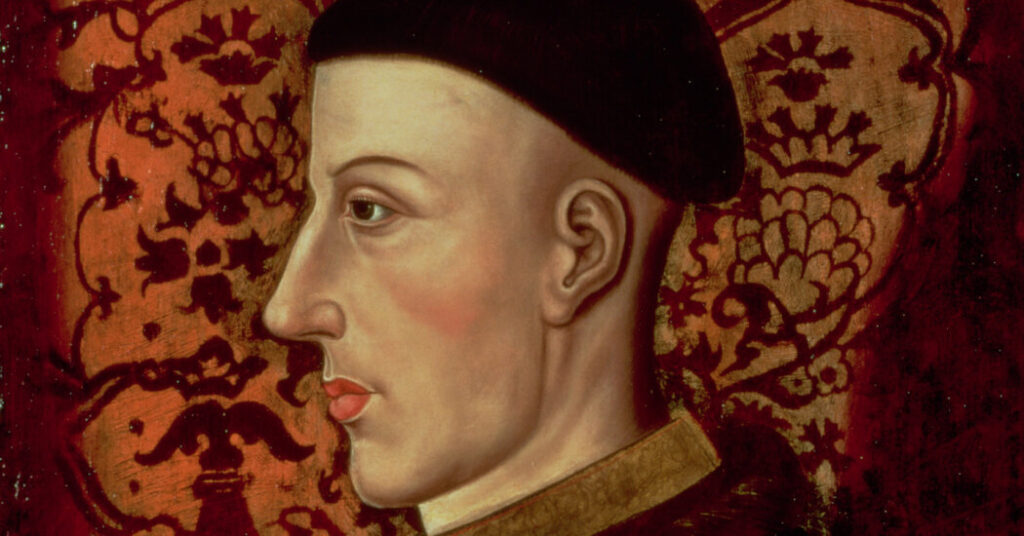
During a battle in 1403 the future King Henry V of England was shot in the face with an arrow. The arrowhead — an ounce of dirty metal — lodged six inches deep in his head. Yet thanks to a pioneering and risky piece of medieval surgery, Henry survived, and a decade later he succeeded to the English throne.
His reign was a roaring success. Henry restored law and order, united his nobility and suppressed heresy. In 1415 he led an army to a famous victory in the Battle of Agincourt. Later, Shakespeare gave him some of the finest soliloquies ever written in English. So what if the arrow shot at Henry in 1403 had penetrated half an inch deeper, or the surgeon’s hand had trembled? What if one of Henry’s three brothers had taken the throne? How different would English history have been?
The answer, if we extrapolate from “Profits, Prophets, Coaches, and Kings,” Jared Diamond’s new study of leadership, is: not much. The value added by leaders, Diamond argues, is often overrated, especially by their biographers. And while Diamond accepts that at certain places and times, one person can bend the world to their whim, for the most part, individual leadership matters only under special circumstances.
Jesus? He would have been just one of many Jewish sect leaders of his day, had he not had St. Paul to proselytize and the Roman Empire to finish the job. Genghis Khan? The mere beneficiary of heavy rainfall. Adolf Hitler? “Hitler’s own life before the age of 30 gave no hint of his subsequent qualities as Germany’s leader,” Diamond writes. “How, then, can we claim that no one else could have become the mature Hitler?”
How indeed? Figuring out how to separate historical forces from human agency has puzzled scholars since the days of Herodotus and Thucydides. And it is not surprising that Diamond should be drawn to the question. As an interdisciplinary scholar who has written on geography, anthropology and ecology, he is best known for theories that are agnostic about the individual. His best seller “Guns, Germs, and Steel” made a case for the role of climates and continents, rather than human actors, in shaping the modern world.
Still, people can change. Recent works such as “Upheaval” have softened his position somewhat, blending the structural with a person-led approach. Now, Diamond proposes a new tool for assessing leaders. Rather than using “the biographic method” of studying leaders in their own context, he suggests the “natural experiment.” Social scientists have used natural experiments — finding occasions where life allows them to run comparative data studies — to analyze things like the economic impact of the minimum wage. Diamond claims that natural experiments also have significant potential in political history, religious studies and sports.
The problem is, they don’t really work. Diamond is a wonderfully likable and curious writer — as enthusiastic about public health policy as he is about baseball. But at almost every turn his book runs into the shortcomings of its own methodology.
Let us return briefly to the case of kings. Diamond’s natural experiment method for assessing the impact of monarchs leans on royal inbreeding. He assumes inbreeding is a direct indicator of mental impairment. Then he cites research showing that the inbreeding of a ruler correlates inversely with territorial expansion. He adds that the research also shows that the fewer restraints a monarch experienced on their power, the more important their intelligence was in shaping political outcomes. Et nous voilà: “This natural experiment shows that political rulers do, on average, make a difference.”
This blending of the tenuous and the obvious is as far as the adventure goes. Can the natural experiment help us figure out the historical effect of a president being assassinated — or narrowly escaping such a fate? Not really. “If a leader dies, the next leader might be either better or worse, so the average result is no change.” However, things do tend to change in the years after a leader dies. “That is, leaders do make a difference — either for better or for worse.”
Vacillation — less historical meditation than thoughts in the tub — permeates the text. Diamond tries to use his sociological insights to proclaim surprise candidates for historical pre-eminence. But the net effect is bathos. Seretse Khama, who led an independent Botswana to prosperity between 1966 and 1980, is an example of a leader “who clearly made a difference,” although he was, Diamond observes, helped by the timing and place of his ascent to rule. Meanwhile, Winston Churchill and Charles de Gaulle are given some credit for defending the free world, but in their cases good timing means we must be cautious in awarding them too much praise.
Likewise, the Amazon founder Jeff Bezos is lauded for his influence over commerce in the internet age, but his achievement is set alongside that of a couple in California who helped turn pomegranate juice into a mass-market drink, though Diamond acknowledges that the expanded availability of pomegranate juice “doesn’t approach” recent innovations in technology “in worldwide importance.” The careers of religious leaders including Jesus, Muhammad, Joseph Smith and Jim Jones are described. But Diamond’s frameworks get us nowhere here, and he limps to the conclusion that religious leaders should be charismatic and organized and coexist with an economic or demographic engine for success.
Diamond has more to say about sports — where the opportunity to use natural experimentation does seem clear. But even here he fumbles his data. He writes of soccer coaches in the German Bundesliga that the difference between a good coach and a terrible coach is “only 0.3 points won per game.” Only? In fact, 0.3 points per game is a big difference. In the 2024-25 season, it would have taken a German club from ninth place to third in the championship.
Sadly, it is hard to come away from this book feeling anything more than nonplused. Diamond is always a fun time, and over the decades his writing has shaped the popular history field in a way that must be considered a unique personal achievement rather than a historical-structural event. But other writers have considered leadership in greater depth and with a clearer sense of what they are trying to demonstrate.
To take just one example: Henry Kissinger’s 2022 book “Leadership” examined “leaders who, in the unending contest between the willed and the inevitable, understood that what seems inevitable becomes so by human agency. They mattered because they transcended the circumstances they inherited and thereby carried their societies to the frontiers of the possible.” That book, rather than Diamond’s uneven joining of unjoinable dots, is a better place for would-be leaders to begin their education.
PROFITS, PROPHETS, COACHES, AND KINGS: (When) Do Leaders Matter? | By Jared Diamond | Mariner | 281 pp. | $32
The post What Is It About Jesus Christ and Genghis Khan? appeared first on New York Times.