PITTSBURGH — Most die-hard NFL fans think they have a good idea of what defines Aaron Rodgers. Many of them would be wrong.
The 42-year-old former Green Bay Packers star is winding down his career as quarterback for the Pittsburgh Steelers, and some are wondering — in part because he’s also something of a political lightning rod — what comes next.
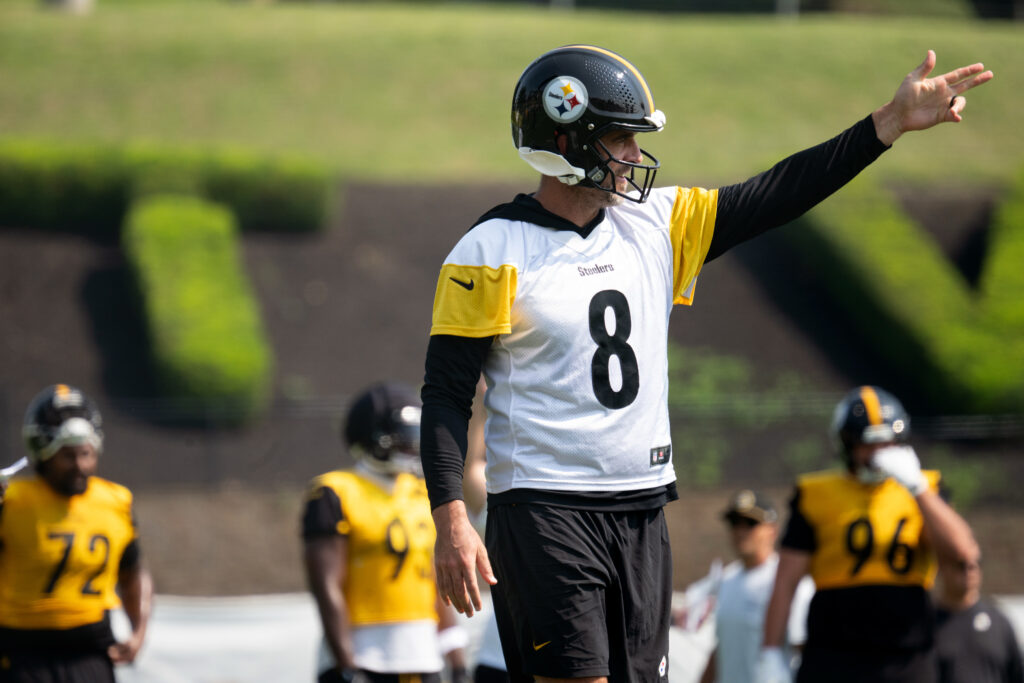
“Something that has meaning that impacts lives not just on the field but off the field as well,” Rodgers told me last month while sitting on a bench at the Pittsburgh Steelers practice field.
Politics? A run for office?
Two-and-a-half years ago, Robert F. Kennedy Jr. confirmed Rodgers was among the leading prospects to be his running mate during his independent campaign for president. Despite admiring Kennedy, Rodgers wasn’t willing to give up football to be on the ticket.
Three weeks after he expressed unequivocally how he felt about Anthony S. Fauci and covid vaccines — taking a swipe at the retired government scientist for pleading the Fifth Amendment during a Senate hearing in July — Rodgers flashed a broad smile, laughed and answered about potentially running for higher office: “No. No. Definitely not politics.”
For more than two decades, the nation has watched a kid from modest roots in Chico, California, navigate the twisting road of sports stardom. Rodgers went from a junior college standout to a quarterback at the University of California at Berkeley. He spent three years in Green Bay holding a clipboard behind an unyielding and aging Brett Favre. When his moment finally came, he earned four MVPs and a Super Bowl title.
In the dormitories at Saint Vincent College, where the Pittsburgh Steelers disappear each summer for training camp, Rodgers said he has found something that an NFL game, with its four 15-minute quarters, lacks: time.
Time to sit. Time to play cards. Time to get ice cream. Time to talk — something he has been soaking in, knowing it is his last year in the NFL since announcing in May that he would retire after this season.
“There is nowhere to go,” Rodgers said of the three weeks of training camp at Latrobe that ended Aug. 17. “So what do you do? What do guys do in 2025 and ’26 when there’s nothing different? Do they stay and scroll on their phone for an hour? Do they isolate themselves? Or do you actually get a chance to have some real meaningful conversation and spend time with each other?”
For Rodgers, entering his 22nd season in the NFL, those conversations have become as important as touchdown passes. He has occupied nearly every role football can assign a quarterback, from understudy to aging star and, now, the man responsible for ensuring that the next young signal-caller does not have to learn the hardest lessons alone.
“I always looked at it as a responsibility to pass on the knowledge that I learned to those guys,” Rodgers said. That word, “responsibility,” comes up often when Rodgers talks about the young men around him. It is the organizing principle of the player behind the public caricature.
The public knows Rodgers’s arm, the awards and the headlines. But the portrait often leaves out what emerged in our lengthy conversation: his intellect, sharp historical curiosity and ability to connect people and places across generations.
Rodgers scored 1310 on his SATs and attended a university long associated with intellectual independence and rigorous thought. He does not present intelligence as theater. It surfaces in the details he retains, the questions he asks and the way he sees football as more than a game.
His mind moves easily between the mechanics of a zone defense, the institutional memory of a franchise, the economic traps awaiting young athletes and the civic history of places that have shaped him.
It is why Latrobe matters to Rodgers.
Saint Vincent College is not simply a quiet campus where the Steelers hold training camp. It sits in a corner of western Pennsylvania where faith, football and history overlap.
The Benedictines established Saint Vincent in 1846. Latrobe occupies a singular place in football history: In 1895, John Brallier was paid $10 to play quarterback for the Latrobe YMCA, making him the first football player to openly turn pro when he accepted the money to play against the Jeannette Athletic Club.
It is not difficult to understand why the place registers as hallowed ground for Rodgers, a quarterback attentive to lineage.
The Steelers have returned to Saint Vincent for generations, carrying players out of the polished, private world of the NFL and into dorm rooms and long evenings without much escape. Rodgers sees the ritual not as quaint but essential.
“I love that Mr. Rooney insists on us doing that,” he said, referring to Steelers president and majority owner Art Rooney II. “I love the setup because you’re in a dorm room back in college.” And that means they have to share things. “I shared a bathroom both years with DK Metcalf and got to know DK at a more intimate level, which is great,” Rodgers said, laughing.
But that is the point: Training camp in Latrobe is not designed for comfort. It is meant to reveal people.
Rodgers remembered the value of Packers camps, when Green Bay stayed at a small Catholic college and players were removed from their routines.
The evenings in Latrobe are spare, stripped down: “You play cards, you play games, you talk,” Rodgers said. “You have a snack, you have some food. We went to some creameries to get some ice cream.”
In a league driven by measurements — speed, arm strength, completion percentage, contract value — Rodgers is drawn to what cannot be quantified: trust, shared discomfort, memories and friendships that remain when a career ends.
“If all you ever get out of this game is money and accolades, you really miss it,” he said. “The real gist of what we’re doing is that we’re building lifelong friendships based on shared experiences, shared responsibilities that connect us in a way that you can’t share with other people who haven’t gone through it.”
Rodgers recognizes the emotional complexity of being the heir apparent because he was one in Green Bay. When the Packers drafted Rodgers in 2005, Favre was the established star. Rodgers now better understands Favre’s position, especially after Green Bay drafted Jordan Love to replace Rodgers in 2020.
But understanding does not mean rewriting the experience.
“He wasn’t the mentor that I was hoping that he would be,” Rodgers said of Favre. “My expectations were X, and what I got was watching him and learning from him through observation. And it was invaluable for sure.”
Favre was distant. Prickly. Rodgers chose a different model.
“I always thought that if I had the chance to do it, that I could be way more hands-on,” he said. That chance arrived with Love, who has praised Rodgers and acknowledged his mentorship. It has continued in Pittsburgh with young players such as quarterback Will Howard, whom Rodgers described as “so just hungry to learn.”
After practice at Latrobe, Howard described Rodgers’s mentorship not as a performance reserved for meetings or the practice field but as a daily habit of inclusion. Howard said Rodgers is not “a me guy,” content to shut the door of a dorm room and let the younger players find their own way. “He’s out playing cards, he’s talking to people, he’s eating dinner out under the tent,” Howard said. “He’s just a normal guy.”
Rodgers’s way into conversations is not authority. It is admission.
“The greatest icebreaker is being able to start with your own faults and your own mistakes,” he said. “I think a true big brother, a mentor, whatever it might be, is someone who can first admit that it’s okay to make mistakes — because I’ve made the same mistakes.”
Drew Allar, one of the quarterbacks who could become the next starter, said he grew up watching Rodgers and had high expectations for him, but the star exceeded them. The mentoring reaches into the uneasy territory that comes with becoming a public figure: fame, money, media scrutiny and the pressure to answer immediately when something in football — or life — is going badly. Rodgers has urged Allar to pause.
“Just take a deep breath and really think about your answer,” Allar said Rodgers has told him. “Just don’t go out there just saying stuff that you want to say. Be very thoughtful with your response.”
It is advice born of Rodgers’s own mistakes. Allar said Rodgers has spoken about moments in his career when he learned, the hard way, how quickly an ill-considered public response can haunt a player.
His public responses about government overreach during the covid-19 pandemic earned him intense backlash. In 2021, Rodgers told reporters he was “immunized” against covid, which some took to mean he had gotten the vaccine, though he had not. ESPN reported in 2024 that Rodgers told author Ian O’Connor that he regretted using the word “immunized” to describe his status in 2021, stating that he should have been clearer about his immunization status and vaccine allergies instead of giving critics ammunition to attack his credibility. The subsequent media firestorm led to Rodgers defending his choice, saying, “I realize I’m in the crosshairs of the woke mob right now.”
Rodgers talks about football with a quarterback’s precision. He talks about life after football with the urgency of someone who has watched the transition break people.
He begins with financial literacy because he wishes someone had pushed him harder on the subject.
“Being an adult in our position is learning who your accountant is and learning about accounting and learning about taxes,” Rodgers said. “Getting to know who your lawyer is and learning about issues that he has to deal with. And getting to know your financial manager and learning about financial literacy.”
He tells young players to ask questions that can sound almost too ordinary for men who have suddenly become extraordinarily wealthy.
What is a stock? What is a bond? How is my money being invested?
“I didn’t do that the first seven years of my career,” Rodgers said.
He does not talk about retirement merely as someone arranging a business portfolio. He talks about it as someone preparing for a different form of responsibility.
“My next chapter in my life is fatherhood,” Rodgers said. “We are not expecting yet, but I cannot wait to be a father.”
Rodgers understands Pittsburgh’s relationship with the Steelers because he sees what the team has meant for the region.
It was never only football.
The modern idea of Steelers Nation hardened into something permanent in the 1970s, when the Pittsburgh region began to lose its industrial foundation. Between 1975 and 1980, the Steelers won four Super Bowls. Over the same period, the American steel industry faltered under global competition, changing markets, shuttered mills and a new economic order that left western Pennsylvania exposed. The trauma was particularly acute in the early 1980s, when the region lost roughly 95,000 manufacturing jobs.
Families separated as fathers and husbands left the area looking for work. Neighborhoods and business districts struggled. Schools closed or consolidated. Young people moved away after high school and college because staying no longer held the promise it had for their parents and grandparents.
Yet every Sunday, the Steelers remained.
“The team was built in the image of the place: gritty, physical, underestimated and durable,” Rodgers said. “Terry Bradshaw, Franco Harris, Joe Greene, Jack Lambert, Jack Ham, Mel Blount, John Stallworth, Lynn Swann and their teammates did not erase the pain unfolding in the mills and river valleys. But they gave people something dependable to rally around while much of the old economic world was being dismantled.”
The Steelers became a connection for people who had scattered across the country. A black-and-gold jersey or a Steelers game on television in a bar in another city offered an immediate connection to home. It was a shared identity built on memories, pride and a refusal to be embarrassed by where one came from.
That is the deeper foundation of Steelers Nation.
Rodgers said it is not simply a fan base created by championships. It is a community held together by persistence. “Winning mattered,” he said. “But the Steelers came to stand for more than winning. They reflected how Pittsburghers understood themselves: work hard, take the hit, stay loyal and get back up.”
The post ‘The next chapter’: For Aaron Rodgers, it was never only football appeared first on Washington Post.