
Errol Flynn was poised for one more getaway.
On the screen, in a series of daredevil adventures, the actor had extricated himself from a hundred impossible predicaments. He had escaped a Confederate prison and the Spanish Inquisition, Nottingham Castle and Nazi Europe. He had survived bandito ambushes and cutthroat plots, shipwrecks and crash-landings and high-sea duels. He was a close-call specialist.
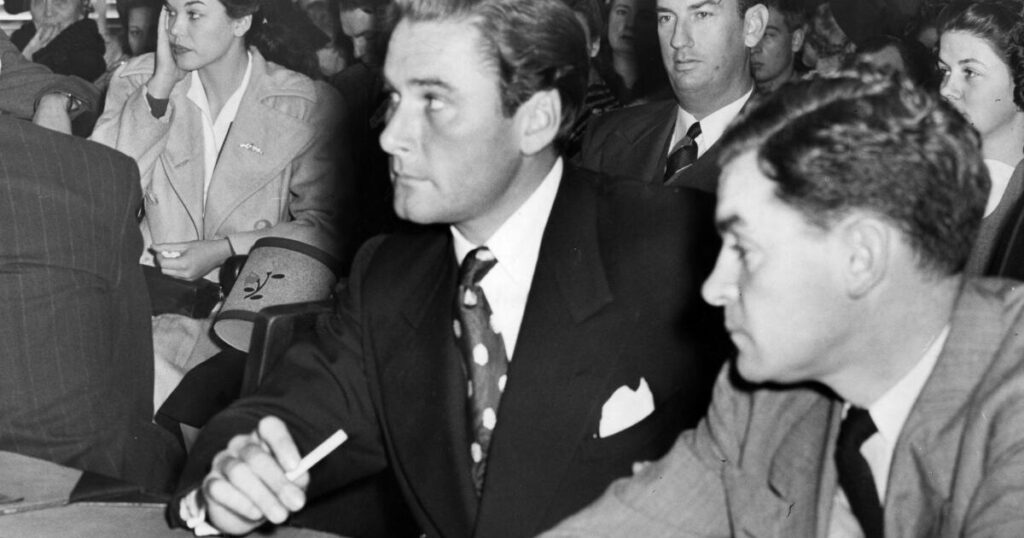
Now, in early 1943, the 33-year-old Flynn — the country’s biggest movie star — was plotting his flight from the American justice system. He was on trial in Los Angeles, charged with the statutory rape of two teenage girls. He had the best defense attorney his fortune could buy, but he was taking no chances. Mexico waited.
“I had no intention of going to jail,” Flynn would write in his memoir. “My two-engine plane was out at Burbank, waiting, so that if I got a bum rap, I’d get out there, hop in, and leave America and my screen career forever.”
Born on the Australian island of Tasmania, Flynn had an uncommonly colorful background, which he recounted with self-mythologizing verve in his memoir, “My Wicked, Wicked Ways.” As a young man, by his account, he smuggled diamonds, oversaw coconut plantations, dynamited fish, captained schooners and hunted killer cannibals in the New Guinea jungle.
It was common to say that his hell-for-leather personal life bled into his film persona. He became an international superstar in 1935 in “Captain Blood,” as a wrongly accused doctor who escapes slavery and takes up piracy. In 1938, he brought a jaunty brio to “The Adventures of Robin Hood” that forever defined the character.
When World War II hit, Flynn tried to join but was deemed 4F, or unfit for service; despite his on-screen athleticism, he had tuberculosis and a bad heart. Instead, he made war films and lived a life of epic drinking and outsize debauchery at his 11-acre Mulholland Drive estate.
It was there in late 1942 — the same year he became an American citizen and signed a nine-picture deal with Warner Bros. — that two plainclothes LAPD detectives came for him.
In the argot of the day, Flynn faced “morals charges” carrying a possible five-year prison term. The mother of a 16-year-old girl, Peggy Satterlee, had tried to press charges the year before on the claim that Flynn had twice forced himself on her daughter aboard his yacht, the Sirocco, while it was anchored off Catalina Island.
The case was dropped, then revived when a new district attorney won office and learned of a second accuser —a 17-year-old named Betty Hansen who said the actor had coerced her into sex at a Bel-Air party after plying her with liquor.
The actor’s defense: that the girls were scheming, sexually experienced opportunists looking for a foothold in Hollywood.
“These girls, who were just teenagers, were brutalized in the trial,” Flynn biographer Patricia O’Brien recently told The Times. “They were treated as the criminals. They were treated as the predators.”
Flynn’s attorney, Jerry Giesler, had become famous defending Alexander Pantages, the theater-chain mogul, on a rape charge. The attorney “had sort of written the playbook about how to demolish any case against these men,” said O’Brien, author of the recently published “Errol Flynn: The True Story of Australia’s Hollywood Icon.”
The trial hinged on “this massive contradiction, that everything in the girls’ sexual history, which was very short, was incriminating to them,” O’Brien said, while nothing in Flynn’s long record of reckless promiscuity was deemed relevant.
Satterlee, described in Times coverage as a “brunette Hollywood showgirl” and “the pretty complaintant,” was forced to admit on the stand that she’d had an “indiscretion” with another man that resulted in an abortion.
Along with the stigma this created, the tactic allowed Flynn’s defense to claim she had cooperated with prosecutors under threat of a criminal charge for what the newspaper delicately called the “illegal operation.”
Today, mainstream news organizations typically do not name accusers in sexual assault cases, much less photograph them in court. Not so in 1943. While Flynn was careful to maintain a solemn courtroom persona, Satterlee and Hansen were caught smiling for the camera.
“They’re just really naive girls who are way out of their depth, and that really shows on every level,” O’Brien said. “You can just imagine these guys wanting to get photos and asking them, ‘smile for us,’ or ‘pose for us.’ And then they did, and then it gets published and it looks really bad.”
During the four-week trial, female fans besieged Flynn. Thousands of letters poured in supporting him. Warner Bros. rushed his films to the screen to make the most of the publicity. Americans fighting overseas followed the trial avidly on the radio.
In his memoir, Flynn portrayed himself as a victim of political corruption. Warner Bros., by his account, had failed to pay the necessary protection money to the powers that be in Los Angeles, and the prosecution of its biggest star was the result.
“Those poor girls were pawns in the local political wrangle as much as I was. They were being drained and wrung out and so was I,” Flynn wrote.
Flynn biographer Jeffrey Meyers endorses the view that power politics and corruption fueled the case. Flynn was being punished for his “reckless personality and defiant way of life,” Meyers writes in “Inherited Risk: Errol and Sean Flynn in Hollywood and Vietnam.”
“He was very well-connected through all his admirers and friends, and he thought he could get away with anything, and he usually did,” Meyers told The Times recently. “So here’s a very high-risk man who not only took chances, but liked taking chances to see how much he could get away with.”
Even as he was on trial, Flynn was secretly living with an 18-year-old actress. “Instead of being cautious, [he] does something that’s really wildly reckless and could get him into trouble at any time,” Meyers said. “His friends warned him and he said, ‘No, nobody will find out.’”
What’s more, Flynn became infatuated with another 18-year-old, Nora Eddington, who worked at the cigarette-and-snack counter of the criminal courts building where he was standing trial. He invited her to his Mulholland house, gave her champagne and began seducing her. (She would become the second of his three wives.)
The language of the law was clear enough. Prosecutors had to prove that Flynn had had sex with girls under 18 who were not his wife. Whether they’d consented was not supposed to matter.
Flynn took the witness stand in an oxford gray suit and categorically denied having sex with either of his accusers.
If jurors believed he had, the defense suggested, the girls had been willing participants.
“Set Flynn free, and return him to Hollywood as one of its brightest stars,” Giesler argued.
“He has used his great acting ability for reprehensible purposes,” prosecutor Thomas Cochran countered.
The defense had stacked the jury with a demographic they suspected would be sympathetic to Flynn — older women — and he was acquitted, amid courtroom cheers. Flynn canceled his flight to Mexico and extolled the justice system that he had been ready to cheat as a fugitive.
“I might have been as guilty as hell — under the law, that is,” Flynn would write, but “everybody knew that the girls had asked for it, whether or not I had my wicked ways with them.”
Flynn praised Giesler’s courtroom prowess, writing: “He claimed that of all the witnesses he had, I made the best. What he meant by that I still can’t figure out: maybe he meant I made the most skillful liar under oath?”
The trial was a snapshot of community attitudes in 1943, some of which shocked O’Brien as she researched her book. In remarks to the press after the trial, the female jurors — who were old enough to be the girls’ mothers — demonstrated “zero sympathy” for them.
“Some of the harshest treatment of these girls was from other women, and that is something which I found very hard to reconcile,” O’Brien said. “There was an extreme harshness, and a lot of that is about class as well, because the two girls in question came from poor families.”
After his acquittal, “In like Flynn” became a popular byword for sexual conquest. The actor complained that for a time, he was “relatively ostracized locally.” People ignored his party invitations. But “with one or two box-office successes I was completely restored in the Hollywood community,” he wrote.
He appeared in dozens more films. The trial had not tarnished his marketability, nor, seemingly, had it checked his behavior. In his late 40s, he met a 14-year-old actor named Beverly Aadland. His sexual relationship with her lasted for years and was not a secret — behavior that was brazen enough to alienate some of Flynn’s friends and supporters.
At one point, Aadland would recount, Flynn was approached to star in a film adaptation of Vladimir Nabokov’s novel “Lolita.” He would play Humbert Humbert, the cultured pedophile who begins raping his stepdaughter when she is 12. Flynn would not take the role, however, unless Aadland was cast as Lolita. It didn’t happen.
“So many of Flynn’s films are supposedly his life being imitated in art, and that was kind of like the last instance of that, in a very sordid way,” O’Brien said.
When a heart attack killed the 50-year-old actor in Vancouver in October 1959, the Times headline abandoned all restraint to convey the magnitude of the loss: “ERROL FLYNN DIES!”
He was in the company of Aadland, then 17, whom the newspaper euphemistically called “the latest in a series of youthful proteges.” The actor had recently told reporters, “I like young women because they give you a feeling of youth.”
The obituary described Flynn as “an adventurer with a penchant for fighting and romance.” It noted that he had punched a Hollywood gossip columnist, kicked a New York cop in the shins and been in fights in Havana, Nassau and Rome. The rape trial was mentioned but the overall portrait was of an enviable, high-spirited rake.
Flynn’s reputation was damaged posthumously, however, by allegations in Charles Higham’s “Errol Flynn: The Untold Story,” a 1980 book claiming that the actor had been an antisemite and Nazi operative. The book pointed to Flynn’s longtime friendship with an Austrian tropical medicine doctor who did become a Nazi spy.
The book alleged that Flynn lobbied to shoot his 1941 film “Dive Bomber” on location at the U.S. Naval yard in San Diego, with the aim of exposing sensitive military installations to the enemy.
The claims have since been convincingly debunked. When the comedy “My Favorite Year” hit screens in 1982, starring Peter O’Toole as an aging, epically soused Hollywood actor trying to reclaim his courage, it could be seen as the Jewish community’s defense of Flynn.
Based partly on Flynn and executive produced by Mel Brooks, it’s an affectionate portrait of an over-the-hill rogue told from the point of view of a young Jewish comedy writer who idolizes him.
“The Jewish community sort of buoys him up and brings him back,” O’Brien said. “It’s a really interesting commentary on that.”
O’Brien sees the Nazi allegations as falsehoods that steal attention from the actor’s actual sins.
“Since it came out, people have been focused on Errol Flynn and basically canceled him because he was antisemitic and a Nazi, which wasn’t true, but forgotten the other things about him which were true — that he was heavily involved in some very nefarious aspects of Hollywood to do with young girls,” she said.
Sources for this story include “My Wicked, Wicked Ways: The Autobiography of Errol Flynn”; “Errol and Sean Flynn in Hollywood and Vietnam” by Jeffrey Meyers; “Errol Flynn: The True Story of Australia’s Hollywood Icon” by Patricia A. O’Brien; and Times archives.
The post Errol Flynn had a penchant for underage girls. His trial barely tarnished him appeared first on Los Angeles Times.