Last month, after a 14-year-old boy gunned down six people with his grandfather’s pistol at school in central Thailand, Kanyaphat Kanphuwanan, the director of a high school in Bangkok, imagined a similar horror unfolding on her own campus.
“How would we have managed it, and how would we prepare our children and our teachers?” she recalled thinking.
That question reverberated widely in the wake of the shooting, which also wounded nearly 30 others and was the country’s deadliest since 2022. As the government vowed to tighten gun laws and instructed schools to strengthen security, anxious parents demanded that Ms. Kanyaphat’s employer — the Bodindecha (Sing Singhaseni) School — implement active shooter drills to prepare their children for the worst.
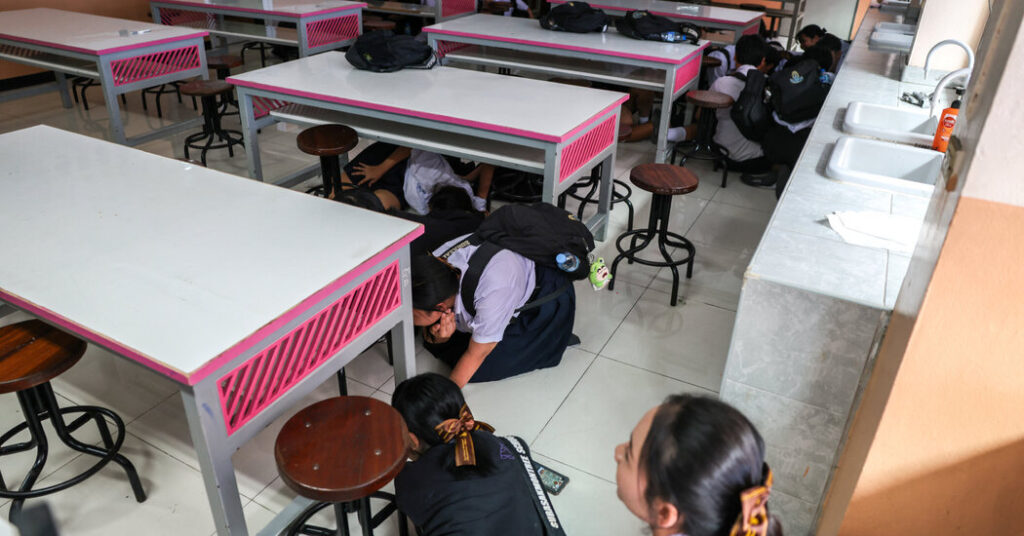
She did not need much convincing. Just 10 days after the school shooting in August, a tactical police unit with real-life active shooter experience was brought in to conduct an all-day “run, hide, fight” drill for the school’s 4,000 students.
Since the Columbine High School massacre in 1999, active shooter drills have become standard practice at schools and universities across the United States, even as some critics have questioned their effectiveness. Now they are increasingly in the spotlight in Thailand and the Philippines, where recent outbreaks of gun violence have sent school and government officials on desperate searches for solutions — searches that in recent weeks have veered in different directions.
These drills are not new to Thailand, which has one of the highest rates of civilian gun ownership in Asia and has experienced a string of mass shootings in recent years. But Col. Kiattichai Kerdchok, the superintendent of a police station in the central province of Suphan Buri, said that primary schools were now beginning to follow suit, in addition to schools with older children.
“The teachers ask more questions than before,” he said. “Before the episode, they didn’t pay attention during drills and weren’t very interested. But now they want to know how to survive.”
In the Philippines, where nonpolitical gun violence has been comparatively rare despite the country’s high rates of gun ownership, two school shootings this year have spurred officials into action.
After two teenage shooters killed three people at a high school in the city of Tacloban in June, school administrators began piloting drills modeled on the principles of “run, hide, fight,” an active shooter protocol developed by the city of Houston and the Department of Homeland Security in 2012.
Appetite for these simulated exercises surged after another school shooting in August in Zamboanga City, where the attacker livestreamed an assault that left one dead before turning the firearm on himself.
“Schools are desperate,” said Lt. Col. June Abrazado of the police, who helped run one of the first pilot drills in Manila this year. “I attended a P.T.A. meeting recently, and most parents’ concern was holding drills so the kids know what to do.”
But realistic active shooter simulations have also come under increasing scrutiny in the country, with some critics arguing they may do more harm than good.
The shooting at the junior high school of Ateneo de Zamboanga University in August seemed to illustrate the point. The school was one of the first in the country to implement active shooter drills after the attack in Tacloban. But Beng Climaco, the vice mayor of Zamboanga City, told local news media that some students on campus had mistaken the real gunfire for a planned drill.
Doctors’ groups have argued that there isn’t enough evidence that realistic active shooter exercises help improve safety outcomes, prompting the Philippine Department of Education to postpone the nationwide drills it had planned for late last month.
“Simulated active-attack exercises expose learners to hyper-realistic scenarios of violence,” the Philippine Psychiatric Association and the Philippine Society for Child and Adolescent Psychiatry said in an open letter last month. “Multiple studies demonstrate that they can cause lasting psychological harm across age groups.”
Citing U.S. research that advises against high-intensity shooter simulations and deceptive practices in such drills, the letter instead proposed tabletop exercises in which students and teachers can mentally rehearse their responses to an attack.
Since then, the police have received new guidelines for drills, Colonel Abrazado said, adding that they would no longer feature prop guns or actors playing shooters.
“We have to understand other people’s views, especially the parents who, as much as they want to protect their kids, also do not want them traumatized,” he said.
Similar questions about whether “run, hide, fight” drills are appropriate for young children have been raised in Thailand. But they have done little to dampen the momentum behind them.
“A briefing isn’t enough. Students just listen,” said Ms. Kanyaphat, the director of the Bangkok high school. “In a real situation, how would they cope?”
To test this, her students were told that their planned drill had been canceled before the real exercise kicked off with the sound of a simulated gunshot, she said.
As a police officer playing the part of the assailant combed his way through the campus, students jumped into action, running and hiding in classrooms. Some became soaked in sweat. Others improvised by using their belts to tie the doors shut. But one older student, who had accidentally wandered outside, was taken hostage.
Ms. Kanyaphat acknowledged that she had been concerned about the psychological impact the episode might have had on the student, adding that she had spoken to him afterward to make sure he was OK. Still, she believed the drill had imparted a critical lesson for the rest.
“They’ve started to understand that if something happened and they only ran, without hiding, without doing anything, they might not get away,” she said.
The post Do Active Shooter Drills Help? Two Asian Nations Grapple With Gun Violence. appeared first on New York Times.