Daryl Caudle, a four-star admiral, is chief of naval operations.
Naval warfare is entering an era when the central question may no longer be who possesses the most exquisite weapon, but who can sustain combat power longest under repeated attack.
Recent conflicts have demonstrated how quickly low-cost drones, one-way attack aircraft and other relatively inexpensive weapons can pressure even advanced air and missile defenses. A defender who fires multimillion-dollar interceptors against inexpensive drones may win the immediate engagement while losing the larger campaign of endurance. Missile inventories, the number of weapons a ship can carry and how quickly U.S. industry can produce replacements all matter in a prolonged maritime fight.
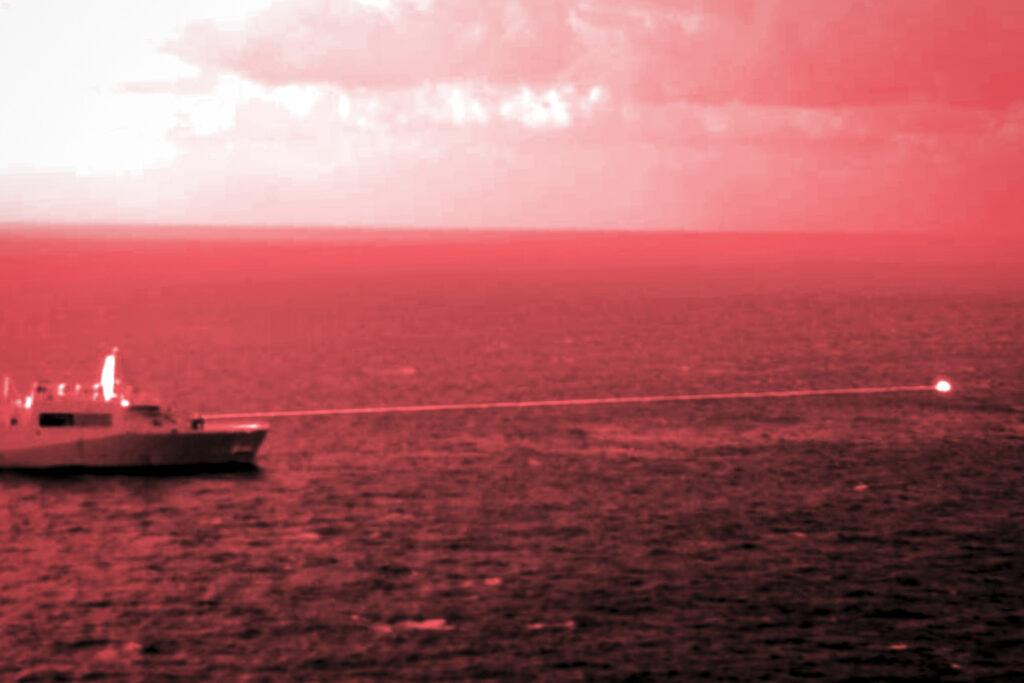
That growing imbalance between the cost of attacking and the cost of defending is becoming a defining challenge for the U.S. Navy. This is why directed energy weapons — especially high-powered lasers — matter strategically.
Lasers offer the possibility of shifting part of naval defense away from finite stored munitions toward shipboard electrical power. Properly integrated, this shift could allow warships to defeat certain lower-cost threats at the speed of light and at a marginal cost measured more in fuel, power generation and maintenance than in defensive missile expenditures.
That promise is real. But it is bounded by physics.
Lasers are not magic weapons. They are line-of-sight systems whose effectiveness depends on atmospheric conditions, beam stability, target composition and dwell time, or how long a beam must remain focused on a target to damage or destroy it.
A missile carries its destructive energy with it after launch. A laser, by contrast, depends on the performance of the entire ship: power generation, the ability to deliver steady electrical power, cooling systems, equipment that keeps the beam accurately focused, the condition of lenses and mirrors, the connection to the ship’s sensors and defensive systems, and crew proficiency.
The issue is not whether a laser can destroy a target during a controlled demonstration. It can. The issue is whether a warship can repeatedly generate and sustain the power required for the laser while simultaneously powering propulsion, radar, communications, electronic warfare and the other systems required to fight another ship.
That makes directed energy as much a ship-design challenge as a weapons challenge.
A ship’s electrical power will increasingly become a measure of its combat power. Future ships with greater electrical capacity will be better able to integrate advanced sensors, directed energy weapons, electronic warfare systems and tactical computing. Ships without sufficient reserve electrical power and cooling capacity will struggle to accommodate future combat systems as power and cooling become as consequential to combat effectiveness as ammunition, speed, range and payload.
Cooling may ultimately prove decisive. Even highly efficient lasers generate enormous waste heat. A system converting 30 percent of the electrical energy it consumes into a usable beam must dissipate the remaining 70 percent as heat. The question is whether it can fire repeatedly against multiple incoming threats without overheating, degrading the laser’s effectiveness or affecting other critical ship systems.
The maritime environment compounds the challenge. Salt air, humidity, aerosols, vibration and ship motion can interfere with a laser’s ability to remain focused and deliver sufficient energy to a target. Systems that function well ashore must prove they can perform reliably at sea.
None of this makes directed energy impractical. It makes careful integration with the ship and its other combat systems indispensable.
The near-term case for lasers is strongest as part of a layered defense against drones, unmanned surface vessels and other lower-cost threats. Against these threats, directed energy can improve the defensive cost exchange and preserve expensive, finite missiles for more dangerous threats, such as supersonic missiles or ballistic weapons.
The proper way to think about lasers is not as replacements for missiles but as a way to extend a ship’s magazine — preserving its limited supply of missiles for the threats that demand them.
Every defensive missile fired at a cheap drone is one less weapon available for the next attack — or for taking the fight to the enemy. If lasers can shoulder part of the defensive burden, our commanding officers gain more options, our sailors preserve the weapons they will need most, and our ships can remain lethal longer.
The challenge extends beyond individual weapons or ships. It is also a manufacturing and fleet-readiness problem.
Directed energy requires a resilient industrial base capable of producing advanced optics, power electronics, semiconductors, cooling systems and shipboard equipment that can be maintained and repaired by sailors at scale. It also requires a fleet able to employ these systems under combat conditions.
The Navy’s “Foundry, Fleet, Fight” framework applies directly here. The foundry must generate the manufacturing expertise and production capacity required for advanced systems. The fleet must integrate those systems into ships and combat units and keep them operating. The fight is where we prove that the technology, the ship and the sailor can perform together under the unforgiving conditions of combat.
The fastest path forward is not to wait for perfect megawatt-class systems. The Navy should proceed incrementally, starting with containerized laser systems — modular, self-contained units that can be added to existing ships with fewer major modifications and manageable power and cooling demands.
Such systems would allow sailors to develop tactics, maintenance procedures and real-world experience now rather than years from now. They could also enable faster upgrades and broader fleet use as the technology matures. They are not the final answer but a practical bridge between promising technology and an operational capability the fleet can learn from, improve and scale.
At the same time, the Navy must resist overselling what lasers can achieve. Atmospheric effects will remain an issue. So will competition among ship systems for electrical power and the demands of maintaining complex laser equipment. Commanders will trust these systems only after they repeatedly demonstrate reliability under realistic conditions at sea and as part of an integrated combat system.
Directed energy will not independently redefine naval warfare. But fleets that master it technically, tactically and industrially will gain a major advantage when confronting large numbers of simultaneous incoming threats — a challenge increasingly likely to define modern combat at sea.
The future advantage may belong not simply to the fleet with the most advanced weapons, but to the fleet that can absorb attacks, preserve its firepower and keep fighting. Directed energy can help give our sailors that advantage. And in a prolonged fight at sea, endurance is combat power.
The post Navy chief: Naval warfare is changing. Our sailors need these weapons. appeared first on Washington Post.