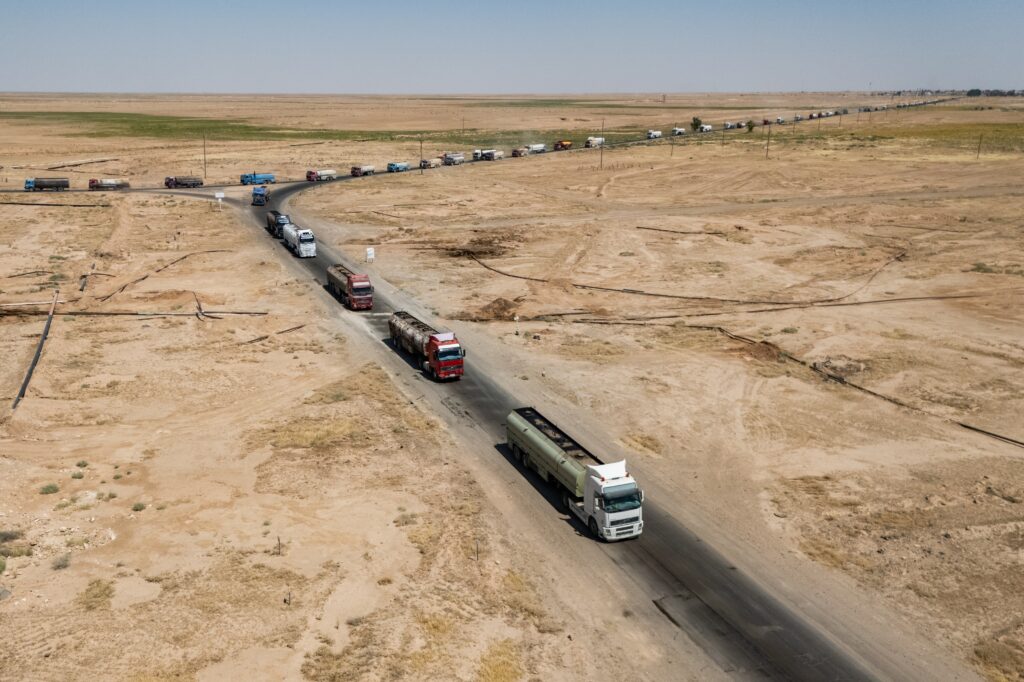
AL-QARYATAYN, Syria — Day and night, 5,000 hulking trucks carrying oil from the Persian Gulf rumble across this stretch of barren desert as if in a caravan snaking its way toward the Mediterranean Sea.
The trucks began shuttling between the refineries of southern Iraq and the Syrian port of Baniyas in April, initially as an experiment by Iraqi oil exporters seeking to circumvent the Strait of Hormuz after cargo traffic in the waterway was stopped by the U.S.-Israeli war with Iran.
Today, the daily bumper-to-bumper procession of tanker trucks is a showcase of how Syria and its new government aim to benefit as global energy flows are reshaped.
More than 18 months after the fall of Bashar al-Assad, who fled after 24 years in power, Syria is poised to capitalize on the lifting of international sanctions and the continuing war in the Persian Gulf.
Boasting access to Europe through its Mediterranean port at Baniyas, Syria — under its new president, Ahmed al-Sharaa — is pitching itself as a relatively stable, overland corridor for energy and goods, and an alternative to the Strait of Hormuz.
Already, international governments and energy suppliers are buying in.
In July, the Trump administration, which has embraced Sharaa, announced its support for a new Chevron-led pipeline that would funnel 2 million barrels of crude oil per day from Basra in southern Iraq to Baniyas, tracing the same route as the trucks now hauling fuel oil across the desert.
When the White House unveiled the pipeline project with senior Syrian and Iraqi officials, Trump’s special envoy, Tom Barrack, said in a statement that it would help make the Strait of Hormuz “an afterthought.”
The move seemed to fit a pattern of the Trump administration working to secure deals for American companies — particularly in fossil fuels — as part of a remarkably interventionist foreign policy from Venezuela to the Persian Gulf.
The 1,000-mile, $5.7 billion pipeline will take at least two and a half years to build and cannot fully replace the seaborne cargo vessels that transit the strait. But in the long term, it would allow oil exporters to diversify delivery routes after the war exposed the world’s dependence on the strait and sent energy prices soaring.
Still, investing in Syria is fraught with risk. While the country is mostly peaceful, Sharaa, a former al-Qaeda-linked militant, has not fully consolidated control over the country. Islamic State cells continue to carry out sporadic bombings. And a pipeline would have to pass through western Iraq, an area largely dominated by Iran-backed militias.
“The delivery of physical security for any kind of pipeline infrastructure is going to be the number one challenge,” said Gabriel Mitchell, an energy specialist and visiting fellow at the German Marshall Fund, the Washington-based policy institute.
“This is a pipeline that’ll be vulnerable to militant attacks, but it’s a 30-year investment,” Mitchell said. “Who will be guaranteeing security? How can you get coverage in terms of insurance? What if the war ends in the Strait of Hormuz and international oil companies think, ‘Now that the strait is open, we don’t need to make that investment?’”
Ahmad Qubbaji, the deputy chief executive of the state-owned Syrian Petroleum Corporation, which will operate the pipeline, said a final contract is expected to be signed in September by a consortium that includes Houston-based Chevron, TotalEnergies of France, and Syrian and Qatari investors. The group is discussing security measures, including using drones and other advanced surveillance technology, to monitor the pipeline, which will also have security backing from the United States, Qubbaji said.
After all, “it’s an American project,” he said in an interview in his Baniyas office. “Every day, we’re having 5,000 trucks coming from Iraq to here without any security incidents.”
Qubbaji said he has already taken calls with Qatari investors to discuss possibly extending the pipeline to Qatar, and analysts say that the pipeline could attract other Gulf oil producers, such as Kuwait, that are keen to diversify away from Hormuz. Qatar has also expressed interest in building another pipeline through Syria that would carry liquefied natural gas to tankers anchored at Baniyas, Qubbaji said.
Kuwait and Bahrain could also be interested in connecting to the Iraq-Syria pipeline to export oil through the Mediterranean, said Mohamad Ahmad, an economist and energy analyst at Karam Shaar Advisory, a Syria-focused consulting firm.
Saudi Arabia also faces a conundrum, Ahmad said: It began diverting oil toward the Red Sea after the Iran war closed off the Strait of Hormuz, but the Iran-aligned Houthi militia in Yemen has also threatened Red Sea traffic.
“This is the first time we have seen such a crisis, and I think the most vital route for everyone would be to go through the Mediterranean, not to go through the Red Sea,” Ahmad said.
Syrian officials say the country’s potential as a regional hub extends beyond oil and gas.
In recent months, Syria has inked agreements with Turkey and Saudi Arabia, two of Sharaa’s key supporters, to rehabilitate an Ottoman-era railway that would link Europe with the Red Sea via Syria and provide an alternative to the Bab al-Mandab Strait and the Suez Canal. Syria and Iraq have also signed deals that would facilitate trucks carrying goods from the Gulf to Europe.
“The Assad regime destroyed our country for 60 years. Everything was under sanctions,” Qubbaji said, referring to U.S. measures, enacted in 2011 at the start of Syria’s civil war, that made the country a no-go for foreign firms. “Now, all the energy in the world can go through Syria. We can have pipelines, roads, all forms of transit.”
In many ways, Qubbaji and other Syrian officials are touting Syria’s most enduring asset: its location. Centuries before the discovery of oil, the sprawling souks in Damascus and Aleppo connected East and West, the Red Sea and the Caspian Sea, trading silk from China, spices from India, gold from Egypt and glass from Europe.
But to journey along the proposed pipeline route today is to be reminded constantly of the devastation suffered during the country’s 14-year civil war, and the vast gap between modern Syria and the country’s ambition to reclaim its historical role as a hub of the Middle East.
Near the Iraq border, a massive pumping station for a previous Iraq-Syria pipeline built in the 1950s lies in ruins after it was taken over by the Islamic State and flattened by U.S. bombing, rendering it unusable.
In the surrounding desert, not far from Iraq’s Anbar Province and its Iran-backed militias, the Syrian Army is still working to remove mines from the war.
Up the Euphrates River at the al-Omar oil field, an hour drive from the site of a bomb attack claimed by the Islamic State in August, Ahmad Al Hudr, a regional official with the Syrian national oil company, downplayed the threat from militants.
Trucks carrying oil have been attacked sporadically, he acknowledged, but those incidents were mostly carried out by locals disgruntled that they can no longer carry out unauthorized drilling. Al Hudr expressed confidence that the army could secure oil infrastructure.
Al Hudr said he hoped the future pipeline would provide an export outlet for Syria’s oil wealth and generate new revenue for a country that once relied on oil for some 30 percent of its income. But for now, he was struggling.
After the new Syrian government took control of the al-Omar field in January, Al Hudr discovered that oil wells were badly damaged by years of mismanagement under Kurdish forces and the Islamic State, and were only able to produce one-tenth of their peak prewar output.
The state oil company, the SPC, lacked capital, and had resorted to hiring contract laborers to strip metal parts from a pumping facility badly damaged by an American airstrike to assemble new pipes. “Syria doesn’t lack technical expertise,” Al Hudr said. “We badly lack investment and better equipment.”
At a desolate junction in Al-Qaryatayn, Syria, on the two-lane road to Baniyas, Mohammad Hatem, a gregarious Iraqi driver hauling oil, complained about a different set of problems.
Syria’s potholed roads are in pitiful shape compared to Iraqi highways and chew up his tires, Hatem said, his rig parked near a desert intersection. And so many trucks now shuttle oil between the Persian Gulf and the Mediterranean that accidents are a daily occurrence, he said.
Still, he wasn’t complaining about the $1,800 he pockets for each 10-day round-trip from Basra to Baniyas. “I’m so scared of this new pipeline taking away my business, I might blow it up,” he said with a belly laugh before stressing that he was strictly joking.
At a nearby checkpoint, Abu Ahmad, 39, who is a Syrian security official, waved along oil trucks and cars traveling in all directions: east toward the Mediterranean and west to the Persian Gulf, north to Turkey and south to Jordan.
A decade ago, Ahmad was a rebel with the Free Syrian Army deployed here in the desert fighting “everyone,” he recalled: the Assad regime to the west; the Islamic State, Russian forces and Wagner mercenaries forces to the east; Kurdish militias; even Hezbollah after the Shiite militia invaded from Lebanon.
In those years, it would have been dangerous for civilian cars, much less trucks full of precious oil, to traverse the region. “Thank god everything is over,” he said.
Today, Ahmad sits in the heat with little more than his paperwork, a rickety fan and an old Russian PKA machine gun resting unused on the floor under a thin layer of dust.
He said he understood why this place was so hotly contested during his days as a fighter, and why it’s so busy with traffic today: “We’re at the crossroads of the Middle East.”
The post Syria, eyeing role as Middle East hub, offers options to bypass Hormuz appeared first on Washington Post.