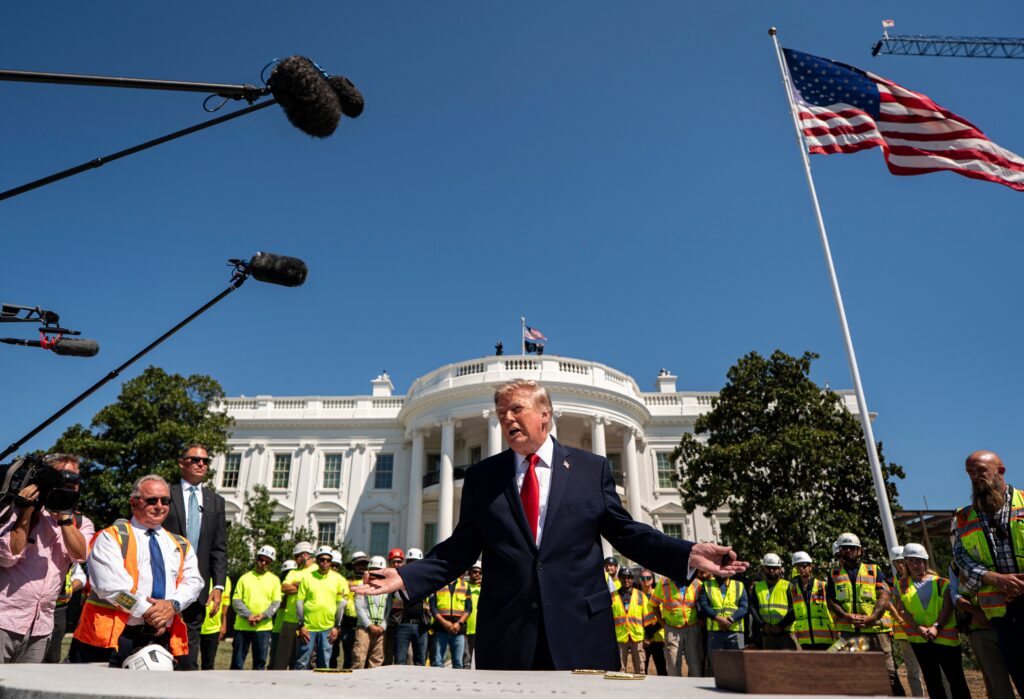
President Donald Trump has said he was puzzled when aides told him he could build a massive new White House ballroom without seeking approval.
“They said, ‘Sir, this is the White House, you’re the president of the United States. You can do anything you want,’” Trump said last October at a dinner honoring ballroom donors, recounting the exchange.
The president has spent his second term in office testing — and often proving — that claim. Within a week of his remarks, Trump had torn down the White House’s East Wing to build his planned ballroom, the most significant change to the White House grounds in generations. He has since directed workers to cut down beloved trees in public parks, ordered up statues at the White House and across the city, and announced plans for new monuments, shaped by his own views for the nation’s capital.
Nearly every corner of the White House’s campus has been eyed for potential renovations or new construction, including a new helipad, which workers are racing to complete this month. Trump has already paved over the mansion’s Rose Garden, added gilding throughout the building and fenced off the neighboring public park for a months-long renovation project.
The president has said he hopes to complete the ballroom and other projects during his term, which ends in January 2029. He and his deputies have insisted that they are beautifying Washington, even as many longtime residents and civic leaders beg him to stop.
To accomplish his construction agenda, Trump has subverted norms that guided past presidents, ignored outraged Democrats in Congress, remade expert panels and outraced the courts. As a federal judge deliberated this spring over whether to halt Trump’s rushed renovations to the Lincoln Memorial Reflecting Pool, the administration completed its rapid six-week project before the judge could rule. (The pool has since been drained again for another batch of changes.)
It is unclear whether anyone can legally stop some of Trump’s most audacious projects, such as the ballroom, despite its widespread unpopularity with the public.
The Justice Department has argued that only Congress, not the courts, could have stopped the ballroom. But administration officials also maintain that lawmakers already authorized the project by setting aside several million dollars for annual White House “improvements.” Stopping it, therefore, would require new legislation, which the Republican leadership of Congress has shown no interest in pursuing.
That has forced Trump’s opponents to seek redress in the courts. But the Supreme Court just created a new, major hurdle.
The court decided on Monday that a member of the National Trust for Historic Preservation who had challenged the ballroom probably lacked legal standing to sue, meaning preservationists had not proved that they were directly harmed by the project’s construction.
The ruling cleared the way for the president to probably complete his planned 90,000-square-foot addition. It also raised questions about whether preservationists will be able to stop future federal projects.
“If the National Trust — which was chartered by Congress in 1949 and expressly granted the power to sue — can’t use litigation to vindicate the public’s interests to historic preservation, who can?” Sara Bronin, a George Washington University law professor who chaired the Advisory Council on Historic Preservation during the Biden administration, wrote in a text message.
Trump has removed other potential gatekeepers by firing President Joe Biden’s appointees from federal arts and building commissions that have slowed or even halted past administrations’ projects. (Trump officials say he is merely continuing a tradition begun by Biden, who removed some commissioners.) Those commissions have instead sped Trump’s changes through, cheered on by appointees with dubious qualifications — such as Trump’s executive assistant — whom he personally named to the panels.
“President Trump showed great leadership in pushing forward expeditiously to complete this important ballroom/military complex,” Mark Paoletta, a longtime GOP lawyer whom Trump recently installed as the chairman of the National Capital Planning Commission, wrote on Monday. “Well done, Mr. President!”
Trump may well pay a political price for his actions. A Washington Post-Ipsos poll in July found that 32 percent of the public was “enthusiastic” or “satisfied” about Trump’s construction projects, while 65 percent was “dissatisfied” or “upset.”
The president’s focus on his construction projects may have contributed to his historic low standing with voters, which is endangering his party’s chances in this fall’s midterm elections. Democrats have vowed to launch investigations into Trump’s projects and other priorities if they retake Congress.
“He’s been talking about his ballroom at a time when Republicans in Congress would prefer that he talk about pocketbook issues of affordability, the price of groceries, gasoline,” said Martha Joynt Kumar, a longtime presidential historian and a political science professor emeritus at Towson University.
But for Trump, any short-term political cost may be worth paying to achieve his goal of remaking Washington for years to come.
Current and former government officials, legal experts, and others pointed to several factors that have allowed Trump to turn his desired projects into reality.
Mostly shrugs from GOP-led Congress
Federal judges, including Chief Justice John G. Roberts Jr., have concluded that Trump’s ballroom construction is probably illegal because it was not expressly authorized by Congress.
“That construction is likely unlawful,” Roberts wrote in his dissent on Monday, joined by the high court’s three liberal justices.
The five justices in the majority did not tackle the issue of legality, focusing instead on whether the people who challenged the ballroom could get into court at all.
“If we had a Congress that was interested in policing and overseeing the president — which we don’t really have right now — we could imagine action that Congress could take,” said Jonathan Adler, a William & Mary law professor.
But Republican leaders have shown little appetite for stopping Trump’s construction projects through enacting new legislative restrictions, opening investigations or taking other steps that could force the administration to pause.
House Speaker Mike Johnson (Louisiana) and Senate Majority Leader John Thune (South Dakota) earlier this year called for the ballroom to be built after a shooting at the White House correspondents’ dinner.
GOP leaders did back away from plans to potentially steer hundreds of millions of dollars in public funding to ballroom-related security after several Republicans questioned whether taxpayers should foot the bill.
Some Democrats insist that they could find ways to slow or halt Trump’s projects, if they were in charge of Congress. Sens. Elizabeth Warren (Massachusetts), Richard Blumenthal (Connecticut) and others have introduced or suggested legislation that would create guardrails around future construction, such as barring the use of public funds for White House construction projects that have not been strictly authorized by lawmakers.
Dozens of liberal lawmakers have also signed onto amicus briefs in lawsuits attempting to stop Trump’s projects, including the ballroom.
“There are still opportunities to stop it whether in this Congress or the next,” said Rep. Jared Huffman (D-California) — who is in line to lead the House’s Natural Resources Committee, overseeing the nation’s public parks, if Democrats retake the chamber.
Little resistance from expert panels
Trump has pursued his projects on federal property, such as public parkland, where he has sometimes been able to directly order rapid changes. The president has said he restored dozens of fountains in the Greater Washington area, for instance, an initiative funded by redirecting money collected from National Park Service entry fees around the country.
Some of Trump’s larger projects, including the ballroom, a planned triumphal arch near Arlington National Cemetery and a planned fence around Lafayette Square next to the White House, have been presented for review to federal commissions that oversee construction in the Washington area.
Historically those commissions, which were established by Congress and traditionally filled with architects, urban planners and other experts, have served as a check on federal projects. Their reviews often stretched months or even years.
There has been a stark difference between how those panels approached past projects and how they have rushed Trump’s priorities.
A decade ago, the National Capital Planning Commission spent about 10 months refining a plan to build a new White House fence. This year, the commission spent less than three months considering Trump’s ballroom and approved the proposal with minimal changes.
The rush was “unprecedented in recent history,” said Bruce Redman Becker, an architect and Biden appointee to the Commission of Fine Arts who was removed by Trump last year.
The commissions’ new leaders have also provided some cover for Trump’s plans.
After Trump tore down the East Wing last year, drawing objections and questions about why the White House had not sought approval, Will Scharf, who was then chairman of the National Capital Planning Commission, said that his commission’s reviews governed only vertical construction — not demolition.
Scharf has also argued that a law limiting the height of most new construction in Washington to 130 feet should not apply to Trump’s planned 250-foot-tall triumphal arch.
Trump last month named Scharf his new top White House lawyer, replacing him on the commission with Paoletta.
Testing the legal system
The administration’s projects have little precedent, former officials and legal experts have said, and Trump’s efforts to defend the work in court have resulted in novel legal arguments — sometimes with dueling approaches.
In litigation over the ballroom, the administration has argued that the project is too far along for courts to stop. In litigation around the planned arch, the administration has maintained that the project is too early to halt because formal work has not yet begun.
“No construction schedule exists for the arch project because it has not even been authorized by the National Park Service,” Justice Department lawyers told a federal judge last week.
Trump officials also contend that Congress effectively authorized the planned arch because lawmakers authorized a somewhat similar project a century ago that was never built.
Preservation groups have searched for ways to delay or stop Trump’s efforts, winning a victory when a federal judge ordered a temporary halt to Trump’s plans to remake the Kennedy Center.
The National Trust’s case to stop Trump’s ballroom was built on a declaration by board member Alison Hoagland, a historian who lives on Capitol Hill and regularly walks by the White House. She said the scale, height and massing of the ballroom project damaged her “aesthetic, cultural, and historical interests.”
The Supreme Court’s conservative majority rejected that argument, over the objections of Roberts and the court’s three liberals. The dissenters noted that Hoagland’s assertion of aesthetic injury was similar to the kind of damage the court had upheld in a landmark 1992 ruling called Lujan vs. Defenders of Wildlife. In that case, the court said that plaintiffs must have a real-world injury, not a “conjectural or hypothetical one,” to have standing to mount a legal challenge.
The court’s majority this time disagreed. “This Court has not found standing in circumstances like these before,” the majority wrote. “To the contrary, we have repeatedly held that mere offense, disagreement, or distaste does not qualify as a concrete and particularized injury.”
Kimberly Wehle, a law professor at the University of Baltimore, said the court’s ruling was alarming. It was “black and white” that the Constitution gives Congress, not the president, the authority to manage and regulate federal property like the White House, she said.
“The problem isn’t so much the standing test as it is the court didn’t apply its own precedent,” Wehle said, referring to the Lujan case.
The way the court has interpreted the rules of standing — requiring an individualized interest — it may be that no one can bring a case, said Adler, the William & Mary professor.
“We are people for whom the White House has a certain significance. That’s something we all share as Americans,” he said. “Traditionally, under standing doctrine, if we all share that interest, then no one has standing. That’s certainly a possibility here.”
Jonathan Edwards contributed to this report.
The post Using legal loopholes and executive power, Trump is remaking Washington appeared first on Washington Post.