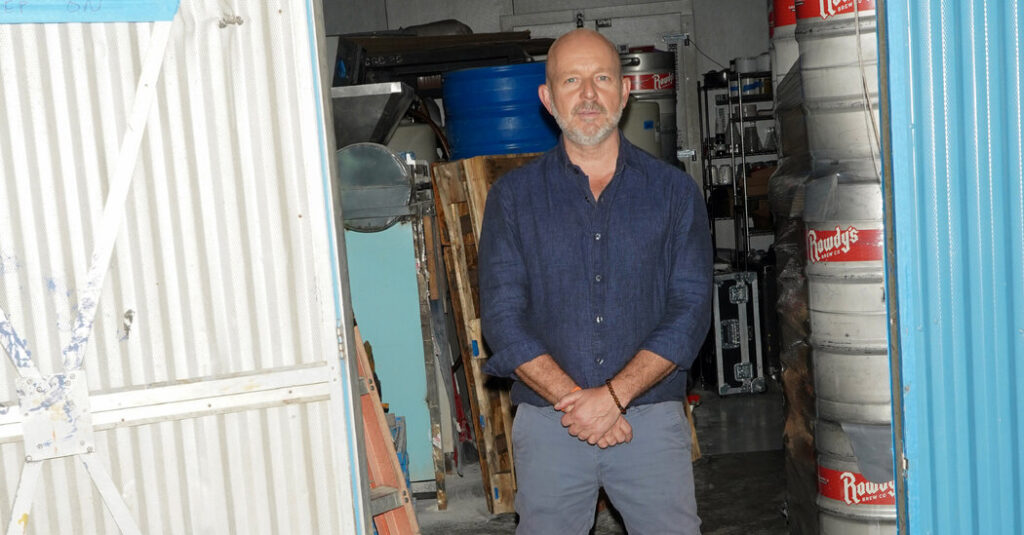
Steve Hilton, a MAGA-aligned Republican, wants to be the next governor of California. The main obstacle in his path may be President Trump.
Mr. Hilton spent much of the primary courting Mr. Trump, rebuffing questions about the 2020 election result and lauding his presidential swagger. In April, he received the all-important endorsement: “a truly fine man, one who has watched as this once great State has gone to Hell,” Mr. Trump wrote on Truth Social. “Steve can turn it around, before it is too late, and, as President, I will help him to do so!”
Since qualifying for the general election in November, Mr. Hilton has changed his tune. “I get it, maybe you hate Trump, MAGA, whatever,” he declared at the beginning of his first campaign video, released on July 22. A few days later, Mr. Hilton placed a full-page ad in several Californian newspapers, emblazoned with the question: “Can you be anti-Trump but still vote for me?” The answer was apparently yes, so long as you agree with anodyne statements like “I just want California to be amazing, but we make it so hard to live here” and “I want to fight climate change, but $6.00 gas is crazy!”
Mr. Hilton’s attempts to distance himself from Mr. Trump are hardly surprising in a state as blue as California. Registered Democrats outnumber registered Republicans nearly two to one, and a majority has supported the Democratic nominee for president in every election since 1992. Mr. Hilton tries to use this dominance to his advantage, describing California as suffering from “one-party rule” and his opponent, Xavier Becerra, as a “puppet.” It helps his case that the Democrats have held the governorship for 16 years, overseeing a state that is creaking under a housing crisis and deep economic inequality. “They think that they just have to sit back and they’re gonna win,” he’s said. “It’s California, a Democrat always wins, the machine always wins.”
In that, he may be right. Mr. Becerra, a cabinet member in the Biden administration, is the clear favorite to succeed Gavin Newsom as the state’s governor. But California has produced conservatives who, after initial setbacks, proved wildly influential. It is the state that gave us Richard Nixon and Ronald Reagan and the ideologues at the Claremont Institute. No matter the result, Mr. Hilton will try to keep that tradition alive. He is already working to fashion a version of conservatism that fuses the complaints of the tech barons with the bombast of the Trumpists, piloting a path to the future.
First, though, Mr. Hilton will have to complete one of the toughest acrobatic acts in politics — that of a loyal yet ambitious politician trying to quarantine himself from a deeply unpopular leader and kiss the ring at the same time. As the Republicans contemplate life after Mr. Trump, they must weigh whether their future lies with someone who has the president’s blessing or someone untarnished by his divisive legacy. It is the party’s defining dilemma.
Mr. Hilton’s campaign suggests a possible third path: someone who can be both.
At first glance, Mr. Hilton is an unconventional torch carrier for the future of Trumpism. The son of Hungarian refugee parents who barely spoke English, Mr. Hilton was born in London, went to the University of Oxford and worked as a high-profile political adviser for the British Conservative Party. He moved to California only in 2012 and became an American citizen in 2021. In Britain, with its air of stuffy traditions, he always stood out as a wannabe renegade, so much so that he became an object of satire. A thinly veiled portrait of him appears in Armando Iannucci’s “The Thick of It,” padding about in his socks and organizing yoga retreats. But for all his seeming strangeness, Mr. Hilton in many ways exemplifies the trajectory of the right.
Mr. Hilton came to public notice in 2006 as the chief strategist to David Cameron, who had just been elected Conservative Party leader. Mr. Hilton, a close friend of Mr. Cameron since the early 1990s, was tasked with rebranding the party. His main innovation was to associate the Tories with nature and environmental concerns. The Conservatives changed their logo from a hand carrying a torch to an oak tree and promised a “new green revolution.” Mr. Cameron began cycling to the office; on a trip to the Arctic, he posed for pictures with huskies. He started saying nice things about the National Health Service and multiculturalism. By 2010, the Conservatives were ready once again for office. The quirky Svengali had done his job.
Mr. Hilton is so associated with the project to detoxify the Tories that many have struggled to understand his conversion to MAGA politics. How could the man who made Mr. Cameron hug huskies embrace the “drill, baby, drill” vulgarity of Mr. Trump? But the truth is that he was always more Trump-y than his progressive-seeming marketing suggested. Beneath his attempts to soften the image of the Conservatives lay a coarser vision that, in the age of Trump, is all too recognizable: a norm-shattering quest to dismantle the state as quickly as possible, with no heed for consequences. He proves that the febrile and fanatical energy of Trumpism predates the president.
Mr. Hilton always craved creative destruction. He merely lacked the language for it. He called for up to 90 percent of the British Civil Service to be fired, in line with the much smaller work force that had overseen the country’s vast empire in its 19th-century heyday. When the Conservatives slashed the welfare budget by 18 billion pounds in two years, he called for a further 25 billion pounds to be cut — a figure that even the Conservatives’ miserly welfare minister called “absurd.” He also proposed a scheme called the Red Tape Challenge, in which the government would list over 20,000 regulations online and the public would vote on which ones to eliminate. That only the last of these ambitions were indulged was proof, in Mr. Hilton’s eyes, of the deep state’s insidious power.
And so, in a huff, he left and headed for California.
Mr. Hilton had a soft landing on the West Coast. His wife, Rachel Whetstone, a fellow Briton whom he’d met while working for the Conservative Party in the 1990s, had a job at Google’s main office as the company’s head of communications and policy. They soon settled in Atherton, an enclave for billionaires in Silicon Valley.
With time and space, Mr. Hilton began ingratiating himself with the tech elite. He taught at Stanford. He set up a digital platform, Crowdpac, which sought to democratize — and monetize — small-scale political donations and granted him the status of tech founder: an essential step on his path to Californian assimilation. He also wrote a book, “More Human,” which was full of platitudes about how start-ups and digital innovation can replace government services and bureaucracy. But business and books were never going to be enough for him. He hankered for a return to the political fray.
He got his chance at Fox News. He first appeared as a guest, discussing Brexit and the evils of the European Union. Then, in the summer of 2017, he was rewarded with his own show, “The Next Revolution with Steve Hilton.” The program celebrated Mr. Trump, cheered the rise of right-wing populism around the world and featured segments like “SwampWatch” and “Decadent D.C.” Within a year, he had reached his target audience. “Thank you Steve Hilton,” Mr. Trump tweeted in April 2018, in the first of what would be many supportive posts about the show. By 2023, the show had served its purpose. Mr. Hilton quit it and began laying the foundations for his bid to be California’s governor.
Mr. Hilton’s campaign takes obvious inspiration from the president. His slogan is “Make California Golden Again.” He has launched “Cal DOGE,” to expose Democratic waste and fraud. He says he wants California to be “the crypto capital of the world.” He has made both small rallies and Trump-style social media posting central to his campaign. He has also used A.I.-generated campaign videos that play on mythic themes and make politics seem like a game. One recent video showed Mr. Hilton fighting in the Coliseum to save ordinary Romans, who have been sent to their deaths simply for wanting cheap gas or affordable housing. Californian Democrats, depicted as Roman emperors, rejoice in the suffering of their people.
If Mr. Hilton’s diatribes against the deep state have been constant, one area where he has changed is green politics. He now treats environmental concerns with contempt, casting them as a spurious ploy by liberal elites to clean their consciences and make everyone else’s lives worse. “There’s no evidence that any of California’s climate policies are helping the climate,” he says. “All it’s done is cause pain and suffering, especially for working-class Californians.” He claims that by axing these regulations and ramping up oil and gas production in California, he can bring the price of gasoline down from almost $6 a gallon to $3.
Already fanciful, that promise has become even harder to sustain over the course of the campaign. Amid the fallout of Mr. Trump’s war on Iran, which has cost the United States an estimated $100 billion, the price of gas has risen over a third in six months. Like many Trump supporters, Mr. Hilton had previously cited the president’s opposition to foreign interventions as proof of his common sense. Now he finds himself in a bind. On Fox, he’ll extol Mr. Trump’s wisdom and foresight. To more liberal audiences, he’ll say that he prefers not to comment on foreign policy matters and that whatever damage Mr. Trump may or may not have done, Democrats’ governance is far worse.
Here is a key divergence from the president. Whereas Mr. Trump has said that he doesn’t “think about Americans’ financial situation,” Mr. Hilton has remained laser-focused on the cost of living in California. As a tactic, that makes sense. Despite boasting the fourth-biggest economy in the world, California has the worst poverty rate in the country, tied with Louisiana. The cost of gasoline and renting a home is higher than in any other state; electricity prices are the second highest. The construction of a high-speed rail linking San Francisco to Los Angeles is running almost 20 years behind schedule and about $200 billion over budget — a boondoggle that encapsulates the dysfunction of California’s political system.
As Mr. Hilton attacks the Democrats and their record over the past 16 years, he has plenty of ammunition.
One night in 2021, “The Next Revolution with Steve Hilton” took a surprisingly personal turn. The host delivered a eulogy for his mother-in-law, Linda Whetstone, and the work of her father, Antony Fisher. Ms. Whetstone had been a prominent free-market activist and the chair of the libertarian Mont Pelerin Society. Mr. Fisher had dedicated his life to fighting socialism and reversing the rise of the welfare state after World War II. He set up an astonishing array of free-market think tanks, first in Britain and then, after he moved to California in the late 1970s, in America, including the Manhattan Institute, the Pacific Research Institute for Public Policy and the Atlas Network. They became, as Mr. Hilton accurately declared on his show, “the birthplace for the free-market revolution that swept the world.”
Mr. Hilton clearly believes that another revolution is needed — and that he is the one to lead it. “We have to stand firm against the further rise of socialism in California,” he declared in a recent speech. “The threat to California workers’ jobs, incomes and quality of life comes not from some billionaire class, but from the socialist-leaning bureaucrat class that’s been in power here for so long.” Never mind that in the past four decades, in no small part thanks to the free-market policies incubated by Mr. Fisher’s network of influence, the richest Californians have increased their incomes by more than two-thirds as the incomes of the poorest have barely risen at all. For Mr. Hilton, Democrats have turned California into the “Wuhan lab of modern leftism.”
Mr. Hilton’s powerful backers in California share his anxiety. This fall, the state will vote on a ballot initiative to tax billionaires 5 percent of their net worths, something many of the state’s 200-plus billionaires have seen as an existential threat. “I fled socialism with my family in 1979 and know the devastating, oppressive society it created in the Soviet Union,” Sergey Brin, the Google co-founder with a net worth of around $270 billion, said in a rare public statement. (Mr. Brin has already decamped to Nevada.) Even though Mr. Becerra also opposes the billionaire tax, Mr. Hilton has positioned himself as the defender of this oppressed minority.
Mr. Hilton might see himself as a maverick, but his program is part of a wider project of anti-leftism, backed by billionaires and aimed at eviscerating the state. The formula, as progressives make gains across the country, is to cast even minor wealth redistribution as proof of a socialist threat that must be crushed. Mr. Trump, who revels in chaos and sensationalism, is one form that this cause can take. Mr. Fisher, with his sober reliance on think tanks to influence the press and politicians, is another. Mr. Hilton offers something between the two: a style of politics that is uninhibited and sensationalist when necessary, and capable of rational debate and pragmatic rhetoric when not. We might call it MAGA with a nice accent.
That has allowed him to become the candidate of choice for an increasingly fretful and MAGA-curious tech elite. But his diagnosis of California’s problems is fundamentally unserious, failing to reckon with how the cost of living is rising everywhere during Mr. Trump’s second term, and his obsession with the tyranny of the state’s labor unions borders on bizarre. His opponent, Mr. Becerra, is also far more centrist than socialist, as is true of the previous Democratic governors: There is no looming socialist takeover here.
Yet for all that, the race remains worth watching. Even in defeat, Mr. Hilton may show where the right is heading — and how Trumpism can outlast Mr. Trump.
Samuel Earle is the author of “Tory Nation: The Dark Legacy of the World’s Most Successful Political Party” and a Ph.D. candidate at the Columbia Journalism School.
The Times is committed to publishing a diversity of letters to the editor. We’d like to hear what you think about this or any of our articles. Here are some tips. And here’s our email: [email protected].
Follow the New York Times Opinion section on Facebook, Instagram, TikTok, Bluesky, WhatsApp and Threads.
The post Is This Quirky British Man the Future of Trumpism? appeared first on New York Times.