The United States carried out a new wave of attacks against Iran on Tuesday, the latest surge of violence to puncture weeks of relative calm as President Trump has tried to pivot from a military campaign to one of strangling Iran’s economy.
U.S. Central Command said it had struck military targets in Iran in retaliation for attacks on ships and American forces in the region. Hours later, Iran’s Revolutionary Guards Corps said in statements that it had launched missiles on an American military base in Jordan and U.S. military equipment warehouses in Iraq. It warned of fierce retaliations on U.S. interests in the region.
The new strikes came three days after the United States and Iran traded fire for the first time in a month. The latest strikes were far broader and more intense, according to initial reports, and Iranian officials said civilians had been killed, including at a wedding. While it was unclear if the violence would escalate further, the hostilities underscored how remote a durable solution to the conflict remains, six months into a conflict that Mr. Trump once predicted would last a few weeks.
Mr. Trump, in a social media post referring to the Strait of Hormuz, said the U.S. attacks were “large and powerful, and in retaliation for the Iranians’ failed attempt at adding sea mines to the Strait.” He added that “if the failed Nation of Iran retaliates for this very justified attack, they will be hit again at a much harder and higher level.”
U.S. Central Command said in a statement that it had struck air defense sites, radar systems, maritime assets and facilities, mine laying capabilities and communications sites.
Iranian state media said projectiles had hit sites in Chabahar and Konarak, southern port cities east of the Strait of Hormuz. Two Iranian officials, who spoke on the condition of anonymity to discuss the U.S. attacks, said the strikes had also hit several other sites across Iran’s southern shores, including a military base in Bandar Abbas, the perimeter of the commercial airport on Qeshm Island and targets in the cities of Sirik and Jask. The officials said the attacks had caused significant damage.
The deputy governor of Hormozgan Province, Ahmad Nafisi, told Iranian state television that a wedding ceremony and a home had been struck in the city of Kuhestak. The Iranian Red Crescent Society, a humanitarian group, reported that four people had been killed, including a child, and 53 others had been injured.
U.S. Central Command said it was aware of the reports. “The U.S. military never targets civilians, unlike the IRGC,” it said, referring to the Revolutionary Guards.
Esmaeil Baghaei, the spokesman for Iran’s foreign ministry, said in a social media post that “Iran will respond to these savage crimes with firmness.” He also put the combined number of those killed and wounded at more than 50.
Photos from Sirik, verified by The New York Times, showed significant damage to a communications tower. Iran’s national electricity company, Tavanir, reported a power outage in some areas of Hormozgan Province because of the airstrikes.
An additional strike hit a residential area around 150 yards from the communications tower. Videos and photographs of the immediate aftermath verified by The Times showed blown- out walls and the collapsed roof and rebar of a smoldering building.
Amid Iran’s statements that it had retaliated against U.S. forces in the region, Jordan said it had been targeted by Iranian missiles, and Kuwait said it had come under an Iranian drone attack.
National security analysts said the latest strikes show how difficult it could be to wind down the conflict.
“I see no fundamental move that either side is now prepared to take that would alter the trajectory and create a pathway out of this,” said Aaron David Miller, a senior fellow at the Carnegie Endowment for International Peace. Mr. Miller, who worked for a half-dozen secretaries of states across Democratic and Republican administrations, described the conflict as “wash, rinse and repeat.”
One thing has become clearer, Mr. Miller said: The Iranians are willing to suffer pain, even if to keep Mr. Trump “in the box he created for himself.”
Michael Froman, the president of the Council on Foreign Relations, said a continuing “tit for tat” is most likely for a significant period of time.
“This is probably the new normal for us,” he said of periodic strikes by the U.S., firing on ships and various blockades in the Strait of Hormuz. He added that it was unlikely that there would be a “black and white situation in which there’s a total cease-fire or the Strait of Hormuz is totally open.”
While it has become evident that Mr. Trump wants out of the conflict, Jon Hoffman, a research fellow in defense and foreign policy at the Cato Institute, said, the president will not do so if it looks as if he has failed to project strength and dominance. And Iran is making it increasingly difficult for him to achieve that.
“The idea that Iran would not capitulate and drop to its feet is, to him, a foreign concept,” Mr. Hoffman said.
Oil prices jumped and were up about 4 percent after the U.S. military said it had retaliated over Iranian strikes on commercial ships. Two ships were attacked within minutes of each other on Monday, according to Marisks, a risk consulting firm.
The U.S. military said on Sunday that its forces had bombarded Iranian troops on Larak Island that were preparing to launch rockets armed with mines into the Strait of Hormuz, the vital shipping corridor for oil and gas. Such an artillery weapon would be unusual, and it was not possible to confirm the military’s report.
The Iranian foreign ministry said several people had been killed and wounded in the strikes on Sunday, but did not provide specifics.
The Revolutionary Guards Corps said it had retaliated by firing at bases in Jordan and the United Arab Emirates that host U.S. military personnel. The Jordanian authorities said they had intercepted eight missiles in their airspace, while the Emirati military said it had “responded to” a drone from Iran. There were no reports of damage or casualties.
Even as the fighting had slowed in recent weeks, there had been few signs of resolution to the issues at the heart of the war that Mr. Trump began in late February alongside Israel. A “memorandum of understanding” between Tehran and Washington quickly broke down after it was signed in late June.
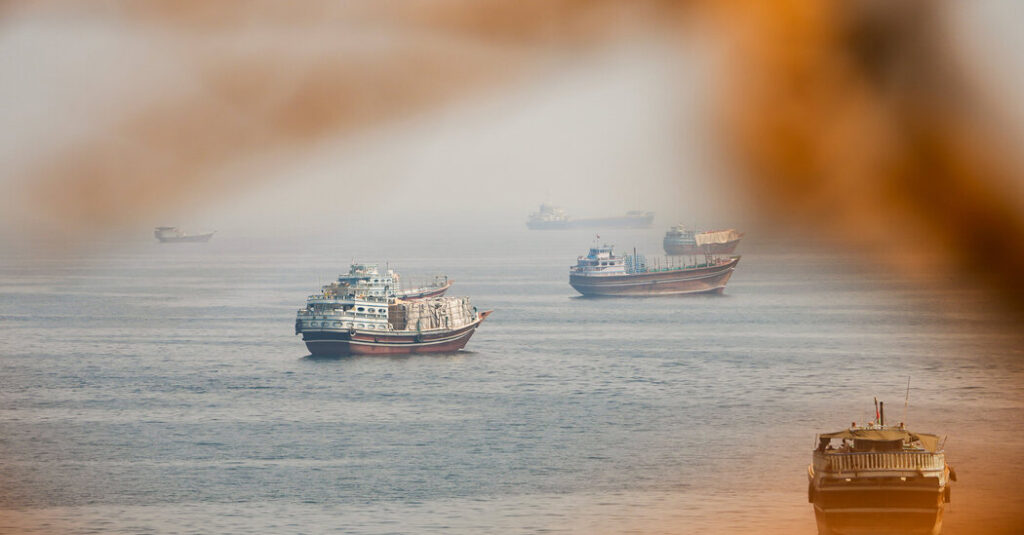
Since then, Iran has fired on ships passing through the Strait of Hormuz, severely curbing the ability of U.S. allies to export oil and gas and gaining significant leverage. Iranian officials have demanded steep and immediate concessions in exchange for reopening the strait, which U.S. officials have rejected.
The Trump administration has sought to squeeze Tehran economically by enforcing a naval blockade on Iranian ports and increasing sanctions on Tehran. But thoroughly enforcing sanctions is notoriously hard, and Iran’s case would require messy run-ins with allies and powerful rivals capable of retaliation, most notably China.
Rozhin Rezai, Malachy Browne, Christiaan Triebert and Jenny Gross contributed reporting.
The post U.S. Launches Intense New Wave of Attacks in Iran appeared first on New York Times.