President Vladimir V. Putin of Russia has pledged to continue his escalating war against Ukraine and support for Iran in its conflict with the United States, ending a two-day appearance at a summit in Kyrgyzstan with a note of defiance .
The Russian leader also expressed his comfort in dealing with President Trump’s special envoys, Steve Witkoff and Jared Kushner, in peace negotiations over Ukraine — a pointed declaration days after the C.I.A. director arrived for a rare visit to Moscow and made a case to his Russian counterpart for ending the war.
“We are completely comfortable working with people we know well and generally trust,” Mr. Putin said, noting that the two envoys have Mr. Trump’s trust and a direct line to the American president. “These are people close to President Trump.”
Asked about trip by the C.I.A. director, John Ratcliffe, Mr. Putin said direct contacts between the heads of intelligence agencies had taken place even at tense moments during the Cold War. He noted that negotiations were “currently frozen, to a certain extent.”
The Russian leader spoke during and after a meeting of the 10-nation political and security grouping known as the Shanghai Cooperation Organization in Bishkek, the Kyrgyz capital.
His appearance there came as the war in Ukraine has entered a new and more dangerous stage, with escalating air attacks by both sides against targets that often lack sufficient air defenses to protect them.
For months, Ukraine has been pummeling Russian oil refineries, ships and e-commerce warehouses with long-range strikes. The attacks have caused gasoline shortages across Russia and disrupted the Russian economy. Ukrainian forces have also isolated Crimea and held back Mr. Putin’s troops on the battlefield, where Moscow’s progress has slowed. Ukrainian strikes damaged about 100 Russian ships over 40 days, according to Mr. Putin, who said the loss was equivalent to 1 percent of Russia’s gross domestic product.
Russia has begun an aggressive escalation in response to Ukraine’s strikes, carrying out relentless bombardments with new jet-powered drones, increasing attacks on the Ukrainian capital, Kyiv, and threatening Ukraine’s grain exports by taking aim at its Black Sea ports.
Mr. Putin leaned in to that pugnacious response in his comments in Bishkek, saying the Russian military had been given orders to carry out mass strikes against the energy infrastructure of Ukraine. He said Russia’s strikes were jeopardizing Ukraine’s agricultural exports and risking a financial crisis.
“I’m not saying we’ll collapse the economy there, but it’s a serious challenge for them,” Mr. Putin said.
When asked about comments by the Ukrainian president, Volodymyr Zelensky, that civilian aircraft would not be safe in Russia, owing to Ukrainian drones, Mr. Putin called the remark “state terrorism.”
“And I’d draw attention to the fact that they are the ones asking us to resume negotiations, asking for personal meetings,” he said, referring to Mr. Zelensky’s requests to meet with Mr. Putin. “Negotiations are not conducted with terrorists.”
The developments in the war have caused a wave of anxiety in Russia about a possible new draft after parliamentary elections later this month. In his comments, Mr. Putin called such suggestions “nonsense.”
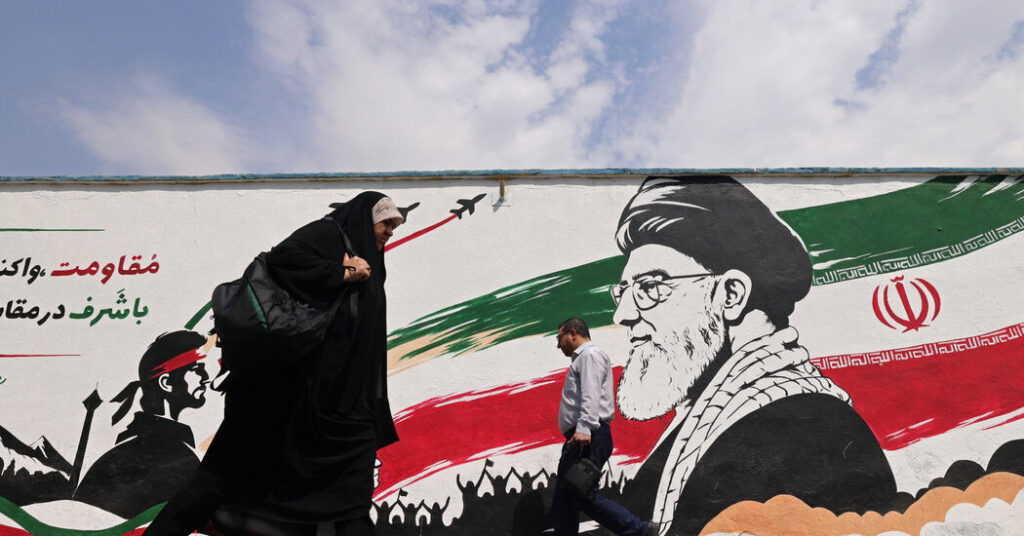
Earlier in the day, Mr. Putin met with President Masoud Pezeshkian of Iran and pledged his continued support for what he called the Iranian people’s “courage and resilience” in defending their national interests.
Since Mr. Trump launched his war against Iran with Israel in late February, Russia has backed the Iranians with intelligence, including on U.S. assets in the Persian Gulf, and shipped drone components to Tehran via the Caspian Sea. The United States and Iran resumed trading strikes this week after what had been a weekslong hiatus in fighting.
“During this difficult time, we are trying to provide you with the assistance you need,” Mr. Putin told the Iranian leader in Bishkek. “We have discussed this with you and are supplying you with the necessary goods.”
The New York Times reported that Mr. Ratcliffe, the C.I.A. director, traveled to Moscow in recent days to deliver a bleak assessment of the toll and trajectory of Russia’s war effort in Ukraine and urge its leaders to cut a deal. U.S. intelligence officials have long believed that Mr. Putin isn’t getting an accurate battlefield picture from his subordinates.
During the news conference, Mr. Putin said he had many sources of information that together formed an objective view of the battlefield.
He said Russian forces had taken 270 square kilometers of territory in Ukraine’s Donetsk region in August. Statistics from Deep State, a Ukrainian group that maps changes to the frontline, show Russia taking only 26 square kilometers in the region.
Before traveling to the summit, Mr. Putin attended a meeting with teachers and students in Russia at which he made a confounding reference to orcas eating polar bears as a way to explain why Russia needed to go to war with Ukraine.
Asked about those remarks in Bishkek, Mr. Putin replied by saying that during the Soviet era, Western nations were described as “sharks of imperialism.”
“If anyone tries to drag us down the food chain, to gobble us up or devour us, they might get punched in the teeth,” Mr. Putin said. “And Russia is ready to do this, despite the rapidly growing appetites and teeth of these sharks.”
Zane Irwin contributed reporting from New York.
The post Putin Pledges Increased Strikes in Ukraine and Support for Iran appeared first on New York Times.