A California collector, facing arrest on criminal possession of stolen property charges, has surrendered to New York investigators a 2,000-year-old bronze statue of a Roman emperor thought looted from an ancient site in Turkey.
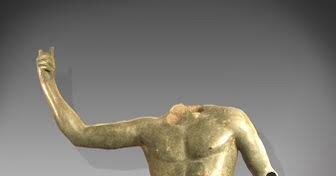
The collector, Aaron Mendelsohn, 74, of Santa Monica, a philanthropist and former medical technology venture capitalist, bought the headless bronze torso, “Nude Emperor,” in 2007 from a now defunct New York gallery.
But the Manhattan district attorney’s office said the statue, valued at $1.33 million, is one of at least 13 larger-than-life antiquities that were pillaged in the 1960s from the site of a Roman-era shrine in a city known as Bubon, in present-day Turkey.
The statue was one of several dozen items handed over to Turkey on Monday at a ceremony in Manhattan. The other items included a marble head of the Greek orator Demosthenes, valued at $800,000, which was seized from the Metropolitan Museum of Art in September on the grounds that it too had been looted.
Mr. Mendelsohn gave up all claims to the emperor statue as part of an agreement filed in New York Criminal Court under which prosecutors agreed to drop a warrant for his arrest. He paid for the statue’s shipping to Manhattan, but the agreement did not require him to acknowledge that the statue had been looted, and it included Mr. Mendelsohn’s assertion that he had not done anything wrong.
The collector had previously filed suit to block the district attorney’s office from seizing the statue in court papers that challenged its jurisdiction and argued that additional research was needed to determine the statue’s precise origins. That lawsuit was withdrawn.
Investigators had accused Mr. Mendelsohn of possessing the statue despite knowing it had been stolen and conspiring with art experts to disguise its illicit history. Mr. Mendelsohn has described those communications as good faith efforts to determine the statue’s origins.
Under the agreement, filed in September, investigators said they would not prosecute Mr. Mendelsohn if, after a year, he had not violated any of its terms.
A lawyer for Mr. Mendelsohn, Marcus Asner, declined to comment.
The Bubon site in Turkey is known for a Roman imperial shrine, or sebasteion, where local people erected statues of emperors and their wives from around A.D. 50 to 250 to venerate imperial power at a time when the region was part of Rome’s extended empire.
The site was illegally excavated in the late 1960s by villagers, and many valuable artifacts were trafficked by a network of smugglers, provenance falsifiers and gallery owners known for whitewashing stolen cultural objects, according to investigators with the district attorney’s Antiquities Trafficking Unit.
Eight larger-than-life statues from the sebasteion and several broken-off body parts and heads from Bubon made it into the United States, according to the investigators. Since the trafficking unit began its investigation several years ago, prosecutors say they have seized and repatriated six of the imperial statues, including the one held by Mr. Mendelsohn. Two more are the subject of investigation.
All told, investigators say, the recovered antiquities are valued by independent appraisers at $80 million.
“The looting into ancient sites like Bubon was extensive, and I am pleased that our investigation has yielded such significant results,” said District Attorney Alvin L. Bragg.
Investigators say many of the Bubon pieces passed through the hands of Turkish and European smugglers and were acquired by New York art dealers who crafted false provenance histories to hide their origins. The artifacts from Bubon wound up at collections including those at the Met Museum, the Cleveland Museum of Art, the Getty Museum in Los Angeles, Boston’s Museum of Fine Arts, the Santa Barbara Museum of Art, the Worcester Museum of Art and the Fordham University Museum of Art.
Gökhan Yazgi, Turkey’s deputy minister of culture and tourism, said in a statement that the restitutions send a clear message: “Do not buy cultural property removed illegally from its country of origin.”
Zeynep Boz, a Turkish official who worked to reclaim her country’s antiquities, said Turkey plans to exhibit the returned bronzes in a dedicated gallery. “This space will present the archaeological and scientific history of Bubon together with the full journey of these bronzes, from their illegal removal to the years they spent in private hands and to their eventual return,” she said in an interview.
The antiquities unit had not previously announced the seizure of the marble head of Demosthenes, who lived from 384-322 B.C., from the Met. It is thought to be an ancient copy of the head from a Greek bronze statue by the sculptor Polyeuktos from roughly 280 B.C.
The museum’s listed provenance for the marble head begins in 1973 and reports that the item changed hands several times before entering the Met’s collection in 2012, as a gift from a collector. Investigators said two New York galleries had falsified provenance information about the head. One of the galleries, Fortuna Fine Arts, is currently under indictment for fraud in federal court, according to a statement by the district attorney’s office.
The gallery could not be reached for comment. The Met said in a statement that “new information came to light that made it clear that the work rightfully belongs to Turkey.”
“The Met,” the statement continued, “has initiated a number of repatriations in recent years, and its team of provenance researchers — now the largest of any museum in the world — is continuing with a rigorous review of the collection in partnership with experts inside and outside the museum, including the D.A.’s office, which often has information that the museum would otherwise be unable to access.”
The Met recently surrendered another 12 objects associated with Fortuna Fine Arts that had also been seized by the Manhattan investigators. Those artifacts included jewelry, swords, terra cotta jugs, stone ax heads and other archaeological works ranging in date from 2700 B.C. to 400 B.C.
Another 40 items returned at the ceremony on Monday were ancient Phrygian terra cotta decorative items belonging to Turkey. Matthew Bogdanos, the assistant district attorney who heads the antiquities unit, credited a chief curator at the Virginia Museum of Fine Arts, Michael Taylor, with “proactively” alerting authorities after growing concerned that the items in the museum’s collection had been looted.Speaking at the handover ceremony, where the marble head of Demosthenes was on display in a wooden packing box and the bronze emperor was shown to reporters in a basement storage area, Mr. Bogdanos said that, though the culture was changing, not all museums or collectors were willing to investigate and cleanse their collections of looted art. He praised the Virginia museum and other museums for reaching out to the trafficking unit to report problematic pieces.
“They are about doing the right thing, not just saying the right thing,” he said.
Graham Bowley is an investigative reporter covering the world of culture for The Times.
The post Collector Surrenders ‘Nude Emperor’ Statue Identified as Looted appeared first on New York Times.