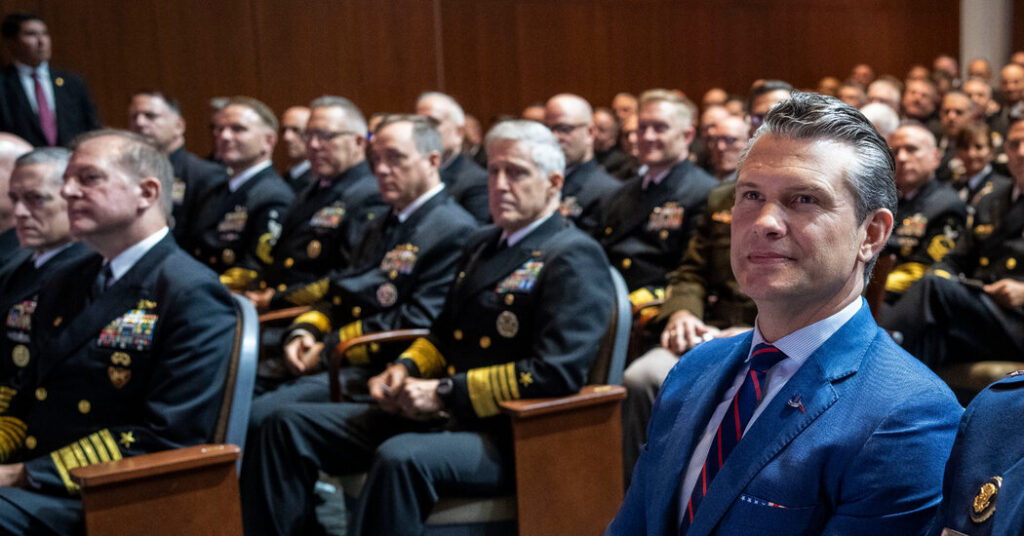
Defense Secretary Pete Hegseth has fired or blocked the promotions of more than 80 generals and admirals, a purge that has hit about 10 percent of the military’s top officers and shows no signs of slowing.
In recent days, Mr. Hegseth targeted seven Army officers who had been selected for two-star general rank by a board made up of senior Army leaders, according to current and former military officials, who discussed sensitive personnel matters on the condition of anonymity.
The moves come at a time when the military is badly strained by the Iran war, which has gone on far longer than administration officials anticipated.
The military, especially the Army, is also racing to keep up with the proliferation of sophisticated drones and precision missiles that have exposed the vulnerability of its overseas bases and weapons systems.
The firings and Mr. Hegseth’s refusal to explain the logic behind them are dividing the Pentagon and alienating many in Congress, the officials said. The latest to register his disapproval was Army Secretary Daniel P. Driscoll, who recently submitted his resignation to Mr. Trump.
In a meeting with the president, Mr. Driscoll complained that Mr. Hegseth had fired some of the Army’s most combat-tested leaders, imperiling its efforts to modernize the force, military officials said.
He also warned Mr. Trump that the firings and blocked promotions have damaged morale, causing some in the military to question the fairness of a promotion system that is supposed to be apolitical and merit-based, senior officials said.
Mr. Hegseth’s purge does not appear to be driven by job performance, but rather is part of a broader effort by the defense secretary to fashion a force, particularly at senior levels, that is aligned with his political and ideological views, according to military officials.
Some senior administration officials, concerned about the leadership vacuum at the top of the Army, had pressed Mr. Driscoll to stay, officials said. Those concerns have spread to Congress; Senator Mike Rounds, Republican of South Dakota, said he was “disappointed” to see Mr. Driscoll go.
“I’m hearing the same rumors as everybody else — that he was frustrated with some of his top generals being released, and that’s not the first time I’ve heard that,” Mr. Rounds said. “I think that points to questions that we’re going to be asking when we get back.”
Sean Parnell, the Pentagon spokesman, defended Mr. Hegseth’s decisions as normal Pentagon business. “The idea that these lists cannot be altered is ridiculous; every single secretary has exercised this exact prerogative,” he said.
But senior officials and members of Congress have said that Mr. Hegseth’s moves are without precedent. In the past, the defense secretary and service secretaries have removed officers for moral or ethical breaches. But officials said that these officers have behaved in accordance with Pentagon policy.
Senator Jack Reed of Rhode Island, the top Democrat on the Senate Armed Services Committee, has called Mr. Hegseth’s removals “illegal.”
More than half of the officers affected by Mr. Hegseth’s dismissals are Black or female in a force whose senior ranks are dominated by white male officers. Of the seven officers Mr. Hegseth removed from the Army two-star promotion list, two are Black and two are female.
Last fall, Mr. Hegseth laid out his vision for the firings in a speech that he required all of the military’s generals and admirals to attend.
“We are clearing out the debris, removing the distractions, clearing the way for leaders to be leaders,” Mr. Hegseth said. “You might say we’re ending the war on warriors.”
That vision and the widespread firings that accompanied it increasingly conflicted with Mr. Driscoll’s efforts to lead the Army, officials said.
Mr. Driscoll sought to defend the integrity of the Army’s promotion system and advance the modernization vision that he and Gen. Randy George, the Army chief of staff, had built. Mr. Hegseth fired General George in April without explanation.
Today the Army is dealing with its most deadly stretch since the Iraq and Afghanistan wars. Army air defense soldiers are playing the leading role in defending U.S. troops in the Middle East from increasingly sophisticated Iranian missile attacks. The Army’s command in Europe is providing critical intelligence and other support to Ukraine as it fights to hold off a larger Russian force.
And it is rushing to catch up with adversaries, like Russia and China, who have made rapid advances in drone warfare.
Mr. Driscoll, a Yale Law School classmate and close friend of Vice President JD Vance’s, had valuable connections in the White House. He had also won the trust of the Army’s senior officers and many in Congress.
But those relationships were of little help as Mr. Hegseth has consolidated his control over the Pentagon, largely by firing senior officers and replacing them with leaders he viewed as more loyal.
The purges have hit the Army most heavily.
Mr. Hegseth has forced out at least three senior officers who had been viewed as potential successors to General George. Mr. Hegseth’s choice for Army chief of staff, Gen. Christopher LaNeve, does not appear to have the votes needed to be confirmed by the Senate.
Mr. Hegseth came into the job complaining that there were too many generals in the military. In May last year, he ordered a 20 percent reduction of four-star officers. “A critical step in the process is removing redundant force structure to optimize and streamline leadership by reducing excess general and flag officer positions,” he said.
But his moves to fire officers and block promotions do not seem to be motivated by a desire to limit redundancies or improve lethality of the force.
One senior Army officer removed from the Army’s one-star promotion list recently had commanded the Army 173rd Airborne brigade in Italy and was described by officers as of the best combat leaders in the infantry. He had led troops in Iraq and Afghanistan and earned two master’s degrees from Columbia University.
The officer was pulled from the promotion list because officials in Mr. Hegseth’s office erroneously believed he had allowed a mentorship group for female paratroopers to exist in his unit and conduct an all-women’s airborne jump, Army officials said.
In fact, the group predated his command.
Rather than order it to shut down in compliance with Mr. Hegseth’s ban on affinity groups, the officer asked leaders of the group to rename it and open it to men. He was still pulled from the list.
Another person taken off the list is an intelligence officer who worked closely with the special operations community and played a key role in the development of the Maven system, which helps analyze intelligence and suggests targets for airstrikes. It’s not clear why she was removed.
The military has long prided itself of being one of the country’s most integrated institutions. More than 40 percent of the active duty military and its reserve components are people of color. But the people making crucial decisions about how and when those troops are deployed to combat are almost entirely white and male.
As a result of Mr. Hegseth’s moves, the military’s top ranks will be even more white and male for years to come. This year marks the lowest percentage of women nominated to general and admiral rank in at least 25 years, according to a New York Times analysis.
No women are likely to be nominated to admiral rank this year for the first time in more than a decade.
Mr. Hegseth has cast his firings as a cleansing of less qualified Black and female candidates.
“This administration has done a great deal from day one to remove the social justice, politically correct and toxic ideological garbage that had infected our department,” he said in his speech to the force last fall.
Michael Gold contributed reporting.
The post Hegseth Targets 7 More Officers as His Frustrated Army Secretary Quits appeared first on New York Times.