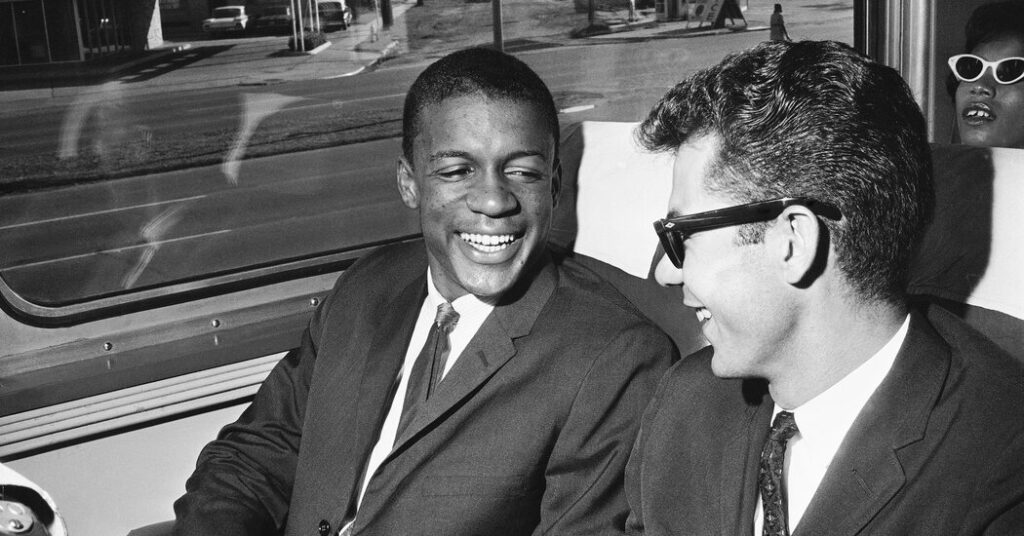
Jerome Smith, who as a young Freedom Rider in 1961 was jailed and beaten for his efforts to desegregate transportation in the South, and who excoriated Attorney General Robert F. Kennedy for not doing enough to protect him and the other riders during that harrowing year, died on Aug. 21 at his home in New Orleans. He was 87.
His daughter Farin Smith said the cause was cancer.
When the first Freedom Riders set forth in early May 1961, Mr. Smith was 21 and had dropped out of Southern University in Baton Rouge, La., to devote himself to the Congress of Racial Equality, the civil rights organization known as CORE.
It had been 15 years since the Supreme Court had ruled that segregated seating on interstate buses was unconstitutional. Yet the Southern states had largely ignored the decision. CORE organized a series of Freedom Rides — beginning with teams of Black and white activists who would travel by bus from Washington to New Orleans — to put the ruling to the test, challenging the federal government to finally enforce it.
Mr. Smith — who was stuck in jail in New Orleans, having been arrested after participating in a lunch-counter sit-in — was unable to join the first ride. That journey ended in bloodshed in Alabama, where the young riders were beaten and one bus was firebombed. Senior CORE organizers urged a halt to the rides, but the activists regrouped, and by the end of the month, participants from all over the country were once again heading into the South.
On May 24, Mr. Smith, finally released from jail, boarded a Greyhound bus in Montgomery, Ala., for a ride to Jackson, Miss., where he was promptly arrested. “Breach of peace” was the charge, a coy workaround to flout the law. Like hundreds of other riders who poured into Mississippi that spring, summer and fall, Mr. Smith and his group were moved to Parchman, the notoriously brutal state penitentiary, where they spent their weeks of incarceration irritating the guards by singing protest songs.
Mr. Smith’s second ride was more perilous. On Nov. 29, he and four other CORE members from New Orleans, including 18-year-old Doratha Smith-Simmons, rode a bus to McComb, Miss., a fiercely segregationist community.
The Justice Department had ordered the removal of Jim Crow signs from McComb’s bus terminal. Although the mayor complied, he declared that “our local people are going to respect the color line whether the signs are there or not,” as the historian Raymond Arsenault recounted in “Freedom Riders: 1961 and the Struggle for Racial Justice” (2006).
When Mr. Smith and his group walked into the bus terminal, they were ambushed, beaten with brass knuckles and sticks, and kicked to the pavement outside.
“I thought we would die that day,” Ms. Smith-Simmons said in an interview. She recalled how Mr. Smith had taught her and the others about techniques of nonviolence, and how, the winter before, he had led them in 24 hours of silent fasting in a schoolyard.
“It taught us confidence and it taught us courage,” she said. “It changed my life.”
Mr. Smith suffered a traumatic brain injury from his beating, and for the rest of his life he was bedeviled by headaches and mood swings. Yet he kept working with CORE, traveling the country to raise funds and going through the rural South to register Black voters.
In May 1963, he was in New York City being treated for his lingering injuries when James Baldwin, the celebrated Black author, invited him to a meeting that Mr. Kennedy, the attorney general, had asked Mr. Baldwin to organize with other civil rights advocates, including the playwright Lorraine Hansberry, the musicians Lena Horne and Harry Belafonte and the actor Rip Torn.
The topic was racial justice in Northern cities. But when Mr. Kennedy began to speak about the Justice Department’s efforts, things took a turn.
Mr. Smith began to weep. He angrily declared that he had seen federal forces do little more than stand around as he and his friends were beaten nearly to death. He said that he thought it was hypocritical for the government to ask for his patriotism in supporting the war in Vietnam when it would not protect him and other Black Americans. He added that he would rather die than raise a gun against the Vietnamese people, but that his pacifism was being put to the test at home: He was, he said, “close to the moment where I’m ready to take up a gun.”
Enraged, Mr. Kennedy turned away, at which point Ms. Hansberry and the others lit into him.
“You’ve got a great many very, very accomplished people in this room, Mr. Attorney General,” she said, as Arthur Schlesinger Jr. reported in “Robert Kennedy and His Times” (1978). “But the only man who should be listened to is that man over there,” meaning Mr. Smith.
The meeting devolved from there. Mr. Kennedy seemed incapable of understanding the passion and frustration of the group, and after three hours, the activists walked out. “They seemed possessed,” Mr. Kennedy later told Mr. Schlesinger.
But, Mr. Schlesinger wrote, Mr. Kennedy “began, I believe, to grasp from the inside the nature of Black anguish.”
Mr. Smith said in a 1988 oral history for the Kim Lacy Rogers Collection at the Amistad Research Center in New Orleans that the meeting was a pivotal moment for everyone in the room.
“I remember sitting here and Robert Kennedy sitting there,” he recalled, “and seeing him tremble from the impact of what that struggle gave to me to bring to him.”
Jerome Smith was born on May 21, 1939, in New Orleans. His father, Walter Smith, was a merchant seaman. His mother, Leona (Juluke) Smith, was a seamstress who also worked as a domestic.
He came by his activism naturally; his parents practiced a resolute defiance of Jim Crow laws in their daily lives. Mr. Smith liked to tell the story of how, after seeing his father move a “whites only” barrier on a streetcar to claim a seat, he did the same while riding alone one day when he was 10.
He said he was scooped up by an older Black woman who berated him for his foolhardiness — but, once she hustled him off at the next stop, she threw her arms around him and cried, “Don’t you ever stop doing that!”
Later in life, he remained a stickler for racial justice, forbidding his children to recite the Pledge of Allegiance in class because, as his daughter Farin recalled him telling her principal, “My kids will not honor the American flag because the American flag does not honor Black children.” Nor did they attend school on the Rev. Dr. Martin Luther King Jr.’s birthday, long before it became a federal holiday.
In addition to Farin Smith, Mr. Smith is survived by his daughters Kami and Saidah Smith; his son Jerome Jr.; his brothers, Walter Smith Jr. and Archie Sampier; his companion, Cynthia Thornton; and 11 grandchildren. His sons Juden, Tarik and Taju Smith predeceased him, as did his grandson Tarik Jr. His marriage to Betty Watler ended in divorce.
In 1968, he co-founded Tamborine and Fan, an organization that offered to New Orleans children programs in academics, sports, arts and civic engagement, all infused with the city’s Black cultural and musical traditions. He never retired.
He earned the nickname Big Duck, because children followed him around like ducklings.
“He was a pied piper,” Don Hubbard, a New Orleans community activist and entrepreneur, and a friend of Mr. Smith’s from the CORE days, said in an interview. “Education was always his focus and he never got out of that lane.”
In the oral history, Mr. Smith said, “I think the movement was a prayer, the struggle was a prayer, and the failure of the struggle has been our inability to maintain that prayer.”
But, he added, he now saw the struggle succeeding — “through the children.”
The post Jerome Smith, Freedom Rider Who Challenged Robert Kennedy, Dies at 87 appeared first on New York Times.