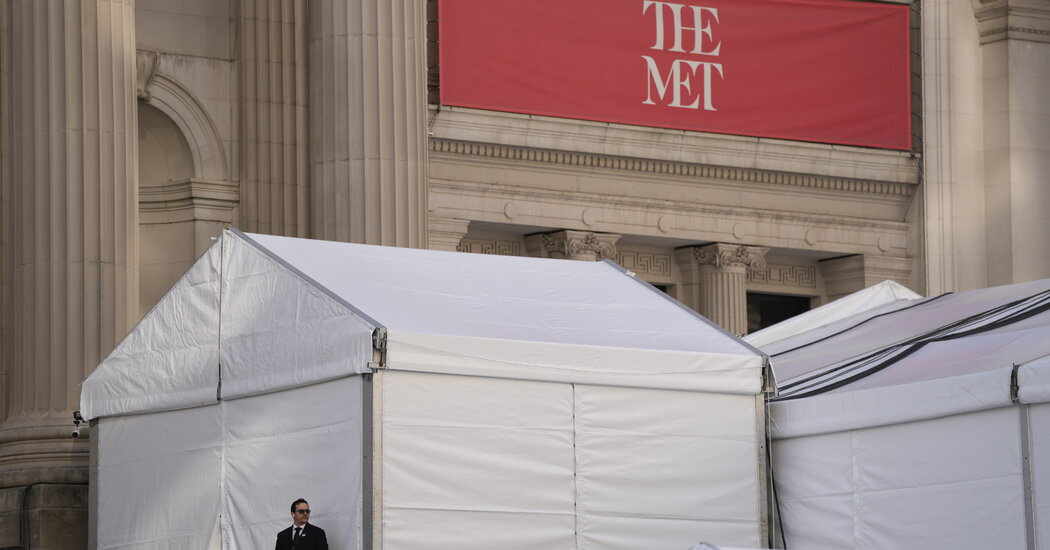
There are many questions to be asked about the Metropolitan Museum of Art’s decision to dedicate its spring Costume Institute exhibition to the designer John Galliano, and then to cancel it when the backlash came. Did organizers, including the Met trustee Anna Wintour and the Costume Institute curator Andrew Bolton, think that, after a stint in rehab and a multitude of apologies, the past had been forgiven — or perhaps even forgotten? Did Ms. Wintour’s loyalty to her talented but troubled longtime friend so cloud her judgment that she thought she could just will his slate clean?
I understand the outrage and the objections over “John Galliano: Horizons.” But the exhibition should not have been canceled. Instead, the Met Gala should have been canceled.
The ball has long overshadowed the exhibition. In the fashion ecosystem, it’s the Super Bowl and the Oscars rolled into an hourslong red carpet featuring extraordinary artistry, flashes of buffoonery and long-suffering fans waiting and waiting … and waiting for Rihanna or, perhaps, Beyoncé.
The gala traditionally takes its dress code from the exhibition. Did Ms. Wintour expect guests to arrive wearing vintage Galliano? Did she want them to show up dressed like a pirate or one of the other outlandish characters that Mr. Galliano would often portray when he took his bows as the creative director at Dior? Did she want a circus?
In 2011, a French tribunal found Mr. Galliano guilty of making hateful remarks about Jews and Asians. His antisemitic comments were vicious and bigoted, and were not a one-off incident fueled by a singularly bad alcohol-drenched night. Mr. Galliano was a repeat offender.
The designer was fired from Dior. He tried to make amends by studying the Holocaust and antisemitism. Ms. Wintour stood by him. Three years after his professional conflagration, Mr. Galliano was hired as creative director for Maison Margiela. Now he works with Zara.
Mr. Galliano has been a design force for more than four decades. He was among the first generation of designers brought into luxury conglomerates to energize dusty brands and make them palatable to a younger, global consumer. His vividly realized runway dramas were a how-to for the Instagram era.
And then he set it all aflame with hateful words. Or perhaps hate in his heart.
This is a worthy subject for an exhibition.
Maybe I had too much faith in Mr. Bolton, but I wanted him to mount a show that would examine Mr. Galliano’s profound failings closely and without hesitation — not as unfortunate asides to his career but as something central to it. I also wanted him to help museum visitors understand the ways in which Mr. Galliano’s creativity had always been fueled by dark musings about cultural outliers.
“I believe deeply in the responsibility of museums to examine difficult histories with rigor, candor and care,” Mr. Bolton said in a written statement. “I also recognize the pain and concern this exhibition has caused. After extensive discussion, I support the decision not to proceed.”
I believe Mr. Bolton could have helped people understand how antisemitism takes root and grows in the mind of someone like Mr. Galliano. He regularly romanticized the disenfranchised and idolized hierarchies. In the collections he showed under his own name, as well as those from his time at Dior, he fetishized royalty as well as homelessness. He took liberties with Hinduism and Maasai culture. Trying to understand Mr. Galliano could help us make sense of other contradictions in character, of how hate hides in shadows.
It could also help us, perhaps, understand something of ourselves. Or of the animal instincts that drive the fashion world. Or perhaps of Ms. Wintour herself, and what propels her toward the sometimes perverse creative gesture in her search for the new.
The Met is the world’s most prominent museum with a department dedicated to fashion — not historical costume, but the kind of fashion that’s part of contemporary life. Almost every time I’ve visited the Costume Institute, I’ve overheard someone remark that a dress or a coat or a pair of shoes on display reminds them of something in their own closet. The Costume Institute, no matter how rarefied its collection or how high-minded its exhibitions, speaks intimately to people because it explores an enduring question: How do you construct a personal identity for all the world to see? How did Mr. Galliano construct his identity?
Critics of the now-canceled exhibition are right that the designer should not be venerated. The proposed exhibition on Mr. Galliano’s work was an acknowledgment of his influence, not a judgment of his morality. Hagiography was not preordained.
The Met Gala was an entirely different concern. And that’s what should have been canceled. It never should have been attached to this exhibition.
In addition to Ms. Wintour’s enduring, and perhaps blind, loyalty to Mr. Galliano, she rules over the gala, which has raised more than $200 million for the Costume Institute. The department, which relies on the gala for its funding, has been building a nest egg so that it is not forever dependent on Ms. Wintour’s party-planning expertise. This would have been a fine year to reconsider its relationship to the so-called party of the year, which has also been a point of protest over the war in Gaza and the growing clout of America’s billionaires. There surely would have been protests against Mr. Galliano, too.
Museums help society undertake painful conversations, to contextualize art and craft and to explore confounding contradictions. I am desperate for our cultural institutions to have an intellectual spine at a time when the political currents are eroding access to terrible truths and our ability to sit with anger and pain. Perhaps I’m naïve, but I thought museums were where these hard considerations were supposed to happen. Canceling the exhibition will not make the pain go away — or prevent someone else from causing more of it.
In explaining his opposition to the exhibition, Elisha Wiesel, the chairman of the Elie Wiesel Foundation, said: “If someone had screamed the worst racial epithet you can imagine, said, ‘You’re a horrible Black person and your ancestors would have been hung from a tree,’ you could not imagine them being honored by a prominent cultural institution.”
No one has to imagine enslavers and racists being honored. They are revered by this very nation. Look around. Our public squares are still filled with odes to Thomas Jefferson, Woodrow Wilson, Robert E. Lee and assorted other hallowed figures who degraded Black people. When activists forced the dismantling of some of the public monuments to them, some were pointedly reinterpreted in museums. That’s where we should put our dangerous desires and base instincts under a microscope.
Perhaps if the Costume Institute weren’t so firmly tethered to a pop culture juggernaut, critics would have been more willing to believe that a serious and meaningful look at Mr. Galliano’s life was possible. They might have allowed that a survey mounted now, while he is alive, would force people, including Mr. Galliano, to wrestle with his words and deeds in the context of today’s politics and emotions. The past, after all, is not past.
There’s no exhibition. Some may reasonably breathe a sigh of relief. But nothing else has changed.
Robin Givhan is a Pulitzer Prize-winning fashion critic and a former senior critic at large for The Washington Post.
The Times is committed to publishing a diversity of letters to the editor. We’d like to hear what you think about this or any of our articles. Here are some tips. And here’s our email: [email protected].
Follow the New York Times Opinion section on Facebook, Instagram, TikTok, Bluesky, WhatsApp and Threads.
The post Cancel the Met Gala Instead appeared first on New York Times.