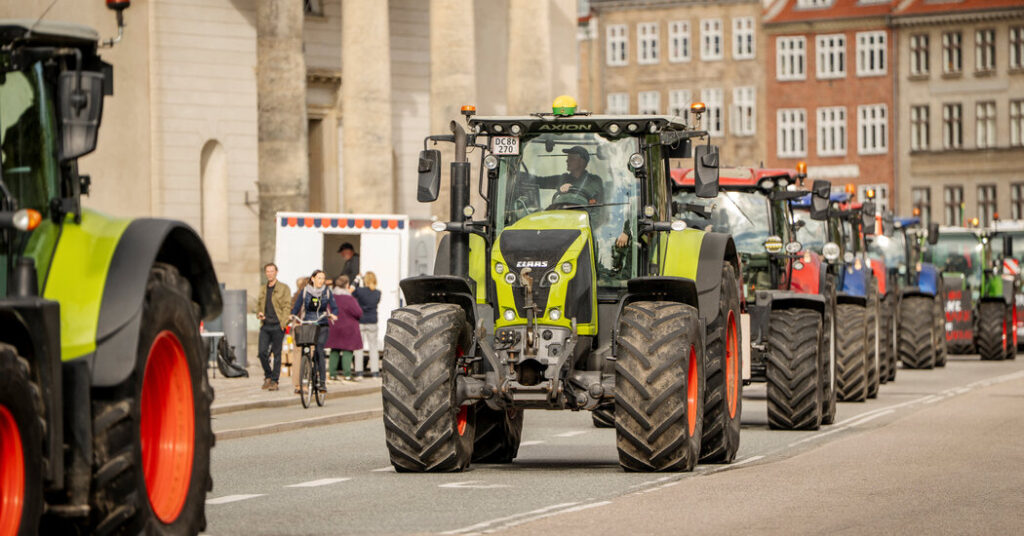
Commuters heading into Denmark’s capital on Tuesday morning encountered an unusual traffic snarl: a three-kilometer column of tractors crawling toward Copenhagen, carrying farmers protesting a proposed fertilizer law they say could upend their livelihoods.
One of them was Vagn Lundsteen, 69, who grows rapeseed, barley, wheat, corn and peas on a farm west of the capital.
“We’re not just going to walk up to the guillotine and have our heads chopped off,” he said from his tractor as he chugged toward the Danish Parliament.
Hundreds of farmers and tractors gathered outside the parliament building as lawmakers discussed the fertilizer bill, which has broad cross-party approval and is widely expected to pass in a vote on Thursday.
The new rules would impose stricter limits on how much nitrogen farmers can send into nearby waters. To meet water quality targets, farmers in some areas would have to use less fertilizer, change crops or farm some land less intensively. The rules would take effect next year or, for some farmers, in 2028.
The proposed rules are meant to limit water pollution, but farmers say they could cut yields and make some farms impossible to run profitably.
“If this is passed on Thursday as it stands now, I can’t justify farming anymore,” said Jens-Ole Dilling, a seventh-generation grain grower.
Mr. Dilling, who said his family had worked the same land northwest of Copenhagen for 220 years, watched with other farmers on a giant screen outside Parliament as lawmakers debated inside.
Brightly-colored tractors rolled past on the square, honking their horns as protesters held signs reading “No farmer, no food, no future.” Many wore green caps stamped “Fired by the state.” Some ate carrots from a feeding trough carrying the words “The last Danish carrot.”
Denmark is not alone in tightening fertilizer rules, as European Union regulations limit the amount of manure farmers can spread on their fields. The Danish proposal would focus even more directly on the environmental impact of nitrogen runoff by toughening restrictions in areas draining into vulnerable fjords.
Nearly 60 percent of Denmark’s land is used for agriculture, according to official statistics. The country’s center-left governing coalition says existing rules have failed to protect struggling marine environments and that a more targeted system is needed.
“What we are doing today, we should have done yesterday,” Christian Rabjerg Madsen, the minister for nature and animal welfare, told a crowd of about 4,500 farmers and agricultural workers at an tense gathering on Monday in Odense, about 100 miles west of Copenhagen. His speech was met with boos and foghorns.
“We cannot make it our children’s problem,” he said.
The fertilizer debate also reflects a broader change in Denmark, where farming has become more distant from the everyday lives of much of the population even as environmental concerns have gained prominence.
Niels Thulesen Dahl, a political analyst for Jyllands-Posten, a Danish newspaper, said in an interview that the country had “moved away from the agricultural roots it came from.”
“Agriculture matters much less in Denmark today, and most people — myself included, even though I come from an old farming family — live lives completely detached from it,” he said. “That gives people very different priorities.”
But some Danes are still attached to those agrarian roots.
In Copenhagen, Mariette Grathwohl, a 26-year-old schoolteacher, said she had “grown up in a tractor” on her family’s farm. Around her, protesters watching the parliamentary proceedings cheered and booed lawmakers as if they were watching a football match.
“We used to talk about how great it would be to take over the farm,” Ms. Grathwohl said. “Now you start asking: Do you even dare?”
The post Tractors Clog Copenhagen as Farmers Protest Fertilizer Restrictions appeared first on New York Times.