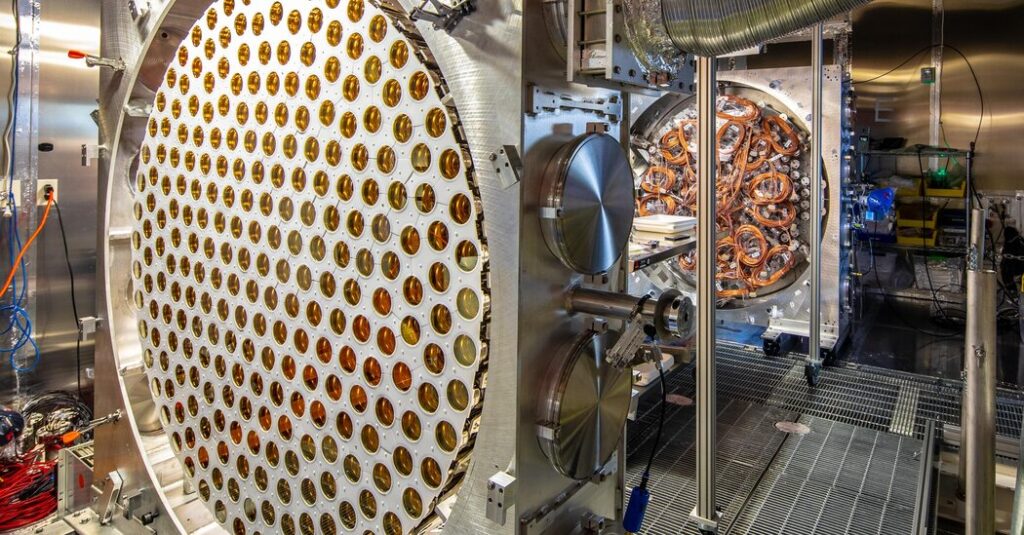
Hundreds of physicists have spent years scrutinizing the data from a detector deep underground, listening for the faintest whisper from a part of the universe that is dark and out of reach. They’re running the LZ Dark Matter Experiment, in search of the invisible substance whose gravity drives the motion of galaxies and stars.
They may have finally found something.
The researchers shared a tantalizing new result on Tuesday in a paper describing a single, tiny nudge of one particle into another. This caused a curious signal to be recorded by the LZ detector, which is at the Sanford Underground Research Facility in South Dakota.
The physicists are careful not to claim that they detected dark matter. But they are saying that the event doesn’t fit the description of any other known particle interaction in the subatomic world.
“At this point, we’re interested to get feedback from the wider scientific community,” said Richard Gaitskell, the spokesperson for the LZ collaboration. “After doing so much work internally, we felt ready to talk to the rest of the world about the results.”
The findings were first announced at a particle astrophysics conference in Japan. Hours later, the LZ collaboration uploaded a paper detailing the results to a preprint server. The paper will be submitted to the journal Physical Review Letters for peer review.
“I’m super, super excited,” said Katherine Freese, a theoretical physicist at the University of Texas at Austin who was not involved in the work. She added that the techniques the LZ team used to analyze its data were “phenomenal.”
Dark matter has evaded direct detection for decades because it does not emit, absorb or reflect any light. It is as pervasive as it is inaccessible, making up 85 percent of the matter in our universe, a tease for the particle physicists keen on deciphering its nature.
Theorists have concocted dozens of ideas for what kind of particle dark matter might be and how it might interact with ordinary matter. Among the most popular candidates is the weakly interacting massive particle — known cheekily as the WIMP — which is relatively heavy by subatomic scales and mostly engages with the visible universe through gravity.
Very rarely, so the theories say, WIMPs can also bump into atomic nuclei, a collision that creates a small but detectable amount of energy.
Experimental physicists have spent decades chasing such a signal in ever larger particle detectors, hoping to catch a WIMP in action. In spite of increasingly sophisticated techniques, their searches have come up short.
Until maybe now. The LZ detector is a tank filled with more than seven tons of liquid xenon. Particles that enter the tank and interact with the xenon atoms create characteristic flashes of light, as well as a stream of electrons. Such signals can be used to determine information about the incoming particle, including its mass and position inside the detector.
LZ physicists go to great lengths to maximize their chances of detecting a WIMP, lest the signal get overshadowed by the plethora of other interactions that show up in the detector, caused by particles already known to physicists.
“It’s kind of like looking for a needle in a haystack,” said Alvine Kamaha, an LZ physicist at the University of California, Los Angeles, who helped oversee the construction of the detector.
The experiment lives a mile underground because the bedrock shields it from the shower of radiation coming from space, which would otherwise produce thousands of particle interactions in the LZ detector each second. Water surrounds the detector to block neutrons, which can create signals that mimic those made by dark matter. And the xenon is purified to prevent any radioactive contaminants that could also cause undesired particle events.
The result, physicists hoped, was a detector quiet enough to hear a WIMP.
For months, the LZ experiment recorded dozens of particle interactions each day. Researchers sifted through 220 days of that data and threw out anything that didn’t match the simplest theoretical profile of a WIMP interaction. At first, they found nothing. But then they expanded their search to consider hypothetical WIMP particles from more complicated theories.
What was left was just one event: a particle that slipped into the detector on June 16, 2023, and bumped into the nucleus of a xenon atom, exposed by a flash of light and a stream of charge.
The detection has about a 1 in 400 chance of being a fluke, or a confidence level of around 3-sigma, in the units of uncertainty preferred by particle physicists. (A confidence level of 5-sigma is the gold standard to claim a discovery.)
The lone event is intriguing, Dr. Gaitskell said, but that it’s possible it could be ordinary matter interacting in a way that scientists just don’t understand very well.
Only time — and more data — will tell. The detector has since recorded nearly four times as many events as what was used in the latest study, so the LZ team has a lot more particles to sift through. Two other experiments, in Italy and China, are also hunting for dark matter using liquid xenon detectors.
Dr. Gaitskell acknowledged that he did not have enough information to know whether those experiments would be able to shed light on LZ’s mysterious particle. “But it would be my hope,” he said. “That’s how science is supposed to develop.”
In the meantime, the search continues.
The post Dark Matter Has Eluded Capture for Decades. Did It Just Leave a Trace? appeared first on New York Times.