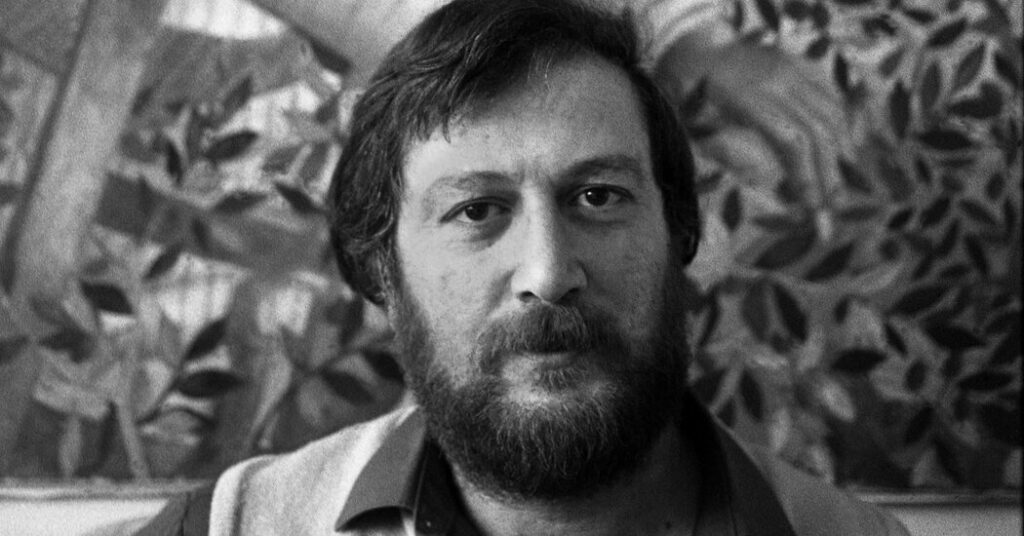
Sliman Mansour, a painter and sculptor whose socialist-realism style of images depicting the struggles of Palestinians made their way into hundreds of homes as inspirational posters, died on Aug. 24 in East Jerusalem. He was 79.
His death, in a hospital, was announced by his family, who did not specify a cause.
Mr. Mansour painted idealized images of heroic Palestinian women, men and children against the backdrop of a landscape — filled with olive groves, orange trees, terraced gardens, stone houses — that he had known as a child but that now in many cases no longer exists, after years of Israeli settlement.
His brightly colored canvases — reminiscent of the Mexican muralist Diego Rivera, whom he admired, and with hints of Chagall — were explicitly political. The symbolic images that bedecked his paintings, including olive branches, guns and doves, were easily understood and translated readily into widely reproduced posters.
That earned him unwanted attention from Israeli authorities but also hundreds of thousands of dollars from rich collectors and museums in the Arab world. Major collections — the Arab World Institute in Paris and the Guggenheim Abu Dhabi, among others — hold his work.
His best-known image, the oil painting “Camel of Hardship” (1973), is of an elderly, hunched-over Palestinian man struggling under the burden of an image of Jerusalem, which he carries in a sack on his back. It exists as a poster in many Palestinian homes.
Another painting, “The Sea Is Mine” (2016), shows a boy, a girl and a woman striding impassively forward along a beach; in the background, impervious Israelis sun themselves, while the three figures, under a flying dove, hold aloft a gun, a key and a set of paint brushes.
“The artistic was the vehicle for the political” in Mr. Mansour’s art, the Palestinian art scholar Sascha Crasnow, an assistant professor at Drake University in Iowa, said in an interview. “He’s creating the Palestinian iconography, an iconography that clearly had national meaning,” Professor Crasnow said, calling Mr. Mansour “extremely foundational” for Palestinian art.
“He is an important artist,” the Palestinian-American artist and scholar Samia Halaby said of Mr. Mansour in a 2012 interview with the online magazine Jadaliyya. She also called him one of the best-known of all Palestinian artists, noting his role traveling back and forth through Palestinian villages after the 1967 Arab-Israeli war to connect artists and youth and to highlight the importance of art as a tool of liberation.
Mr. Mansour depicted the commitment of his own art to politics less as a matter of choice than of necessity.
“I reflect, in my art, my way of life; and my bad luck is that I am under occupation,” he told Germany’s Deutsche Welle radio in a 2018 interview. “I didn’t choose that. It would be surrealistic to live under occupation and to paint nice flowers and beautiful women, and everything is so nice.”
He made money from his art — a print of “The Sea Is Mine” sells for more than $1,000 at the Zawyeh Gallery in Ramallah — but he was hardly immune from the humiliations of Palestinian life.
As he recalled in a 2018 interview with the BBC, an Israeli officer summoned him to his office in 1980 and said, “Why are you making political paintings, why don’t you paint a nice flower?” After that, Mr. Mansour vowed to never make paintings of flowers.
In 1981, he was arrested and jailed for two weeks. “No reason,” he told the BBC. He was with family in Nablus, “photographing villages,” he said, when the authorities, “stopped me and took my film.”
A bag was slipped over his head, and he was handcuffed and beaten, he later told the art news website Hyperallergic in 2023.
Despite this, he refused to leave the land from which he drew inspiration.
“Everything is complicated here,” he told Deutsche Welle. “They want to complicate our lives, and their end aim is for you to be fed up and leave. That’s why I don’t want to leave, no matter what happens.”
Sliman Anis Mansour was born on July 27, 1947, in the village of Birzeit, north of Jerusalem, in what was then the British Mandate of Palestine.
He was 4 when his father, Anis Mansour, a farmer, died, and Sliman and his five siblings were largely raised by their mother, Kamal (Shaheen) Mansour. She “spent all her time working, sewing clothes to make a living for us,” he recalled to Deutsche Welle. “She didn’t have time to talk to us.”
He developed an early interest in drawing and was accepted for study at the Art Institute of Chicago but was prevented from going by the outbreak of the 1967 war. He then enrolled at the Bezalel Academy of Arts and Design in Jerusalem but left in 1970 before graduating.
The fashion, then, was for abstract expressionism, but Mr. Mansour said to Deutsche Welle that he detested it, sticking with a kind of realism to which he remained faithful throughout his career.
In the early 1970s, he and several peers co-founded the League of Palestinian Artists and committed themselves to producing work that could be printed on posters, to gain the widest possible diffusion.
In 1987, in response to the first intifada, a series of Palestinian protests and uprisings, he and others founded a group they called New Vision, vowing to boycott Israeli-produced artists’ supplies and opting for natural materials derived from the soil: mud, straw, wood, leather and henna.
Mr. Mansour produced a number of sculptural works using mud, a material he told the German radio station “reflects the human fate, with the cracks, people waiting to disappear, fall down and go away.”
In 1978, he married Hanan Kattoua. Besides his wife, he is survived by two sons, Fares and Bassel; two daughters, Sahar and Abeer; three sisters, Hilaneh, Adibeh and Aniseh; two brothers, Adib and George; and five grandchildren.
“His art was deeply rooted in the Palestinian experience,” his son Bassel wrote in an email. “He used it both as a form of resistance to the Israeli occupation and as a means of preserving Palestinian identity, memory and attachment to the land.”
Increasingly pessimistic about the prospects for peace, and for his own people, Mr. Mansour told interviewers toward the end of his career that he was turning away from the “heroic” subjects of earlier years.
“I can’t make heroic paintings like I used to,” he told the BBC in 2018. “I can’t make nice landscapes now. Everything is destroyed.”
Alain Delaquérière contributed research.
The post Sliman Mansour, Artist Who Depicted Palestinian Struggle, Dies at 79 appeared first on New York Times.