A federal judge struck down the New York State’s new climate “superfund” law on Monday, ruling that it conflicted with federal law.
The New York law was modeled on the 1980 federal Superfund program to clean up industrial waste, and several other states have been considering similar climate legislation. Republican-led states, the Trump administration and business groups have challenged New York’s law as well as a similar one in Vermont.
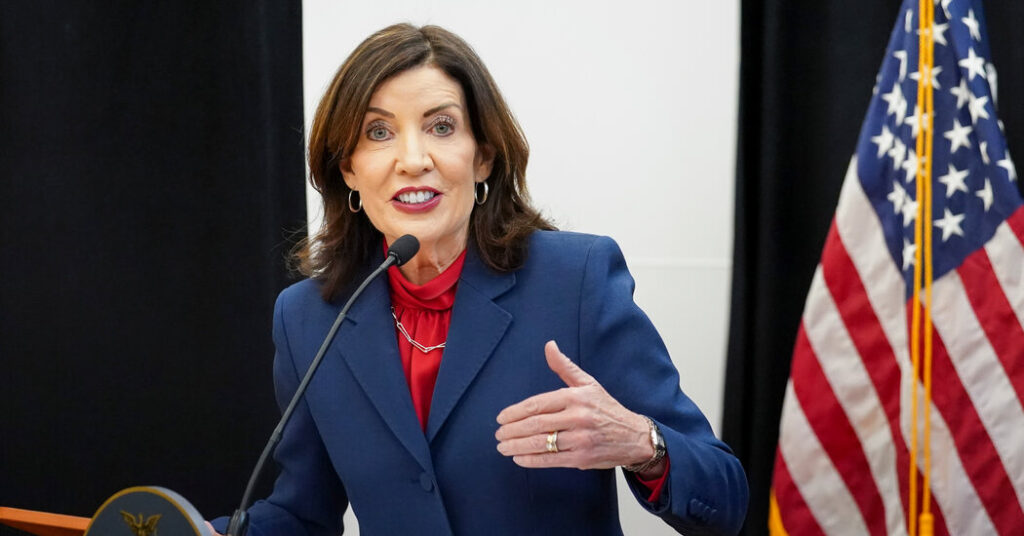
The Climate Change Superfund Act was signed by Gov. Kathy Hochul in 2024 and required large fossil fuel companies to pay $75 billion over 25 years for projects to bolster the state’s ability to withstand the extreme weather associated with global warming.
Judge Brenda K. Sannes, an Obama appointee and chief judge for the Northern District of New York, ruled that the “unusual and sweeping statute” was unenforceable. She wrote in the 63-page decision that its ambitions surpassed the limits of state law. The judge relied heavily on a 2021 decision by the Second Circuit Court of Appeals dismissing a lawsuit by New York City against oil companies that argued that the companies should pay for the damage caused by climate change. The so-called polluter pays principle is also central to the “superfund” laws.
State Senator Liz Krueger, a sponsor of the law, on Tuesday called it “unfortunate” that Judge Sannes did not recognize a distinction between a suit like New York City’s and “a state legislature exercising its constitutional powers to raise revenues and protect its citizens.” She said she had expected “many rounds of legal wrangling” before the law could take effect.
Attorney General J.B. McCuskey of West Virginia, whose office led the challenge, called the decision “a major victory in the fight against liberal states, trying to balance their budgets on the backs of our hard-working men and women in the coal, oil and gas industries.”
It was unclear whether the state would appeal. New York officials are likely to face pressure from environmentalists to fight on. Maya Golden-Krasner, deputy director of the Center for Biological Diversity’s Climate Law Institute, who is based in Los Angeles, said New York should appeal and that a campaign for a similar law in California was “gaining momentum every day.”
The burning of fossil fuels is accelerating global warming and leaving states and cities with mounting bills from storms, flooding and other effects. But who should pay for that remains hotly disputed.
West Virginia and other Republican-led states, along with business organizations, had argued that New York’s law was blocked by the Constitution as well as the federal Clean Air Act. They said the law was an attempt to regulate greenhouse gases, which is the purview of the federal government.
The lawyers for New York disputed that premise, saying the law did not set standards for greenhouse gas emissions. They failed to persuade Judge Sannes.
Neil Bradley, executive vice president and chief policy officer for the U.S. Chamber of Commerce, one of the plaintiffs, said the court had “sent a strong message to states: The Constitution does not allow you to fill your budget holes by punishing businesses for lawful conduct.”
It was not immediately clear whether New York would appeal. “Taxpayers shouldn’t have to foot the bill for damages caused by polluters,” said Ken Lovett, senior communications adviser on energy and environment for Governor Hochul. “We are reviewing the decision to determine possible next steps.”
The Justice Department had argued in support of the lawsuit at a hearing before Judge Sannes last month, and has filed its own suit against the New York law in the Southern District of New York, which is pending. Vermont, the only other state to have passed a climate superfund law, is facing a parallel legal challenge. Similar bills proposed in other states have not been passed into law.
The new laws came about after years of still-unresolved litigation by state and local governments against oil companies to force them to pay for the effects of the use of their products. Those lawsuits, some two dozen of which remain pending, argue that the companies covered up what they knew about the dangers of global warming for decades.
None have yet gone to trial. In October the Supreme Court is set to hear arguments in one of the cases, brought by Boulder, Colo. The defendants in that case, Suncor Energy and Exxon Mobil, have asked the Supreme Court to review a Colorado Supreme Court decision allowing the case to proceed.
The Supreme Court will be considering the same key question that Judge Sannes ruled on: Whether federal law precludes state-law cases seeking damages for the effects of climate change. The decision will have major consequences for the lawsuits and the climate superfund laws.
The litigation is playing out amid an effort to pass laws at the state level shielding fossil fuel companies from liability over climate change, which achieved several successes this year. Federal bills have also been introduced in the House and Senate.
The post Judge Strikes Down New York’s Climate ‘Superfund’ Law appeared first on New York Times.