I attended a military retirement ceremony last month at which Gen. Dan Caine, the chairman of the Joint Chiefs of Staff, was the presiding officer and featured speaker. It was eerily, even alarmingly normal. In a large room full of current and retired senior military officers, everyone was playing the same game of “Let’s pretend everything is fine.”
Denial is one of the two approaches the nation’s senior military leaders seem to have taken to cope with Donald Trump’s presidency. When they aren’t ignoring how abnormal things have become, they turn to the other approach, claiming that they have no responsibility for the actions the armed forces have been ordered to take because those orders were “policy” choices outside the scope of their duties. This is a cop-out, and it is putting our democracy at risk.
General Caine has even advocated this strategy. In a recent speech to graduates at the National Defense University, he talked about the need for “perfect beautiful clarity” on the distinction between two questions: Can we do something? and Should we do something? The “can” question was a military matter, he explained. The “should” is “at the policy level, and we don’t do that,” he said.
The message is that a senior officer’s only professional obligation is to tell the president and the secretary of defense whether the military can do whatever civilian leadership asks it to do; that a senior military leader has no duty to say whether the military should do the things the president wants, and that it would be wrong to try.
It isn’t that simple.
The Trump administration is committing acts that military officers should consider outrageous and unacceptable. The military has conducted extrajudicial executions of alleged drug dealers at sea and of a country’s head of state, along with several of his family members. The administration has kidnapped another head of state. And the president started a war without even consulting Congress, much less obtaining congressional authorization. In an indication of what may be still to come, the president has put National Guard troops on the streets of Democratic-governed cities without local leaders’ request or consent.
Many lower-level officers I have spoken with are privately appalled but afraid to challenge what they are seeing. The collective hope seems to be that if they can all just go on as if nothing unusual is occurring, that this time will pass and nothing bad will happen to them — no loss of position, no demotion or forced retirement, no loss of reputation, no removal from a promotion list by Defense Secretary Pete Hegseth.
But all officers take an oath to “support and defend the Constitution of the United States against all enemies foreign and domestic.” This demands that they think about what the military should or should not do and advise the president and the secretary of defense on the policy choices they make. It also means that there are some lines that they cannot cross, even if ordered to do so by the commander in chief. The country’s top military leaders serve at the very nexus of the application of military force and policy; that role requires them to be more than mere military technocrats.
As secretary of the Air Force, I recommended many officers for four-star positions. These jobs require the character and courage to do one’s duty and behave honorably whatever the personal consequences. I have been asked by some retired officers if it is fair to expect a senior military leader to stand up to or refuse to accept an immoral, unethical or illegal order from the president or the secretary of defense — particularly when a senior leader gets supposedly independent guidance from a government lawyer to accept the order.
But fairness is irrelevant. It also isn’t fair to send some people into combat and not others, yet the responsibility comes with the job, and no one is forced to accept these positions.
At the start of his second term, Mr. Trump removed one of the finest officers I have ever known, Gen. Charles Q. Brown Jr., as chairman of the Joint Chiefs. I always thought well of General Caine, but he lacks the experience and stature that General Brown had. Mr. Trump and Mr. Hegseth do not want candid, sound and independent advice from senior military leaders, including General Caine. They want personal loyalty and compliance with their orders.
To ensure this result, the president and secretary of defense replaced senior military lawyers with loyalists who seem willing to support legal justifications for the things the executive wants to do, however frivolous or flawed. For the most part, Mr. Trump seems to be getting what he wants from his lawyers and from his generals.
Our senior military leaders, including General Caine, might face even tougher tests from here. Although General Caine has indicated that there are no plans for the use of troops in the midterm elections, Mr. Trump has refused to rule out the possibility. No pretense of normality, no artificial distinction between policy and military matters, and no lawyer’s justification can relieve our senior military leaders from their oath, the burdens of their conscience, or of the judgment of the men and women they lead, the American people and history. From all of these, there is no place to hide.
Frank Kendall was the secretary of the Air Force from 2021 to 2025. He is a senior fellow at the Center for American Progress and the author of “Lethal Autonomy: The Future of Warfare, Whether We Like It or Not.”
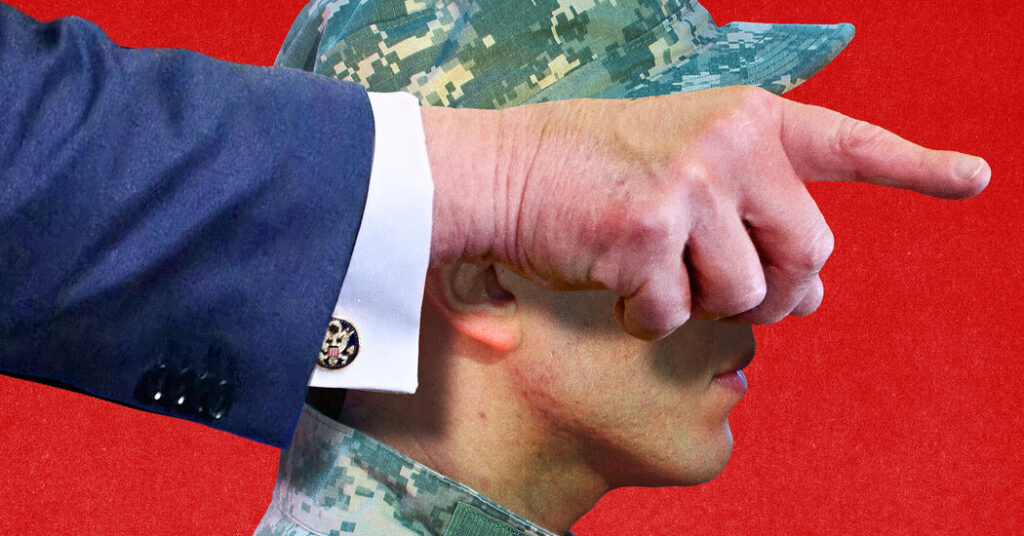
Source photographs by Saul Loeb and ajr_images/Getty Images.
The Times is committed to publishing a diversity of letters to the editor. We’d like to hear what you think about this or any of our articles. Here are some tips. And here’s our email: [email protected].
Follow the New York Times Opinion section on Facebook, Instagram, TikTok, Bluesky, WhatsApp and Threads.
The post Military Officers Can’t Look Away From This Any Longer appeared first on New York Times.