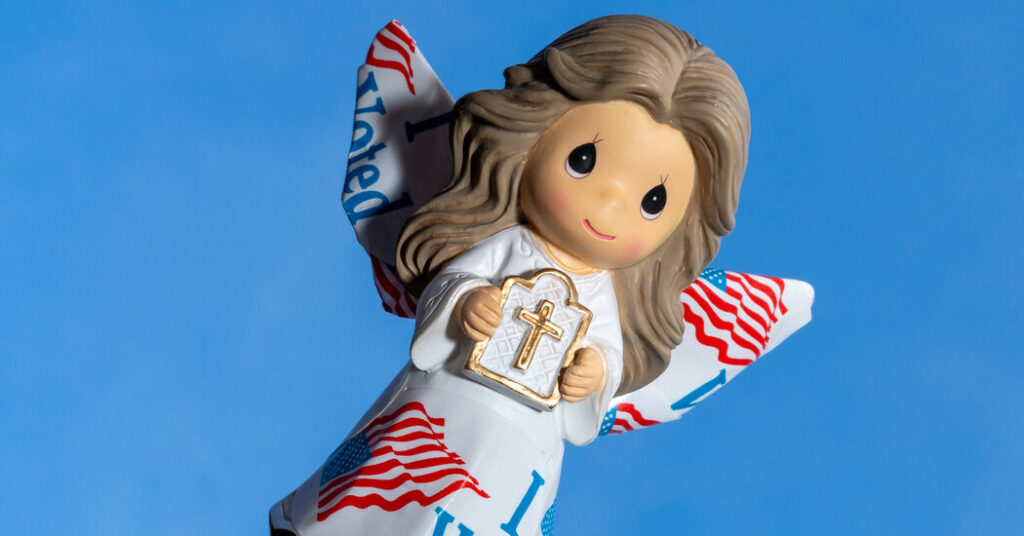
For more than half a century, floral-covered Bible study guides, inspirational home décor and popular novels have taught Christian women what to believe, how to live and also how to vote.
The consistent messages across this vast cultural universe are that women’s place is in the home, femininity is a religious duty, hierarchy rather than equality is God’s design, and happiness comes through obedience to God and submission to men.
If you ask Christian women about their politics, many are likely to insist that they’re not political at all. Yet the power of their vote within the Republican Party, starting roughly in the 1970s, tells a different story.
At around 37 percent of the electorate, white women today constitute the nation’s largest voting bloc by race and gender, but also its most divided politically. From suburban “wine moms” spearheading local resistance movements to performative “tradwife” influencers renouncing their right to vote, this key demographic spans the nation’s deep ideological divides.
White women are closely divided along partisan lines, but a majority have voted Republican in every presidential election this century. And it is white Christian women who are chiefly responsible for the Republican advantage.
Sixty-eight percent of white women identify as Christian, and in 2024, two-thirds of those — and more than eight in 10 white evangelical women — voted for President Trump, while nearly eight in 10 white women with no religious affiliation voted for Vice President Kamala Harris.
Conventional wisdom suggests that opposition to abortion drives Christian women to vote Republican, but even among white evangelical women, the religious group most stalwartly opposed to abortion, polling shows that abortion ranks well below issues like the cost of living, immigration and crime.
In truth, the politics of white Christian women cannot be reduced to a single issue. Rather, their voting patterns reflect an underlying cultural worldview shaped less by formal political organizing than by the products they buy and the culture they consume.
In the mid-1970s, when the Christian right began to mobilize voters through Jerry Falwell’s Moral Majority, Phyllis Schlafly’s Eagle Forum and Beverly LaHaye’s Concerned Women for America, The New York Times noted that religious books were the fastest-growing segment of U.S. publishing. Christian books might not be found at most bookstores, but they lined the shelves of thousands of Christian bookstores scattered across the country.
Catering to small-town and suburban white Christian women, Christian bookstores stocked more than just Bibles and other kinds of Christian literature. They also sold spiritual self-help books, inspirational wall art, greeting cards and the latest Christian music albums. By 1980, revenues reached around $770 million.
Best-selling books like Marabel Morgan’s “The Total Woman” promised women liberation, but not the kind feminists were fighting for. According to Mrs. Morgan, women’s happiness came not from asserting one’s rights but from accepting one’s circumstances and adapting to a husband’s needs. To this end, women should keep up their feminine “curb appeal,” satisfy husbands sexually and submit to their authority. Attitude was everything: Women should stop complaining and stay positive.
Selling more than 10 million copies, Mrs. Morgan’s book offered a kind of template for an idealized Christian femininity. Those who complied were promised tangible rewards in the form of loving husbands, happy homes and the life they’d always dreamed of.
Christian fiction followed. Published in 1979, Janette Oke’s “Love Comes Softly” offered an evangelical version of the prairie fiction genre popularized by Laura Ingalls Wilder’s “Little House” books. Mrs. Oke’s beautiful, if defiant, young heroine finds her happy ending after learning to stop complaining, trust God and depend on the provision and protection of her strong, handsome and godly husband. Like the “Little House” books, Mrs. Oke’s novel also taught the virtues of industriousness, libertarianism and free-market capitalism: ne’er-do-wells (and unvirtuous women) suffered the consequences of their actions.
Christian bookstores also carried products designed to beautify homes and provide women with daily reminders of their faith. Precious Moments figurines, introduced in 1978, offered messages of love and encouragement. There was a figurine for every occasion, and the pastel ones depicting little children became a kind of currency of care among Christian women. As a member of a Precious Moments Collectors Club described it in the 1990s: “We’re people who have love for God; our families are important to us; we’re patriotic.”
Thomas Kinkade, an art-school dropout, mass-produced colorful prints of idealized cottages and lantern-lit paths that similarly conveyed purity and innocence. “It’s not the world we live in,” he conceded. “It’s the world we wished we lived in.” Sold in Christian bookstores and in mall stores around the country, by the early 2000s Mr. Kinkade’s prints adorned an estimated one of every 20 American homes, according to his company.
Direct sales organizations brought shopping directly into women’s homes and offered Christian women a way to combine faith and commerce. In 1963, Mary Kay Ash, the businesswoman behind Mary Kay Cosmetics, started her own direct sales cosmetics business. Mrs. Ash, an evangelical, described her business as “We’re really selling femininity.”
Structured as a multilevel marketing company (MLM), Mary Kay Cosmetics celebrated beauty, positivity (“Mary Kay Enthusiasm”) and the values of free-market capitalism; with the right attitude, every woman had within herself the power to succeed. After attending a Mary Kay sales meeting in the late 1970s, a Texas Monthly reporter, Carol Edgar, estimated that Mary Kay’s influence on conservative femininity likely outpaced that of Marabel Morgan and Phyllis Schlafly combined.
As multilevel marketing grew into a multibillion-dollar industry, pastors’ wives and women’s ministry leaders leveraged their unique positions to build lucrative sales networks. Using a mix of “god talk,” prosperity gospel mantras and paeans to positivity, women bought and sold cosmetics, housewares and wellness products, along with the tantalizing promise that anyone who tried hard enough and stayed positive would be blessed with success.
While Christian women were joining MLMs and shopping at Christian bookstores, their daughters were being inducted into an elaborate “purity culture.” Books in the ’80s and ’90s like Elisabeth Elliot’s “Passion and Purity” and Joshua Harris’s “I Kissed Dating Goodbye” taught girls to refrain from seducing naturally lustful men and abstain from sex before marriage. Songs like Rebecca St. James’s “Wait for Me” provided a soundtrack to the movement, and at carefully staged “purity balls,” Christian fathers gave daughters “purity rings” to remind them of their duty. The duty, however, came with a promise: Girls who obeyed would be rewarded with loving marriages, happy families and great sex lives.
In the early 2000s, Christian radio executives, too, leaned into positivity and purity to appeal to white Christian women. Branding stations “positive and encouraging” and “safe for the whole family,” they made sure nothing would challenge or offend their target audience. Although some artists chafed at the need to avoid more complex themes, keeping Christian women happy was key to the industry’s profitability.
Everywhere a devout woman looked, a certain perspective came into focus: The world might be filled with evil, but women who embraced beauty, positivity and purity would be blessed with happiness in this life and the next.
One way to gauge the cohesiveness of the white Christian woman’s vote is the 2016 election of Mr. Trump. For decades, they had voted majority Republican. But when Mr. Trump secured the nomination in 2016, the media anticipated that the crass, twice-divorced candidate who bragged on camera about groping and kissing women might struggle to win their support. When the votes were tallied, however, 65 percent of white Christian women and 82 percent of white evangelical women had chosen Mr. Trump.
How could they betray their values to vote for a man like Mr. Trump? In fact, framing Christian women’s political choices in terms of betrayal obscures the extent to which Mr. Trump’s posturing aligned with many of the values they had patterned their lives around.
They had been taught to be beautiful, that success was a sign of God’s blessing, that their power came through submission and that obedience would be rewarded with the provision and protection of powerful men. Mr. Trump surrounded himself with beautiful women, boasted of his wealth, reveled in crass displays of power and promised to use that power to “protect Christianity.”
Mr. Trump’s second term has featured an overweening and oftentimes unrealistic emphasis on purity and innocence, imposing stark divisions between good and evil. Trading in sentimentality and nostalgia, Christian kitsch has for more than half a century stirred longings for a time that never existed. When Mr. Trump decried “American carnage” and promised to make America great again, Christian women were a receptive audience.
We are now seeing the values embedded in prairie romance novels and inspirational décor items harnessed for reactionary ends. Survey data on white evangelicals — the original target audience for the contemporary Christian products industry — reveals how this constellation of beliefs fits together into a larger political worldview.
In 2023, 92 percent of white evangelicals supported a rigid gender binary, and 61 percent believed that a wife should submit to her husband’s leadership. That same percentage also agreed, in 2024, that “society as a whole has become too soft and feminine.” White evangelicals are far likelier than other Americans to dismiss allegations of racial discrimination, support the use of internment camps for immigrants who are in the country illegally, and believe that “a final battle between good and evil is upon us.”
White evangelicals are the only religious group in which a majority scores high or very high on the Public Religion Research Institute’s “Right-Wing Authoritarianism Scale.” (The scale measures agreement with such statements as “Our country will be destroyed someday if we do not smash the perversions eating away at our moral fiber and traditional beliefs” and “What our country really needs is a strong, determined leader who will crush evil, and take us back to our true path.”) Although they account for only around 15 percent of the population, white evangelicals make up nearly a quarter of the electorate.
Jayme Leagh Franklin, the founder and chief executive of the media and lifestyle brand The Conservateur, described the right-wing playbook: drawing women into a culturally conservative worldview, and letting “pro-America, pro-Western civilization, pro-family” votes follow. There was no need to talk about politics at all.
In the summer of 2025, the Department of Homeland Security posted a Thomas Kinkade print on social media amid the administration’s immigration crackdown. The post was captioned “Protect the Homeland.” In Mr. Trump’s America, defending the nation’s purity justified the consolidation of executive power and the use of state violence. For this plan to succeed, however, Christian women’s compassion must be properly directed and contained.
As the killings of Renee Good and Alex Pretti at the hands of ICE and Border Patrol agents sparked widespread outrage, a Christian influencer, Allie Beth Stuckey, worked to redirect the “toxic empathy” that women were expressing for immigrants and protesters into compassion for those harmed by immigrants instead. Influencers like Mrs. Stuckey understood that Christian women were on the front lines in the battle to define the nation’s values.
A top aide to the president, Stephen Miller, recently gave a speech on the threat of political terrorism in which he explicitly connected this cultural value system to a reactionary political agenda: “The leftist looks at a perfect family with a perfect life and a perfect job and perfect kids that goes to church every Sunday” and wants to destroy that goodness, he said. To protect what was good and pure and beautiful, “the left” must be destroyed — whether through the ballot box or through state power.
For generations, products designed for Christian women have taught them how to live, how to love and whom to obey. They also prepared members of this key voting bloc to hear Mr. Miller’s words and vote accordingly.
Kristin Du Mez is a senior democracy fellow at the Public Religion Research Institute.
The Times is committed to publishing a diversity of letters to the editor. We’d like to hear what you think about this or any of our articles. Here are some tips. And here’s our email: [email protected].
Follow the New York Times Opinion section on Facebook, Instagram, TikTok, Bluesky, WhatsApp and Threads.
The post Whimsy and Kitsch Built This Powerful Women’s Voting Bloc appeared first on New York Times.