The Secret Dinner
by Raphael Montes; translated by Zoë Perry
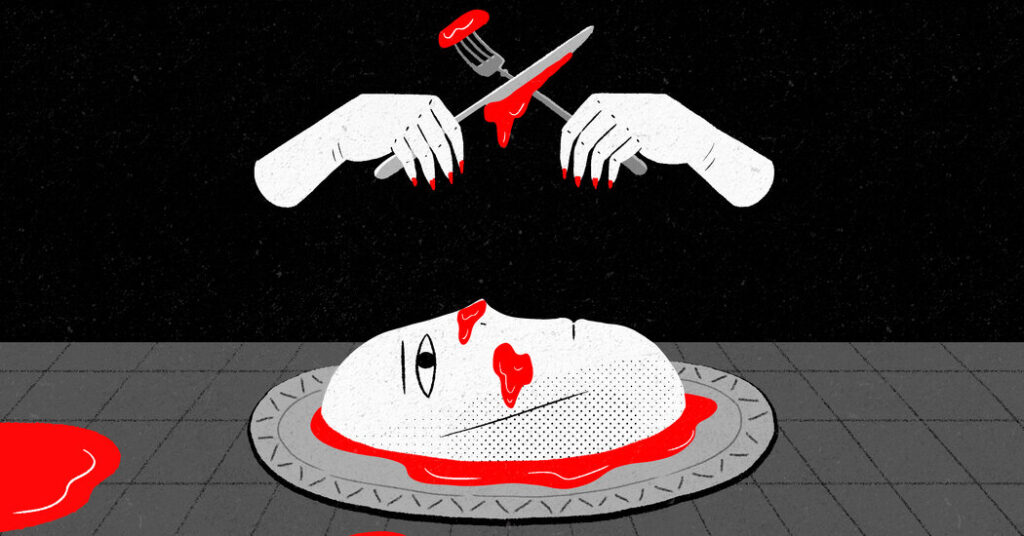
It’s easy to see why THE SECRET DINNER (Celadon, 337 pp., $28.99) was a phenomenon in Brazil. Who wouldn’t be curious about the story of a group of broke, 20-something roommates who start a catering business serving human flesh to rich people at underground dinner parties?
Or, as they say in their promotional materials: “Come and enjoy Rio’s most exotic, unique and delicious culinary experience!”
Part satire, part shaggy-dog story, part body-horror gore-fest, the story evokes the musical “Sweeney Todd” with its musings about what sort of person makes for the best meat, as well as Jonathan Swift’s 1729 essay, “A Modest Proposal.”
“Round up all these people and slice them up into steaks,” one character says, about the poor people in Rio’s favelas. “Carpaccio. Chicken-fried deadbeat.”
Unfortunately for Hugo, the 24-year-old bookstore clerk who narrates the book and serves as its moral center (such as it is), the operation is co-opted by a blackmailing aristocrat and a passel of corrupt cops with creative ideas about the treatment of suspects at traffic stops. If you have a weak stomach, don’t pick up this book after a big meal.
The Silent Appeal
by Janice Hallett
Hello again to the Fairway Players, the chaotic, occasionally murder-prone amateur theater troupe that featured in Hallett’s delicious debut, “The Appeal.” In its sequel, THE SILENT APPEAL (Atria, 467 pp., $30), this motley crew is attempting to stage a dramatization of Agatha Christie’s classic mystery “The Hollow.”
Things are off to an inauspicious start. “We are keen for new members to join and keep our ever-dwindling numbers up,” the director writes to the group.
As ever with Hallett’s work, the story is told in a jumble, with members’ emails, text and WhatsApp messages presented as evidence in a murder case that may have resulted in a miscarriage of justice. We won’t learn the hapless victim’s identity until late in the game. (Suffice to say, candidates abound.)
The whole thing is enhanced by Hallett’s sly observational humor and sense of the absurd — and how it applies to the deluded, self-regarding and back-stabbing characters she brings so amusingly to life.
Big Little Truths
by Liane Moriarty
Moriarty’s best-selling novel “Big Little Lies,” set in Pirriwee, Australia, took on a newer, more glamorous life when an HBO mini-series (and sequel) transported it to uber-wealthy Monterey, Calif. and populated it with a stack of Hollywood stars. But readers should banish the glossy memories of Nicole, Reese and Meryl from their minds, because Moriarty has returned to her original material in a sequel, BIG LITTLE TRUTHS (Crown, 464 pp., $34), set 10 years later.
The women at the center of the story — Madeline, Renata, Jane, Celeste and Bonnie — are now great friends, drawn closer by the shared drama in their pasts and by the complications of middle age: difficult elderly parents, surly teenage children, demanding men and, for some of them, the aches and indignities of menopause.
The women take the narration in turns, but much of the drama has shifted to their children, who are going through big things of their own. When the new principal at the local high school receives a gruesome package — a severed finger dotted with dried blood — the students respond accordingly. They “were euphoric about this ghoulish interruption to their day, although some experienced nausea, and the theater kids, who felt things deeply, wept and fainted, or did their best to faint,” Moriarty writes.
Whose finger is it? What does it have to do with the charismatic new history teacher, Melody Montclair, who has a hot young husband and a strange hold over not just her students, but their parents? And what about Brenda, the unfortunate counselor brought in by the school to talk to the children after a series of traumas that the readers don’t know about yet, and who is treated by them with dripping condescension?
“It’s called ‘school refusal,’ Brenda,” says one of the children, teenage-splaining a classmate’s behavior. “Oh, you probably know all about it, because that’s your literal career!”
Moriarty expertly mixes high drama and slapstick comedy with emotional acuity, a keen understanding of trauma and droll observational humor. It remains to be seen how all this will be woven into a third season of the HBO series.
The post Deliciously Twisted New Thrillers appeared first on New York Times.