It isn’t easy to interview Yo-Yo Ma. Not because he is one of the most famous musicians alive, a cellist who has been playing for world leaders since he was 7. Nor because he tends to answer questions with long stories rather than sound bites. The challenge is that he would rather be talking about you.
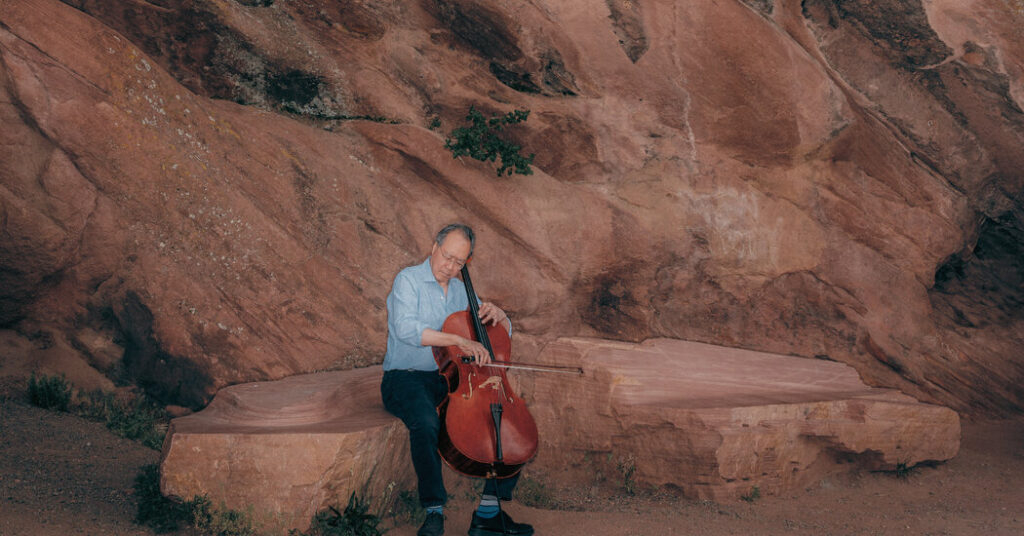
“There’s nobody that’s not interesting,” he said by way of explanation during a recent interview at his hotel while performing in Denver. The night before, he had given a vivid, freshly insightful account of Dvorak’s Cello Concerto with the Colorado Symphony for thousands of people at Red Rocks. I had been sent there to report on his life at 70 and how he is reconciling age with relentless ambition, so my instinct was to shift the focus back to him. But I quickly learned what former President Barack Obama meant when he once said of Ma, “For every question you ask him, he asks you two in return.”
Ma’s way of speaking would seem like deflection or false modesty if he didn’t behave that way with everyone. “You can’t fake it,” the composer Angélica Negrón said. Before the Red Rocks concert, I had followed him throughout the season: to recitals and a concerto premiere, to events that had little to do with music, far from any auditorium. Whether he was meeting a fellow artist, a fan or a community organizer, he was attentive and curious, willing to put his work on hold if it meant getting to know someone.
He is a sincerely committed humanist in a time that more readily rewards cynicism. He sees people as an ecosystem, deeply connected to one another and to nature at large, in an age of algorithms nudging us into echo chambers. When he speaks about immigration or education, he avoids the brash, polarizing rhetoric that reigns today, subtly treating these topics as matters of ethics rather than politics.
What if we followed his example?
“I look for models of behavior in other people,” said Stephen Colbert, who is a close friend. “His position is Olympian; his behavior is not.” And, increasingly, Ma’s way of being is being incorporated into his public-facing work through his organization Sound Postings. He can hardly make a tour stop without some kind of community program, like a conversation about gun violence in Chicago or a farm dinner in West Virginia. He has embarked on yearslong projects that may take him to national parks, for instance, or a nightclub in Lebanon. When he addresses audiences, he mixes expressions of wonder about time and memory with worries for the future, especially when it comes to the environment.
Because of who he is, maybe people will listen. “If he’s putting in that much work,” the historian Heather Cox Richardson said, “how can we do anything less?”
AT THIS POINT, Ma’s eminence and celebrity are givens. This is a musician who, born in France to Chinese immigrants, visited the United States as a 7-year-old and quickly impressed the great cellist Pablo Casals. It wasn’t long before he found himself performing for President John F. Kennedy at a concert hosted by Leonard Bernstein. Since then he has hung out with Elmo and Mr. Rogers on television, sold millions of albums and accumulated shelves’ worth of Grammy Awards, and received the Presidential Medal of Freedom from Obama.
“But maybe the most amazing thing about Yo-Yo Ma,” Obama has said, “is that everybody likes him.”
You could imagine a much different version of Ma: the child prodigy who, after growing up in the monastic world of music school, would still be a star but not such a people person. Casals, though, told him to go play baseball. “I don’t think he was a talent scout,” Ma said, “but I think the implication was, ‘Live a full life.’”
Ma, who ended up staying in the United States, was also shaped by being an immigrant. “One thing about immigrants is that they are always trying to understand a new place,” he said. “Now that I travel so much, the immigrant part of me is always thinking, I would like for you to plop me down anywhere, like Waldo, and I will find a way to do something purposeful and meaningful.”
When he was 15 and studying at Juilliard, he met the pianist Emanuel Ax in the cafeteria, and they became lifelong friends and musical partners. (“I would say that the two luckiest things that happened to me were meeting my wife and meeting Yo-Yo,” Ax said.) Around that time, Ma wasn’t sure the world needed another cellist. He would prepare a recital program, then present it in concert and realize halfway through that he was bored.
“We live in a world of people saying, ‘I need to achieve, achieve, achieve,’” Ma said. “But I’ve never felt like achieving something does anything more than give you a blip of pleasure.”
Ma followed the Casals adage “I think of myself as a human being first, a musician second and a cellist third,” and chose not to study music full-time. Instead he earned a bachelor’s degree in anthropology from Harvard, and in a way, he never left that field. With the passion of a gleeful amateur, he has channeled his interest in humanity into projects like the ensemble now called Silkroad, an enduring relic of the multicultural ’90s; the Bach Project, which introduced him to strangers around the world; and Our Common Nature, a more recent, outdoorsy effort to bring people together.
“He’s voraciously curious,” said Sophie Shackleton, the creative producer at Sound Postings. “He’s very nonjudgmental about people across all different backgrounds and disciplines, and he loves trying to understand them.”
Because of this, a Yo-Yo Ma concert is never just a concert. Even something as conventional as a recital of Bach’s complete cello suites, which he performed at Symphony Hall in Boston last fall, extended out into the world. It was simulcast to public libraries, nearby and into Massachusetts. In Watertown, where the screening room was at capacity and there was a waiting list of nearly 500 people, families gathered with cookies and apple cider from the cafe, and explored an exhibition upstairs. One mother referred to it all as “a gift.”
Inside Symphony Hall, Ma put on a marathon performance: more than two hours of music, padded with spoken interludes; a prompt to everyone to write what they want for their communities in 2050; and an encore duet with Michelle Wu, Boston’s piano-playing mayor. Around 10 p.m., a trickling audience exodus began. “I know, it’s too much cello for a lot of you,” Ma said from the stage. “I agree. But it’s all I’ve got.”
At 70, Ma’s technique has become temperamental. There were slips of intonation and bow control in those Bach suites, but also a charismatic honesty. Colbert, who got to know him through his wife, Evelyn McGee Colbert, said that he was “thoughtful, attentive, curious and kind” with her parents, and that he noticed something similar in Ma’s performances. “There’s a real relationship between the way he plays and the way he talks. There’s a sense of gathering the room, gathering a community, and you’re drawn into the emotional experience of his playing.”
Even when his concerts aren’t a knockout, like an autobiographical, quasi-theatrical recital that he tried at the Grand Ole Opry this spring, he can win over an audience. The evening’s format was stiff and lacked a sense of purpose, but by the end, Ma was playing Arvo Pärt’s “Spiegel im Spiegel” while a man waved his cowboy hat as if hearing a Dolly Parton ballad.
The quintessential Yo-Yo Ma tour stop includes an event, or several events, designed to bring together members of a local community who might not otherwise cross paths, even if they have a shared interest. There is usually some music, but mostly people share stories and ideas. These used to be juggled alongside his performances; now, they are managed by Sound Postings, whose five-member team is made up of non-musicians.
“I love that,” Ma said, “because most of the audiences I play for are not musicians.”
“FOR ANY INSTRUMENTALIST, once past 70 is a crapshoot,” Carter Brey told Playbill this year as he was preparing to retire from his post as the New York Philharmonic’s principal cellist. Ma’s daughter gives him a hard time whenever he plays out of tune, and he made adjustments in bowing and tempo to the Dvorak concerto in Denver. But he also said that these days, he is “more efficient and more musical.”
But why, at an age when musicians wind down their careers, is he expanding his reach? Despite maintaining a full performance calendar, Ma has a running joke is that he is retired, and that “when you’re retired, you only do what you want to do.” The truth is that his brain may not be wired for a life at rest. “I hope,” he said, “that I will stay curious until I die.”
Richardson, the historian who recently appeared at Tanglewood as part of Ma’s festival “We the People,” theorized that he “would play if there was no one to listen, and he would play for nobody but third-graders if that was who was there.” Ax described their collaboration as a kind of endless search, saying, “We’ve played the Beethoven sonatas for almost 50 years, and we’re still finding ways to do them differently each time.”
Ma is putting much more than music out into the world, though, including an example to learn from. “He is trying to reclaim American democracy and move it forward in a much healthier, more holistic way,” Richardson said. But she also acknowledged that it’s an enormous responsibility; a public figure herself, she knows that someone in his position can never lash out or punch down. He must, as even he put it, “choose the better angels of our nature.”
He has his critics, and there are ways in which his extra-musical work can seem like a Pollyannaish vestige of multiculturalism’s golden age. His community programming sometimes raises the hackles of locals, who most often change their minds once they meet him. And there are limits to what he can do. He’s only one person, and he can’t give his full attention to every person and place. (Shackleton said that Sound Postings spends a lot of time trying to ensure that his visits have lasting effects.)
“This is actually the best reason for cloning,” Ax said. “If we had nine or 10 Yo-Yos, the world would look different.”
Maybe pollination is more apt. When Ma was in Los Angeles this May, he left an impression with virtually everyone he met. Negrón wrote a new concerto, “Mundillo,” for him, inspired by his personality; it included a moment in which he and the conductor Gustavo Dudamel sat together and played music boxes, while the audience let out a collective “aw.” Backstage, Negrón saw Ma speaking with her nephew and parents. “The things they were talking about after 10 minutes were not surface level,” she said. “It’s something about how he was listening, but also truly caring.”
The morning after the premiere, Ma and Negrón met at a superfund site-turned-park on the Los Angeles River in Maywood. They shared a hug and chatted; the concerto, apparently unimportant in the moment, didn’t come up. Then they gathered with artists, engineers, Native Americans, community organizers and others to discuss the state and revitalization of the river, which has been paved since the mid-20th century.
Over conchas in the morning and enchiladas in the afternoon, people shared stories, traditions and ideas, and by the end they gathered to watch Negrón and some fellow musicians perform. Ma joined in eventually, at one point playing his cello away from the audience and toward the river.
When he finished, he handed his instrument to a Sound Postings colleague, who wrapped it in a velvet case and carried it away. But Ma stayed put. As some people began to leave and some stuck around, he wanted to linger, and listen.
The post What if We Were All a Little More Like Yo-Yo Ma? appeared first on New York Times.