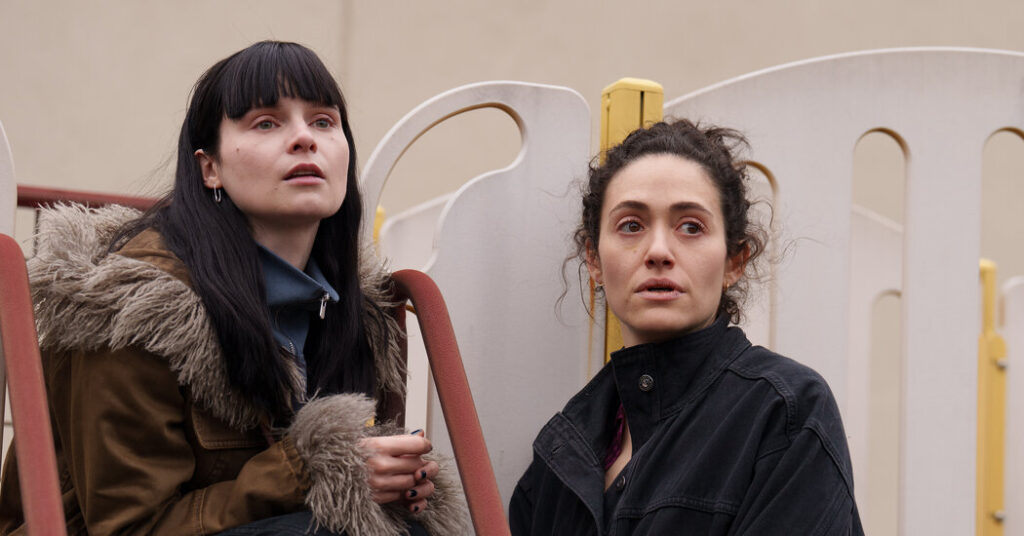
“Furious,” which just ended a remarkable first season on Hulu, is a series full of audacious, often hard-to-watch scenes. But the sequence that keeps coming to mind is musical.
Catherine Grace (Lola Petticrew), who was sex-trafficked as a girl, has been systematically hunting and murdering the men who exploited and raped her. After her most recent kill, she makes her way home and puts on a song, Rihanna’s “We Found Love.” She scream-sings the lyrics. She puts on sunglasses, pops in a retainer and thrashes her body around, like a teenager having a solo dance party.
The song has a meaning in the story. It’s a reminder, like the physical mementos she keeps in a sticker-plastered shoe box, of Catherine’s adolescence and of her beloved best friend, also trafficked, whose death she wants to avenge. But the scene also has a feeling that’s hard to detail literally. It’s murder and bubble gum, wrath and elation and regression, the desire to somehow time-travel to a point before everything went wrong. It’s a mourning ritual and a war dance.
This is not the first time Elizabeth Meriwether, the creator of “Furious,” has depicted women dancing through their complex feelings. In her limited series “The Dropout,” the tech entrepreneur-hustler Elizabeth Holmes (Amanda Seyfried) has a memorable habit of dancing awkwardly and aggressively to hip-hop, alone and in intimate settings. The scenes are uncomfortably funny, but they also show the enigmatic Holmes trying in her ungainly way to be her true private self — whatever that is.
In Meriwether’s 2025 limited series “Dying for Sex,” Molly (Michelle Williams), who has terminal cancer (and goes on a quest to have a satisfying sexual experience before she dies), struggles to express her grief. So she dances it instead, silently rising, gesturing, swaying, then thrashing, a gentle exploration that evolves into an exorcism.
Over the past few years, Meriwether has become one of the most interesting and idiosyncratic creators on TV, making stories of interesting and idiosyncratic women. She was best known before that as the creator of “New Girl,” the roommate sitcom starring Zooey Deschanel that was sometimes unfairly knocked as a slight “manic pixie dream girl” fantasy but was really a sweet, inventive comedy about misfits.
Her recent series are departures on one level, but on another they extend Meriwether’s feel for the odd and uncategorizable to new genres. In each story, the female characters feel something, or are something, that the culture around them is not used to acknowledging in women — something so ineffable that it can be expressed only in action.
In “Furious” — it’s right there in the title — that thing is anger. And there is plenty to go around. The protagonist investigating Catherine’s serial killings, Alice Black (Emmy Rossum), was herself abused by her former police-officer boyfriend, Marshall Connelly (Jake Lacy). Now an F.B.I. agent, she has special insight into Catherine’s mind and motives partly, we learn later, because Alice was a child-pornography victim herself.
The third Fury in this myth is Nora Washington (Quincy Tyler Bernstine), the sex-crimes investigator with whom Alice collaborates and sometimes butts heads. Nora — tough, direct, with a drinking habit and a dark sense of humor — has herself had run-ins with contemptuous, corrupt male superiors and is enraged by a system that dismisses the testimony of sex workers.
In a key early scene, Nora tells Alice the story of Medusa’s rape by Poseidon. “The god of the ocean rapes her in Athena’s temple,” she says. “But Athena decides that’s Medusa’s fault, and turns all her beautiful golden hair into snakes. She’s a victim. But it doesn’t make her a good person. It turns her into a monster.” In a later episode, Nora describes the many forms of anger cataloged by the ancient Greeks, who considered it a form of insanity.
“Furious,” loosely inspired by the 1987 movie “Black Widow,” is thrilling, incisive, at times hilarious. And it is bursting with anger. But it is no simple story of righteous or even tragic rage. Instead, it asks: What does anger do to you? What does it transform you into?
Alice’s traumatic experience has made her better at her job — she often sees things in her cases that the men around her don’t, especially as the investigation begins to enfold the ring of sex abusers who victimized Catherine and her friends.
It has also made her untrusting, distant and almost feral. She doesn’t like to shower because her boyfriend used to drag her out of the shower to beat her. She finds men on dating apps and asks them to knock her around. She wolfs food ferociously; her friend Danny Kelly (Scoot McNairy), a New York cop who joins her on the investigation, tells her, “You eat like an animal.”
In “Furious,” the animals hunt the monsters. But who are the real predators, who the prey? What of the men Catherine kills, who would never have been punished by the legal system? When is violence justifiable, or at least understandable? What would justice look like in this story? Meriwether resists easy or final answers. Instead, she gives her characters the respect of being wrong sometimes, of being messy, difficult — and yes, even monstrous.
The symbiosis between Alice and Catherine invites comparison to the cat-and-mouse dance of “Killing Eve.” But thematically, “Furious” also reminds me of Sally Wainwright’s “Happy Valley.” In that British crime series, the criminal is a rapist, not a victim of rape. But it also involves an investigator — her own daughter was among the victims — who is dealing with the questions of how to live with irresolvable anger and what justice means in an unjust world.
“Furious” was just renewed for a second season, ending on a note suggesting that Alice may start facing her own past more directly. That character conflict, more fascinating than any crime investigation here, is captured by another scene that keeps popping into my mind.
In the second episode, Alice attends a party, where she runs into Marshall, and where Danny confronts her about not aggressively pressing charges against him: “You just left. And he’s still around.”
She doesn’t respond. She walks off, pounds a few shots from a waiter’s tray. Then she steps out on the barroom floor as music pounds and — eyes closed, as if there were no one else in the room — starts to dance.
The post The Right Moves: ‘Furious’ and the Dance of Women’s Anger appeared first on New York Times.