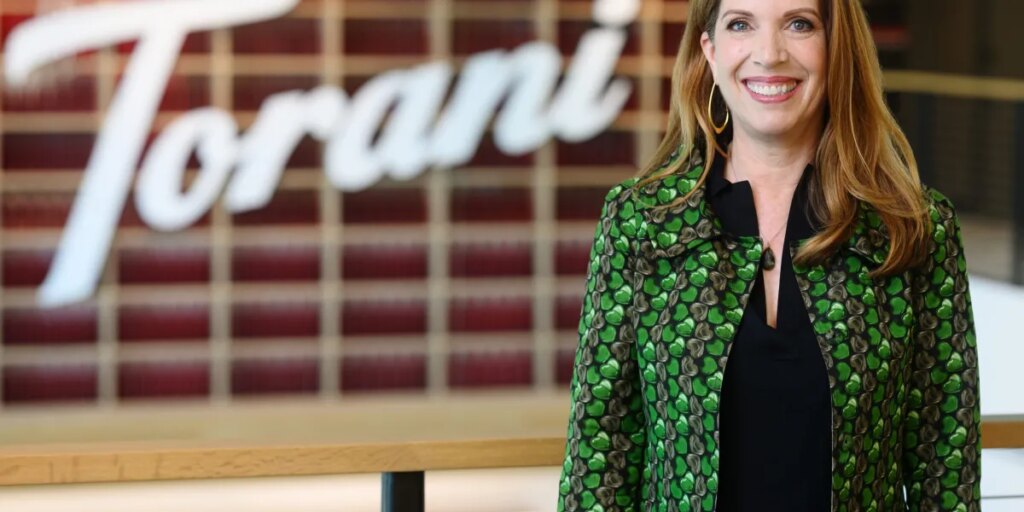
Beverage and syrup company Torani hasn’t laid off a single employee since the Great Depression. Not in 2008, not during globalization or the automation wave that gutted American manufacturing towns, and not during the pandemic that shut the cafes that buy most of its flavored syrups.
Now, as generative and agentic AI reshape entry-level work in corporate America, Melanie Dulbecco—who has run the 101-year-old, San Leandro, California-based syrup maker for 35 years—is wrestling with the same question facing executives everywhere: How can she adopt technology that could theoretically replace employees’ work? But Dulbecco has an extra consideration, and that’s navigating the AI age without breaking Torani’s no-layoffs streak.
“It is going to dramatically change things, and we’re all going to live through this together, but our approach is going to be the same as it has been,” Dulbecco told Fortune. “How do we create great jobs through this for everyone?”
After a friend got her connected with the family that owns Torani, Dulbecco joined the company in 1991, when she said it was a nine-employee operation generating about $700,000 a year. Started by Italian immigrants who sold hand-crafted syrups to flavor drinks in 1925 in San Francisco, the company pivoted to producing liqueurs after Prohibition ended in 1933. Its coffee-flavoring business, the syrups the company is best known for today, didn’t arrive until decades later, in 1982. In that time, Torani grew from five syrups to over 150 that can be added into coffee, cocktails and sodas, and Dulbecco even claimed the company “invented the flavored latte” with its vanilla syrup.
This year, the company is expected to bring in more than $800 million with just 500 employees, averaging 20% annual revenue growth over 35 years, the CEO said.
“Most companies focus on their financials, and then people are the tools,” said Dulbecco. “We look at it the other way around, and it works really well for us.”
Keeping the company local
A year into Dulbecco’s tenure, the then-small Seattle chain Starbucks approached Torani to become its private-label syrup manufacturer. Torani already supplied syrups to the company, but the decision split Dulbecco’s team so much that they brought in students from Stanford Business School, her alma mater, to sort it out.
The students said Torani could succeed either way, but private labeling meant becoming a low-cost producer, and skimping on what made Torani special, like swapping high-fructose corn syrup for cane sugar.
“It made the decision easy because then all of us who were here could say, what’s the business we want to build?” Dulbecco recalled.
Decades later in 2020, that same instinct to preserve the company’s legacy kept the company in the Bay Area. As the company outgrew its San Francisco facility, Dulbecco’s team approached every employee and mapped out their respective zip codes to find a commutable site: the current San Leandro campus. Two and a half years went into planning the move, but then in March, California’s Covid-19 order landed, and it became a “moment of truth” for Torani as cafes and restaurants started shutting down.
Dulbecco said the company ran financial scenarios of how they would keep the business afloat without letting anyone go, and “the only way” was to move as soon as possible and get their new equipment running.
“We made it—everyone, safely—and then when things picked up again—because business did go down in April—it picked up because e-commerce took off, retail took off, some other things filled the gaps. We could help our cafe customers reopen their doors and our team was here,” she said. “Being committed to our team, whom we care so much about, ends up really being to our benefit to continue to create the momentum and to be resilient in the hard times.”
The Torani antidote to AI layoffs
Dulbecco explained her team also takes precedence in major financial decisions when incorporating any new technology, especially AI.
“What are those 500 people, or 200 people, or 20 people doing to add more value?” she said. Treating AI purely as a way to slash costs, she argued, misses the bigger picture. Because Torani hasn’t laid off people as new tech comes in, there’s more trust between Dulbecco and her team when it comes to AI.
“What we find is our team is more likely to embrace new technologies also because there’s confidence and an openness to learning new things because they know we’ve got their backs and they’ve got ours,” she added.
Dulbecco said that shows up in employees’ benefits as well. Torani has a unique wealth sharing plan on top of 401(k) matching and salaries, including bonuses for every employee tied to Torani’s top-line revenue and bottom-line profits, and an employee stock ownership plan that kicks in after a year. She called this “sharing the wealth we create together.”
“Every year people get a new tranche of shares, and every year we do a new valuation, so there’s nothing that makes me happier than when we, in a town hall meeting, share, ‘Hey, we just did our valuation, here’s been the increase,’ and then afterwards, I see a forklift driver ask our CFO questions,” Dulbecco said.
Dulbecco said she’s talked to people at law and accounting firms who describe entry-level work changing fast around them, but Torani’s entry level hiring hasn’t changed because Dulbecco expects people to move around once they’re in.
She called it “career mixology,” where an employee may start in an entry-level inventory role and may move into something completely different later on. She pointed to a procurement staffer named Carlos who first started at the company in an entry-level supply-chain job before working through several other positions to his current post.
“He’s mixing up his career,” said Dulbecco, “building a broader perspective of the business, which makes him a more valuable team member as well.” Torani also runs a summer internship program for their college-age children, plus “first job programs” for newcomers.
“In a market where people say it’s hard to hire, we have not had the same challenge, and I think it’s because we look at roles differently,” Dulbecco said. “We appreciate people in every role.”
The post Meet the CEO whose century-old company never laid off employees through the Great Depression, the recession, or Covid appeared first on Fortune.