In 1790, when America’s first Congress met in New York City, it created the Sinking Fund Commission to manage repayment of the nation’s Revolutionary War debts.
Historians and legal scholars regard the five-member group as the country’s first independent agency, explicitly designed by Congress to operate outside of the president’s sole control.
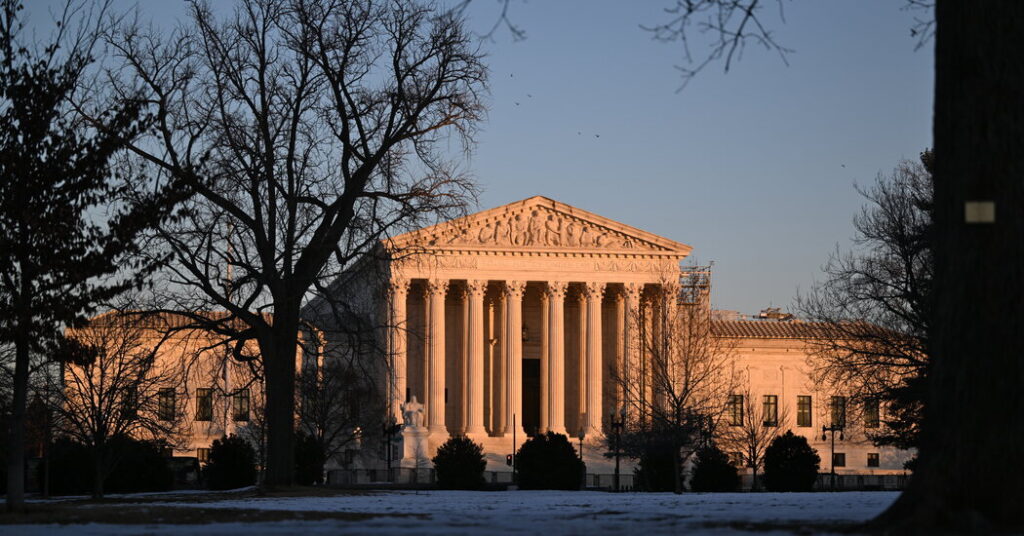
The past and future of such agencies was the central topic at Monday’s Supreme Court argument about whether President Trump has the power to fire a leader of the Federal Trade Commission. The court’s decision will have profound consequences not only for that agency, but also for dozens of other bipartisan commissions and boards created by Congress.
Some are well-known bodies like the National Transportation Safety Board, which investigates plane crashes, and the Securities and Exchange Commission, the nation’s top securities regulator.
Others are relatively obscure but can wield significant powers. Take the Great Lakes St. Lawrence Seaway Development Corporation. The tiny Transportation Department agency draws little notice outside the shipping and maritime industries, but it maintains a key North American trade route through which $26 billion a year in cargo traverses.
A brief filed in the Supreme Court case lists 50 boards and commissions that could be affected by the court’s decision. They have one thing in common: Congress mandated that they be run by bipartisan leadership groups.
Those boards typically have an uneven number of members, with staggered terms, all appointed by the president — but the various laws that created them often specify that no more than a bare majority of members can come from the same political party. The intention is to insulate the groups from partisan pressures and to encourage negotiation and consensus building.
And Congress frequently adds an additional safeguard by mandating that leaders can be removed by the president only for “inefficiency, neglect of duty, or malfeasance in office.” That’s the provision the Supreme Court seems poised to overturn.
In March, President Trump fired the two Democratic members of the Federal Trade Commission. His administration claims that the Constitution forbids Congress from limiting the president’s ability to run the executive branch.
If the Supreme Court upholds the firings, he would still have to replace the two ousted commissioners with appointees who are not Republicans — or leave the spots vacant — but Mr. Trump will be free to select leaders more aligned with his own views.
That potential change, which would upend a legal precedent that has stood for more than 90 years, alarms critics who fear it would undermine the independence and stability Congress sought to give to agencies with bipartisan leadership.
“Removal protections help ensure that presidential influence is exercised in a more consistent manner than it would be through removal and replacement of the entire board at will,” a coalition of 33 former board members of independent federal agencies wrote in a brief filed to the Supreme Court, adding, “The structure of independent agency boards tends to dampen radical shifts.”
Bipartisan leadership boards are especially prevalent at regulatory agencies with significant power over financial affairs and safety issues.
“Why would you want the Nuclear Regulatory Commission to be independent? Well, you don’t want the president firing people for their politics,” said Victoria Nourse, the director of Georgetown Law’s Center on Congress and Democracy. “You want them to be deciding cases based on the physics and their expertise.”
Advocates of multimember commissions argue that those groups operate more deliberatively, especially those stocked with a mix of Democrats and Republicans, than agencies led by a sole director. Forcing officials with diverse views to work collaboratively, the thinking goes, ensures that minority perspectives will be part of the discussion as decisions are made. And it can push regulatory bodies toward compromise positions that temper partisan extremes.
“Every chair in these commissions wants a unanimous decision whenever she or he can,” said Allison Herren Lee, a former S.E.C. commissioner. “It doesn’t always happen, but they try, and that negotiating process almost always produces a better, more balanced rule or decision.”
Ms. Lee, a Democrat, was appointed by Mr. Trump in 2019 and served as the acting chair for the first few months of former President Joseph R. Biden Jr.’s term. “There are always times when the majority just steamrolls, but that’s not the norm,” she said. “And it’s always understood that can be a risky approach to take, because minority commissioners do have tools at their disposal to respond both in the moment and with future issues that arise.”
Those kinds of checks and balances appealed to federal lawmakers stretching as far back as Alexander Hamilton, who proposed the structure the first Congress adopted for the Sinking Fund Commission. He saw it as a way of insulating the commission from political pressure, according to a 2020 article by Christine Kexel Chabot in the Notre Dame Law Review.
The group’s five members included some, like the vice president, who could not be removed at will by the president. And Hamilton himself, then the Treasury secretary, served on the inaugural Sinking Fund Commission alongside Secretary of State Thomas Jefferson, his bitter political rival. (The commission disbanded in the 1830s, after the war debt was resolved and the Treasury Secretary assumed more direct control of the nation’s spending.)
Rachelle Chong, a Republican, spent three years as a commissioner at the Federal Communications Commission during Bill Clinton’s administration. She sees the removal protections afforded to commissioners as a vital safeguard not only for those officials and their work, but also the politicians they ultimately serve.
“We can make hard decisions and take the heat for it, whereas the elected politicians can say, ‘Well, I didn’t do it. Those guys did it, and they’re the independent agency,’” she said.
Both Ms. Chong and Ms. Lee — who each signed the former board members’ Supreme Court brief — fear for the stability of regulatory bodies, and the industries they oversee, if those removal protections vanish.
The Federal Reserve is the most prominent and powerful example of an independent agency led by a bipartisan board. The Supreme Court in January will hear arguments on President Trump’s attempt to remove Lisa Cook from the Fed’s board.
But the court’s decision on Monday’s case will affect the boards of many agencies that shape aspects of Americans’ daily lives. They include the Consumer Product Safety Commission, which investigates products that cause injuries and deaths; the Equal Employment Opportunity Commission; the Federal Trade Commission, the nation’s antitrust watchdog; the National Labor Relations Board and other worker-protection agencies; the Postal Service; and the federal commissions that oversee campaign finance laws, international trade and nuclear safety.
“I think people should be worried,” said Ms. Nourse, the Georgetown Law scholar. “A lot of these independent agencies, Congress creates them to protect the little guy.”
Stacy Cowley is a Times business reporter who writes about a broad array of topics related to consumer finance, including student debt, the banking industry and small business.
The post Planes, Trade and Nuclear Energy: Supreme Court Weighs Fate of Independent Regulators appeared first on New York Times.