A former gang leader was convicted of murder Monday in the 1996 shooting of the rap icon Tupac Shakur, a mystery that captivated the public and stymied police for decades — until the defendant started talking.
Duane “Keffe D” Davis, a former leader of the South Side Compton Crips, was found guilty of orchestrating the shooting, even though authorities said he did not pull the trigger. Drawing on Davis’s own words in interviews and a memoir, prosecutors said he wanted revenge on Shakur after the rapper and his associates beat up Davis’s nephew.
Davis’s defense lawyer argued that his client’s statements should not be taken at face value. He downplayed Davis’s book as fictionalized and zeroed in on discrepancies between Davis’s and others’ accounts of the events. But the unusual strategy of declaring the defendant unreliable did not win over jurors.
Davis faces a potential sentence of life in prison.
Shakur was at the height of his fame when died at 25. He had just released his fourth studio album, “All Eyez on Me.” The mystery around his shooting gripped the public, with police investigators so worried about leaks that they kept their files under lock and key.
The verdict followed two weeks of testimony that laid out a bloody rivalry between Davis’s gang, the South Side Compton Crips, and Mob Piru, a gang closely linked to Shakur’s record label, Death Row Records. Thirty years after Shakur’s death, some witnesses were still reluctant to talk.
The case might have remained cold, authorities say, if Davis had not opened up about the shooting in interviews and a memoir later in life, spurring police to take another look.
“In this world, silence means survival,” Clark County Deputy District Attorney Binu Palal said in his opening arguments. “The one person who has a hard time being silent is Duane Davis.”
Davis has said he set out, in a Cadillac, to confront Shakur and passed a gun to someone in the back seat. But that person did not want the gun, so Davis’s nephew, Orlando “Baby Lane” Anderson, opened fire, by Davis’s account.
At the heart of prosecutors’ case was a once-secret 2008 police interview with Davis. A federal task force was investigating the murder of another rapper — Christopher Wallace, better known as the Notorious B.I.G. — and questioned Davis.
In that interview, played for the jury, Davis said he passed the gun to people in the back of the car because they had a better position to shoot.
Davis said he opened up to federal investigators at the time because he was told he would not be prosecuted. For years, he wasn’t.
But authorities argued that Davis cleared the way for them to use the old interview when he started telling his story publicly.
He recounted Shakur’s death in a 2018 BET documentary series, “Death Row Chronicles.” And he detailed his desire for revenge on Shakur in his book, “Compton Street Legend,” saying that Shakur and his associates’ attack on his nephew “gave us the green light to do something” to them.
The defense tried to block prosecutors from using Davis’s comments. The book, they argued, was written to “sell a product” and should not be taken as fact. But Judge Carli Kierny of the Eighth Judicial District Court said Davis’s comments were fair to use.
Prosecutors played a video of Davis promoting his book, holding it up for the camera: “Go get the book, and you can get the real truth about this whole situation,” he said.
Prosecutors laid out a complex feud between the South Side Compton Crips and Mob Piru over the course of the case. In that gang world, they said, acts of disrespect demanded revenge.
The rivalry escalated, they said, with a brawl at a mall in the summer of 1996 and then flared again the night Shakur was shot. Both Shakur’s group and Davis’s group were in Las Vegas that day to watch the boxer Mike Tyson at the MGM Grand Garden Arena.
When Shakur’s group encountered Duane’s nephew, they beat him up — a fight captured in video that was played for the jury.
Davis, by his own account, was incensed. He and his group in the white Cadillac eventually found Shakur driving with Marion “Suge” Knight, the co-founder of Death Row Records.
Davis wrote in his book that Shakur “made an erratic move” and “pulled out a strap,” meaning he drew a gun. “[That’s] when the fireworks started,” Davis wrote. “One of my guys from the back seat grabbed the Glock and started bustin’ back.”
Prosecutors suggested that Davis was trying to protect himself in that passage by implying self-defense — though they also argued that Davis, as the original aggressor, could not claim self-defense anyway.
The three other people who were in the Cadillac with Davis have died, leaving Davis as the only one who can face charges for Shakur’s death.
Shakur’s killing set off more violence back in Compton, California, because despite the lack of arrests, “the streets knew that South Side Compton Crips were responsible for this murder,” said Palal, the prosecutor. Within 10 days, he said, three others were killed and others were injured, including an 11-year-old girl.
The prosecution called about two dozen witnesses.
The defense called three and sought to show that police could not corroborate elements of Davis’s story. Defense lawyer Michael Sanft asked his final witness, a retired detective, about his unsuccessful efforts to verify various details. Law enforcement did not charge Davis for many years, even after his 2008 police interview.
In his closing arguments, Sanft pointed out testimony at odds with details of Davis’s story — for instance, Davis’s account that he found Shakur on Sept. 7, 1996, because the rapper was hanging out of a car window as fans screamed, “We love you Tupac!” A witness testified that there were “no fans around” and that Shakur was not hanging out of a window.
Davis “is telling you fiction as to how all this goes down,” Sanft told the jury.
Prosecutor Marc DiGiacomo called the defense’s accusations of thin evidence “ridiculous.”
“It is a slam dunk, absolutely, totally no-defense-to-murder case,” DiGiaconomo said in his final remarks.
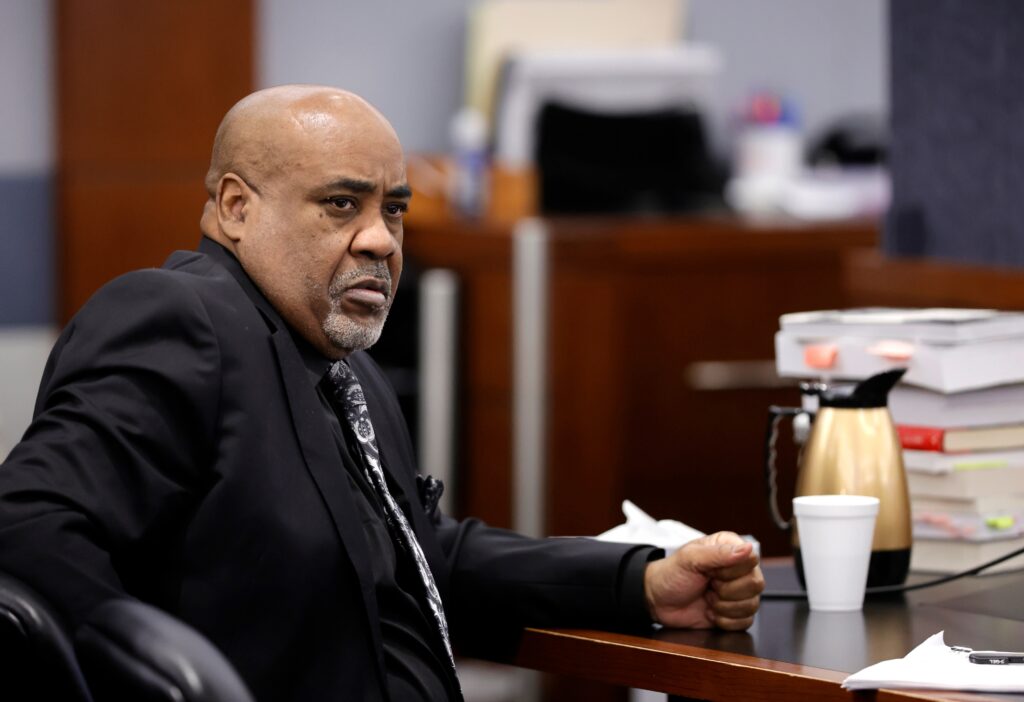
The jury deliberated for about three hours Monday afternoon after several hours of closing arguments. Davis, wearing a black suit jacket, betrayed little emotion but hugged his attorney as jurors left to decide his fate.
The post Ex-gang leader convicted of murder 30 years after Tupac Shakur’s death appeared first on Washington Post.