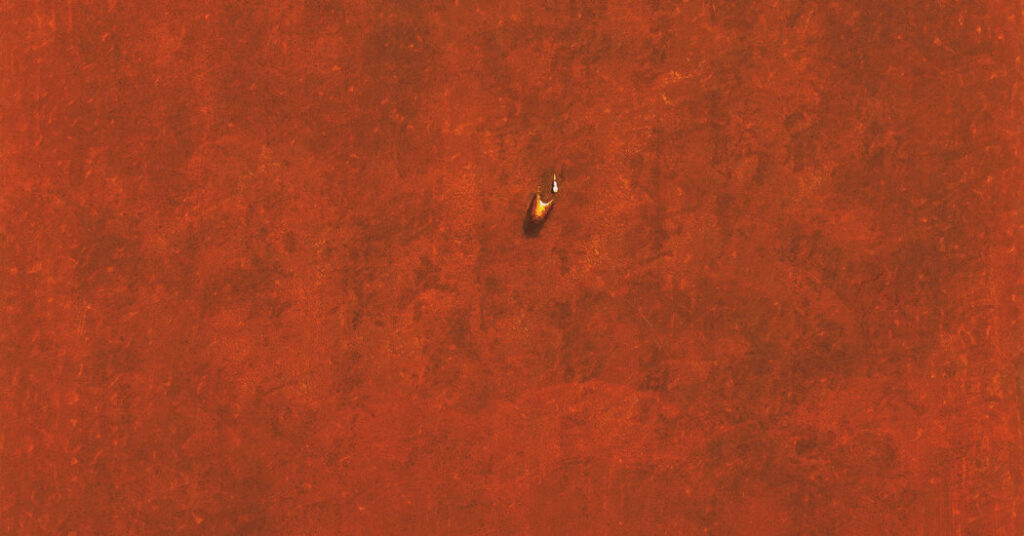
The 1991 painting “Recurrence SNM93016” by the South Korean artist Kim Tschang-Yeul hangs in the office of HyungTeh Do, owner of Gallery Hyundai.
The nearly 45-square-foot image of a simple water drop against a massive rust-colored background speaks volumes, Do said.
“For almost his entire career, Kim Tschang-Yeul painted water drops, but it’s a very conceptual approach to repeating the exact same forms, whether it’s a single water drop on a huge canvas or hundreds of them,” Do said. “It’s a philosophical meditation. It’s the very essence of Dansaekhwa.”
Dansaekhwa, which translates to mean “monochromatic painting,” has come to define what the world thinks of as South Korean art, and will feature prominently at the fifth installment of Frieze Seoul, opening to the public on Thursday.
Even after half a century, experts say, art collectors and the viewing public are still drawn to the quiet elegance of paintings like “Recurrence SNM93016,” which will be on display at the fair.
“For young international collectors it’s not essential to understand Korean culture or history to appreciate the work,” said Kyu Jin Hwang, the Asia director and head of Thaddaeus Ropac Seoul.
“In terms of value, the price has gone up significantly in recent years, but not because the works are considered an investment.”
It is a sentiment echoed by other gallerists who see the commercial legacy of Dansaekhwa but also see it as a springboard to other, lesser-known styles of South Korean art.
“Dansaekhwa is more like a trophy, because when you start collecting, you start with something already known,” Jung Lee, executive director of the Seoul gallery Gana Art, said. “The new collectors, the tech people, really don’t know art, but they’re starting to learn.”
Dansaekhwa will again have a large presence at Frieze Seoul, with some art featured exclusively — almost like single pieces in tucked into the corner of a museum — and promoted by galleries from Japan to France and across the sprawling city of Seoul.
Dansaekhwa at Frieze Seoul
In addition to showing “Recurrence SNM93016” and about 14 other works by Kim, Gallery Hyundai will also display works by the Dansaekhwa artist Seung-taek Lee at Frieze Seoul. Both artists lived through the Korean War and are widely recognized as pioneering figures. In 1976, the gallery organized the first solo exhibition in Japan for Kim, who died in 2021.
The Japanese gallery Tokyo Gallery + BTAP, which opened in 1950, will bring one piece of the “Ecriture” series by Park Seo-Bo, a pioneer in Dansaekhwa who died in 2023 at age 91.
Several other galleries will also have booths featuring Dansaekhwa artists’ works at Frieze Seoul: Seoul’s PKM Gallery will show Yun Hyong-keun; another local dealer, Wooson Gallery, will show Choi Byung-So; and Almine Rech will display work by Kim, Ha Chong‑Hyun and other South Korean artists.
Thaddaeus Ropac will feature a single Dansaekhwa painting: “With Winds S8708-43” (1987), by Lee Ufan, one of South Korea’s most famous painters. It is from a series of paintings known for whimsical brushstrokes that the artist made over four years. Lee is having a bit of a celebrity moment at age 90 with a solo exhibition through Nov. 22 at the San Marco Art Centre in Venice and his first major show in Portugal at the Serralves Villa in Porto, opening Oct. 17.
At Kiaf Seoul, South Korea’s first international art fair — which began 20 years before Frieze Seoul did, and runs alongside Frieze in the Coex center — Johyun Gallery of Busan will show works by Park and Yun, two leading figures of Dansaekhwa.
Going beyond Dansaekhwa
However, the fair will also highlight artists who are showing how South Korea is moving beyond Dansaekhwa.
“Korean contemporary art is no longer defined solely by Dansaekhwa,” Jaewoo Choi, the president of the Johyun Gallery, said. “That spectrum has become broader. Today, the international art world is looking beyond Dansaekhwa alone.”
But the influence of the Dansaekhwa movement on these artists is evident as Frieze Seoul gets underway. For example, Lee Kang-So, a huge influence on both the Korean avant-garde and experimentalism movements that evolved in parallel to Danseakhwa, will have a solo exhibition opening at the Lotte Museum, a few subways stops away from the Coex center.
“The experimental and avant-garde happened at the same time, but Dansaekhwa has been embraced more globally,” Do, of Gallery Hyundai, said. “The Korean avant-garde in many ways was unrecognized 10 years ago, but the big collectors and galleries have been more engaged with those artists more recently.”
While showing Park and Yun at Kiaf, Johyun Gallery will, at Frieze, present a solo presentation by Lee Bae, who works mostly in charcoal and is known for drawings and sculptures with a minimalism similar to that of Dansaekhwa.
“We see Lee Bae as one of the key artists representing the generation that followed Dansaekhwa,” Choi said. “While inheriting the spirit and distinctive Korean abstraction established by the Dansaekhwa movement, he developed a unique visual language.”
Tokyo Gallery + BTAP will bring 13 other artists alongside Park, including Susumu Koshimizu and Kishio Suga, two important artists in the Mono-ha movement in Japan, which also coincided with Dansaekhwa. For Hiroyuki Sasaki, senior director at the gallery, it is the chance to document a bit of history — and to highlight the contrast between the simplicity of Dansaekhwa and the use of industrial materials within Mono-ha. He pointed to Lee Ufan, who also worked in the Mono-ha style.
“Lee Ufan, who is Korean but lived in Japan, is such an important figure because he linked Japanese art to South Korea,” Sasaki said. “Lee Ufan is also considered that bridge between old and new.”
And that bridge is part of how Dansaekhwa has continued to be in demand and open the doors for so many artists after.
“Collectors’ interests are also expanding toward younger generations of artists and new forms of artistic expression,” Sasaki said. “Dansaekhwa set the stage for Korean artists to flourish and be recognized globally. They opened the door to more radical ideas that helped shape the country and the identity of Korean art itself.”
The post How Dansaekhwa Has Inspired and Shaped Frieze Seoul appeared first on New York Times.