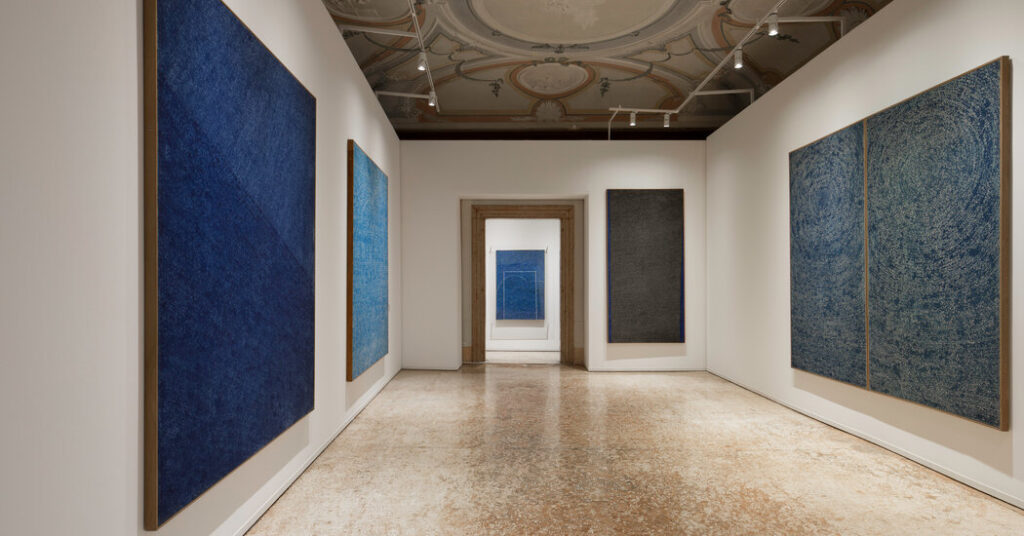
The Korean movement known as Dansaekhwa has become a defining fixture in the international art world in recent years, with museums celebrating once-obscure artists and collectors chasing their works.
But when it got going more than half a century ago, some of the movement’s pioneers were barely getting by. Amid a recession in 1974, Park Seo-Bo wrote to a friend that, the previous Seoul winter, he “couldn’t even afford heating; on freezing days I just holed up in a corner reading books.”
“I never imagined that a time like this would come,” Ha Chong-Hyun, 90 and one of Dansaekhwa’s leading figures, said last month in an email interview.
The term’s three syllables translate to “single-color painting,” but these are not the monochromes of, say, Yves Klein (all blue) or Ad Reinhardt (blacks). In this context, the word connotes a work made with a restrained color palette (often whites, grays, umbers), applied through repetitive motions and often some signature process that emphasize the tactility of the materials.
Lee Ufan, now 90, dipped a brush in pigment, then pressed it to canvas again and again until it was spent. Park, who died in 2023 at 91, ran a pencil through paint to make tight waves that can resemble scribbles. It was a way of “emptying” his mind, he said; the results are at once gritty and alluring. Ha pushed paint through the weave of raw hemp.
A meditative focus or stillness often prevails in these works — some have connected the pieces to Zen Buddhism and Taoist philosophy — that stands in contrast to the artists’ tumultuous times.
Many of Dansaekhwa’s foundational figures were born in the 1920s and ’30s, when Korea was a Japanese colony, and lived through the Korean War. As they became active as artists in the 1950s and ’60s, some made violent, abstract work inspired by Art Informel, a gestural style developed in postwar Europe. (“Hideous paintings” is how Park described some of his early series from the 1960s.)
In 1972, as they were developing their as-yet unnamed aesthetic, South Korea’s president, Park Chung-hee, imposed martial law. In that context, the subtle, plain-spoken style they created can be seen as a form of quiet resistance — an attempt to reject establishment trends and contemporary politics, while trying to create a uniquely Korean idiom.
There were few commercial galleries for vanguard art in South Korea then, and securing a passport was difficult, but some managed to emigrate. Kim Tschang-Yeul, who would become famous for painting ethereal water drops, settled in Paris in 1969. In 1956, Lee left for Tokyo, which would become an important hub for Dansaekhwa artists. Kim Whanki, an influential painter who taught Park Seo-Bo and Kim Tschang-Yeul, and who helped inspire the movement, landed in New York in 1963.
These figures did not think of themselves as Dansaekhwa artists — the term took hold among critics and curators later on — but many were friends with shared passions. And, though you would not know it looking at current auction records, some were women, like Yoon Miran and Lee Chungji. The deeply Confucian nature of Korean society limited their success, said the art historian Yeon Shim Chung, author of the forthcoming book, “Dansaekhwa: Korean Abstract Art and Its Cultural Impact.” If they married, they were expected to manage the household. And as the market and academia started to define the movement, their efforts were often not included.
In the ensuing decades, Dansaekhwa artists steadily built reputations, both at home and abroad, but it was not until 2014 that the movement truly gained widespread attention. That year, the art historian Joan Kee, who now leads New York University’s Institute of Fine Arts, organized a show of work by Park, Ha, Lee Ufan and others at the now-defunct Blum & Poe gallery in Los Angeles.
“I probably bought half the show,” Howard Rachofsky, a Dallas-based art collector, said.
Rachofsky said that, in the 1990s, he had been watching other American collectors spend big on Pop and Abstract Expressionism. “I didn’t have the resources to play in those sandboxes,” he said. Instead, he purchased art from postwar Italy, the Brazilian avant-garde and Japan’s Gutai group. Dansaekhwa captured his imagination next.
He said that he admired “the tactility of it, the resonance of it, the imagination around it, the non-objective essence of it.”
Other global collectors were taking notice too, and the next year, 2015, brought a high-profile show of Dansaekhwa at the Venice Biennale, whose organizers included the Kukje Gallery of Seoul and the Tina Kim Gallery in New York.
The auction market took off in the mid-2010s. In 2014, Park’s works sold at auction for a total of $1.49 million. The next year, that total spiked tenfold. The work of Yun Hyong-keun, who died in 2007, also saw a dramatic rise in auction results. His brooding and beguiling fields of dark color generated $48,655 in 2013 and nearly $4.7 million in 2015.
Many of the original Dansaekhwa artists, now late in their careers or deceased, have become revered figures at home. Kim Tschang-Yeul has a museum dedicated to him on Jeju Island, south of the Korean Peninsula, and his residence and studio in northern Seoul just opened to the public, following renovations by the local government.
Yun’s estate is slated to open his Seoul home and studio to the public for the first time on Tuesday, and the local PKM Gallery is presenting a show of his work through Oct. 3. Park’s foundation opened a museum for him in the city last month, and Kukje has a show of Park’s work up until Oct. 18. Stateside, Ha will have a retrospective at the Asian Art Museum in San Francisco opening Sept. 25.
The greatest marker of Dansaekhwa’s influence may be that succeeding generations have variously adopted and rebelled against it. The Minjung artists of the 1980s made aggressively political work, pushing for democracy, which arrived in the late 1980s, while artists like Kim Taek Sang and Lee Bae have channeled their forebears’ process-based methods in intriguing new directions.
For Ha, the success is gratifying, but it also carries a certain sadness. “I cannot help but think of my late colleagues,” he said, mentioning Yun, along with Chung Chang-Sup and Kwon Young-Woo, who died in their 80s in 2011 and 2013.
They “walked a similar path,” Ha said, “but left us before witnessing this moment. It leaves me with a heavy heart. If I meet them again someday, I would like to tell them of the joy and accomplishments we have come to see.”
The post The Style Without a Name That Came to Define Korean Art appeared first on New York Times.