A French art critic walked into a gallery in November 1908 and was baffled by what he saw: wonky paintings of a Mediterranean port by a young artist named Georges Braque.
Braque “reduces everything, places and figures and houses, to geometric outlines, to cubes,” the critic Louis Vauxcelles later wrote in Gil Blas, a French literary publication.
Little did he know that he was christening one of the most important avant-garde art movements in history: Cubism.
More than a century later, Cubism is getting its first-ever exhibition in South Korea: “The Cubists: Inventing Modern Vision” (through Oct. 4), the inaugural presentation by Seoul’s new modern art museum, Centre Pompidou Hanwha, which opened its doors in June. Public appetite for the show appears solid: Halfway through its run, “The Cubists” had pulled in 150,000 visitors, according to the organizers.
Through a four-year partnership with the Pompidou Center in Paris, the Seoul museum is hosting two shows a year from the collections of the French institution, and staging parallel shows of modern and contemporary Korean art and international art. Next up from Paris: solo exhibitions of Chagall, Kandinsky and Constantin Brancusi.
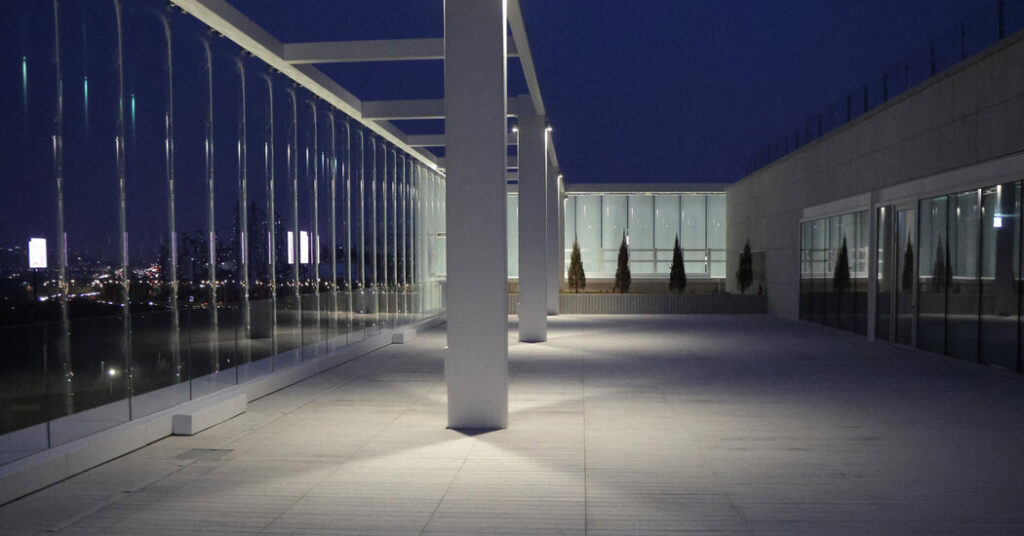
The Centre Pompidou Hanwha is hard to miss; it occupies the former annex to what was once Korea’s tallest edifice — the shimmering 63 Building in the financial district.
The annex itself has had a French makeover: a glowing lightbox-like facade and interiors that were designed by the architect Jean-Michel Wilmotte.
Timing wise, the space is opening at an auspicious moment.
“The Korean art scene is changing a lot,” said Jade Keunhye Lim, the director of exhibitions at the Hanwha Foundation of Culture, in a recent phone interview. The foundation set up the partnership with the Pompidou. For much of the last 30 years, the scene was “shaped by the public sector, by public institutions and public funding,” she noted, identifying the Seoul Museum of Art and the National Museum of Modern and Contemporary Art, Korea, as the main drivers of exhibitions, biennales and other artistic activity in the country.
Now, major international galleries are opening branches in Seoul, and private Korean conglomerates are opening new spaces, such as the Leeum Museum, run by the Samsung Foundation of Culture, she said. Most of all, she continued, the Frieze Seoul art fair, which started in 2022, has made South Korea “more global and more connected with the international art community.”
The Cubism exhibition presents 91 works by 43 Cubist artists including Picasso, Braque, Fernand Léger, Juan Gris and Robert Delaunay, all from the collections of the Pompidou in Paris. While it’s no match for the landmark “Le Cubisme” show, which ran from 2018-19 at the original Pompidou — the most comprehensive survey of the movement in 65 years, featuring more than 300 major works and objects — the Seoul exhibition has enough high-caliber art to offer a solid overview of the movement, and its enduring influence in Europe and around the world.
Cubism, as a movement, was borne of two key influences: the opening in Paris of the first museum displays of African and Oceanic art, and the legacy of the post-Impressionist master Paul Cézanne, who died in 1906. The movement’s pioneers were two young visionaries, Braque and Picasso.
One of the show’s special highlights is Braque’s “The Viaduct at L’Estaque” (1908): a viaduct painted in shades of terracotta with a jumble of houses shaped like building blocks in the foreground. The painting was in the gallery exhibition that inspired the dismissive French critic and his cube analogy. It was so dear to Braque’s heart that he kept it all his life.
The painting that can be considered the movement’s defining manifesto is Picasso’s “Les Demoiselles d’Avignon” (1907, on permanent display at the Museum of Modern Art in New York). According to the catalog, Picasso produced at least 16 sketchbooks and around 70 preparatory paintings, gouaches and drawings for “Les Demoiselles.” One canvas that he produced “Bust of a Woman” (June-July 1907) is in the Seoul show, and resembles at least one of the figures in “Les Demoiselles.”
There are also powerful works from the pair’s analytic Cubism period (1909-1911), during which they flattened the subject — be it a landscape, an object or a figure — into intersecting two-dimensional planes and shapes.
The Seoul exhibition extends its reach far beyond Picasso and Braque. There are plenty of colorful and representational examples of Cubism by painters such as Robert Delaunay — whose “The City of Paris” (about 1911), includes views of the French capital, including a disjointed Eiffel Tower — and Fernand Léger. Works by female artists — Marie Laurencin, Sonia Delaunay and Natalia Goncharova — are also included.
The exhibition’s opening work has an interesting back story. “The Large Horse,” a sculpture made of black-patinated bronze depicting a rider and a horse that have been fused into a highly mechanized and kinetic vision of movement and progress. The piece was designed in 1914 by Raymond Duchamp-Villon, the brother of Marcel Duchamp, the Frenchman who revolutionized art a century or so ago by submitting an upside-down urinal as an artwork to an exhibition.
Duchamp-Villon’s sculpture was intended as an equestrian monument for a Cubist house in Paris, but the sculptor didn’t live long enough to produce the large version. Decades later, his brother Marcel Duchamp had that version produced. Today, it is considered a major work of 20th-century sculpture.
In a final “Korea Focus” section, Centre Pompidou Hanwha presents paintings by Korean modern artists such as Lee Soo-auck; Ham Dae-jung; and Park Rehyun, who reinterpreted Cubism in the 1950s.
Lim said it was essential to show audiences that at the same time as Europe’s 20th-century masters of modern art were capturing the world’s attention, there were Korean and Asian artists producing important work, and Centre Pompidou Hanwha was intent on showcasing their contribution. The mission of the institution, she said, was to be a “two-way channel for cultural exchange between France and Korea,” and “not just a one-way transfer of exhibitions from Paris to Seoul.”
“We want to contribute to shaping a more inclusive and decolonial narrative of modern art,” she said, waving away concerns “that the Pompidou Collection show will strengthen the idea of the Western and non-Western divide and the superiority of Western art over Korean art.”
And what is the Pompidou getting out of this partnership?
The center closed its flagship in Paris in 2025 for a five-year, $500 million redevelopment and has to raise 40 percent of that amount, Julie Narbey, the general manager said in a phone interview. The Pompidou is a state-owned and state-funded cultural institution, though it also privately raises funds, in part by setting up outposts around the world that have the right to use the center’s name and branding for a number of years (subject to renewal), and, in exchange, receive collection displays and exhibitions curated by the center, as well as expertise.
So far, there are Pompidou affiliates in Malaga, Spain; in Shanghai at the West Bund Museum; in Brussels at the Centre Pompidou Kanal; and in Seoul. Another is opening in Foz do Iguaçu, Brazil, at the end of 2027.
Narbey said that international partnerships contributed roughly $26 million a year to the Pompidou’s operating budget, helping to make up for the loss of ticket sales and other revenues at the Paris flagship.
Centre Pompidou Hanwha was also contributing, not to cover operational costs, but to finance the redevelopment project, though she would not provide figures. The Pompidou’s international strategy is to share the 150,000 works in the collection, the vast majority of which are otherwise in storage, she said, thus helping establish a cultural exchange and promoting local artists in the countries in which they work.
“There is also a financial dimension,” she added. “These partnerships allow us to finance our projects in Paris, both in terms of operations and in terms of investments.”
The post Cubism Gets Its First Ever Exhibition in South Korea appeared first on New York Times.