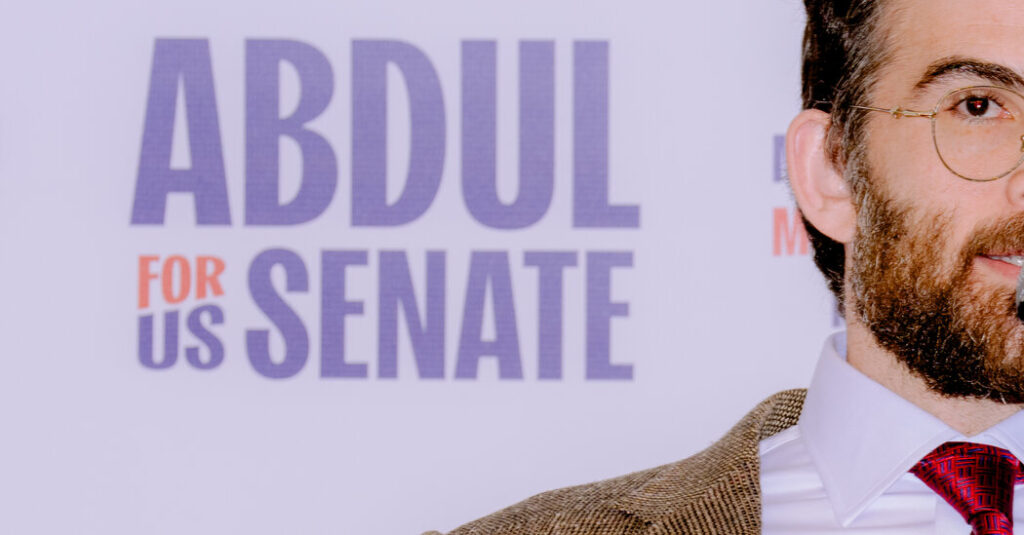
It is frustrating and unjust that Abdul El-Sayed’s relationship with the leftist influencer Hasan Piker has become a discourse bonanza, while Donald Trump’s relationship with the right-wing influencer Laura Loomer is treated as old news.
Loomer is, by any rational measure, the more influential figure. Administration officials she targeted were purged from the National Security Council, and on Friday, she claimed credit for the deportation of the British right-wing troll Milo Yiannopoulos, who’d become her enemy. Loomer is also openly bigoted in a way that outstrips the most offensive things Piker has ever said. Over the weekend, she called Angie Nixon, the Democratic Senate nominee in Florida, a “ghetto bitch” who speaks “Ebonics.”
But noting this unfairness, as many progressives are now doing, is not going to make El-Sayed’s Piker problem go away. We can and should denounce double standards, but successful candidates must also navigate them. And right now, El-Sayed, the Democratic candidate for Senate in Michigan, is letting this one trip him up.
Piker is novel because he’s the left-wing incarnation of a type that, until recently, mainly existed on the right: the shock jock. Stomping on liberal taboos seems to energize him, whether that means praising the Houthis in Yemen, defending the Chinese occupation of Tibet, or calling for “Marxist-Leninist” discipline in the Democratic Party. (Until recently, the only mainstream American political figures citing Lenin were right-wing revolutionaries like Steve Bannon.) Piker makes incendiary statements and then tries to shrug them off as provocations. He’s joked that he is “Rush Limbaugh for Zoomers.”
The rise of Limbaugh and his ilk worked out quite well for Republicans, helping them to wrench the country to the right. But it’s far from clear that Democrats either can or should follow the same template. The Republican Party is more homogeneous than the Democratic Party, so there’s less need to accommodate cultural difference within it. There are more conservatives than leftists in America, and in our system, conservative, rural areas of the country have more electoral power. Democrats will have a far harder time than Republicans building power with a stridently sectarian message.
But, of course, the debate over Piker isn’t just about tactics — it’s about control of the party’s future. Piker, an avatar of the Democratic Party’s insurgent left, is hostile to other parts of the Democratic coalition. He doesn’t just want to make room for anti-Zionism in the Democratic Party — he wants to make Zionism anathema. He once said that any “Zionist tendency” should be treated the same way as “rabid” neo-Nazism, and that no one who’s ever expressed “positive feelings about the State of Israel” belongs in public office.
My own feelings about the State of Israel have become decidedly negative, but it’s easy for me to see why Piker’s rise panics some Jews. For most American Jews, the land of Israel is bound up with their faith. That alone doesn’t give them the right to any particular piece of real estate; the Bible is not a land deed. But many are deeply threatened by what they see as a left-wing drive to drum Zionists out of public life. To them, the victory of El-Sayed, who campaigned with Piker during the Senate primary, would open the door to their own ostracism.
It’s a measure of Jewish anxiety that Michigan’s Jewish attorney general, Dana Nessel, speaking privately to Jewish Democrats this past weekend, urged them to sacrifice their own “comfort, safety and security” to stand with a party some feel betrayed by. I hope they listen; to me there’s no question that Trump and his villainous menagerie are infinitely worse than Piker. But telling people to ignore their own perceived self-interest is a hard sell, and El-Sayed should try to make it easier.
He’s already taken one important step to reassure Jewish voters. A few weeks ago, Jordan Acker, a Jewish Democrat who has known El-Sayed for years, told me that for much of Michigan’s Jewish community, the problem with El-Sayed was not his foreign policy, but his response to the attack on the Temple Israel synagogue near Detroit in March. (El-Sayed condemned the attack, but also noted that the attacker had lost family to Israeli bombs in Lebanon, saying, “hurt people hurt people.) Speaking to Jewish Democrats this weekend, El-Sayed offered a sincere apology. “It moved the people who wanted to be moved,” said Acker, who spoke to several people who were there. El-Sayed is also reportedly planning to hire a Jewish outreach director.
But Piker remains a sticking point. “I am not interested in a conversation about a social media person in California,” El-Sayed told reporters on Saturday. This is a dodge, since he’s the one who made Piker salient by stumping with him in Michigan. It would be so much better if he could show voters appalled by Piker that he understands what they’re worried about.
In 2008, Barack Obama’s campaign faced a crisis when comments from his pastor Jeremiah Wright emerged, including a clip of Wright damning America. Obama turned what could have been a fiasco into one of the best speeches of his career, one in which he tried to explain the anger of disappointed civil rights activists to white voters and the anger of the dispossessed white working class to Black voters. It was a masterpiece of empathy, and at the time it felt that it changed the trajectory of his campaign.
I’m not sure if El-Sayed is capable of something similar, of weaving his visceral grasp of many voters’ fury and despair at Israeli ethnic cleansing with a recognition of the terror American Jews feel in the face of rising antisemitism. But if he was, it might be a turning point in this race. Obama, not Trump, should be the model for handling an inflammatory associate. Maybe someday Democrats will be able to get away with holding their own trolls close. It will be a better country if they aspire to more.
The Times is committed to publishing a diversity of letters to the editor. We’d like to hear what you think about this or any of our articles. Here are some tips. And here’s our email: [email protected].
Follow the New York Times Opinion section on Facebook, Instagram, TikTok, Bluesky, WhatsApp and Threads.
The post How El-Sayed Could Dispatch His Hasan Piker Problem appeared first on New York Times.