Anna Husarska is a journalist and policy analyst.
In August, a few blocks from my temporary home in the historic center of Odesa, Ukraine, a Russian ballistic missile hit a 19th-century building. It was still smoldering when I recorded a 15-second plea into my phone’s camera, in my native Polish.
“I am Anna. This house in Odessa was bombed,” I said. “Let’s crowdsource for power banks for Ukraine.”
I sent it to a friend in Warsaw who posted it to her Facebook page, where she has 1,400 “friends.” Within 48 hours, my video generated a whopping 955 comments, 950 of them anti-Ukrainian — almost all in Polish and many obscene. I was shocked by the quantity, but sadly not by the tone.
I regularly shuttle between Poland and Ukraine; as a volunteer with the nongovernmental organization Assist Ukraine, I deliver donated cars to Ukrainian servicemen. When I am in Warsaw, I see that attitudes since the start of the war have changed.
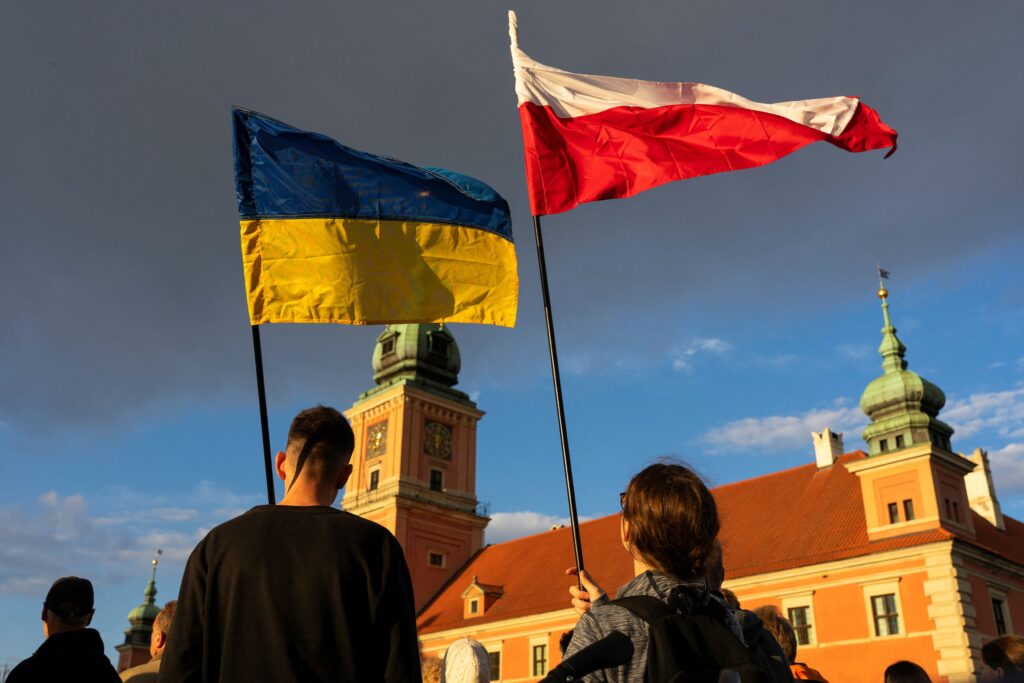
Where did Polish solidarity go? In the aftermath of the full-scale invasion of Ukraine by Russia in 2022, Poles opened their country to their neighbors. Nine million Ukrainians came through the border; I was there and remember the spontaneous crowds with sandwiches and thermoses, free rides and accommodation. Back then, 78 percent of Poles supported military aid — and indeed it poured into Ukraine from, and through, Poland.
That was then.
Today a majority of Poles criticize military help to Ukraine and 52 percent no longer want to admit refugees. Most Ukrainians who chose Poland — linguistically, culturally and geographically close to them — as a safe haven are bewildered and some are planning to move to another country.
Resentment plays a part. Ukrainians are seen as competing on the Polish labor market — and Ukrainian women on the dating market as well. Polish farmers resented that Ukraine could export its grain to the European Union tariff-free, and they blocked its trucks on the border. Many Poles seem to believe that Ukrainian refugees are a drain on the budget, even though they are in fact net contributors.
You often hear it said in Warsaw (and Washington too) that Ukrainians are not grateful enough. In my opinion, the whole of Europe should be grateful to Ukrainian fighters for stopping Russians in their tracks. The Poles should be most grateful of all.
Poland also cannot accept that some figures from Ukraine’s nationalist past — Stepan Bandera in particular — remain in its pantheon, their likeness on coffee mugs and T-shirts. Many Poles see them as toxic characters.
The two countries’ painfully entangled past is a source of friction. In 1943, members of the nationalist Ukrainian Insurgent Army, known by its Ukrainian acronym, UPA, massacred Polish civilians. Poland claims there were 100,000 victims of the “Volhynia genocide.” Ukraine disputes this number, refers to the killings as the “Volhynia tragedy” and points out that thousands of Ukrainians died in reprisals. In spite of the ongoing war with Russia, Ukraine allows Polish historians to carry out exhumations on its territory.
Poland’s president, Karol Nawrocki, never visited Kyiv. When he received his Ukrainian counterpart Volodymyr Zelensky in Warsaw last year, he handed him two volumes on Volyhnia. This is a bit like welcoming German Chancellor Friedrich Merz with a coffee-table book on Auschwitz.
Last May, Zelensky bestowed on a Ukrainian special forces unit the name “Heroes of the UPA.” The UPA fought the Soviets in and after World War II, and remain a potent symbol for Ukrainians. Within days, a furious Nawrocki stripped Zelensky of Poland’s highest state honor. The famous Polish dissident Adam Michnik declared Nawrocki’s gesture a “shame and disgrace.” Michnik was almost alone in his protest. Most Polish politicians supported Nawocki’s decision or remained silent. A serving Polish minister now says Ukraine will not be admitted to European Union if it “comes with Bandera on the banner,” and the Polish opposition’s candidate for prime minister called for all military aid to be suspended.
Social media is perhaps the ultimate exacerbator of discord. Poland’s deputy digital minister said recently that Russian disinformation exploded across social and official Russian media in the wake of the presidential spat. This poison was then amplified on Polish networks. Press Club Poland, which monitors perceptions of the Ukrainian community on social media, saw the proportion of negative posts rise from 15 percent in May to 22 percent in June, before spiking to 49 percent in July. Another prominent think tank reports that Polish-language anti-Ukrainian content increased by more than 250 percent on X, Facebook, Instagram, TikTok and YouTube since May. This is part of what must have come my way in those 950 comments.
Some analysts suggest that much of this filth may well be bot-generated, designed to give the impression that the intensity of the animosity is greater than it is. But when prominent figures and organizations on the Polish far-right are regularly sharing it with their followers, the line between a foreign influence campaign and domestic politics becomes blurred.
On Aug. 15, Prime Minister Donald Tusk singled out the right-wing opposition politicians for turning voters against Ukraine, and made the case for Poland helping its neighbor. “Polish-Ukrainian relations can be debated, but no one can doubt that supporting Ukraine in the war with Russia is for our security,” he said. “We do it for ourselves, for Poles, and for no one else.”
Many of my worried Polish friends felt a bit better hearing his words. Perhaps Tusk’s appeal to self-interest can reach those who have been poisoned. But there is no easy recipe for how to repair bilateral relations and save a crucial alliance against a dangerous common enemy.
I will soon take my 53rd trip to Ukraine, driving a donated car from Helsinki to Kharkiv. And I continue to raise funds to buy power banks and tourniquets. It’s the least I can do to help. If the Ukrainians prevail in their struggle, their monumental sacrifice will have kept my country safe.
The post Poles once embraced Ukrainians. What happened? appeared first on Washington Post.