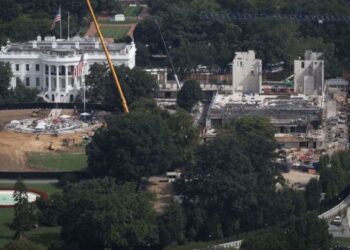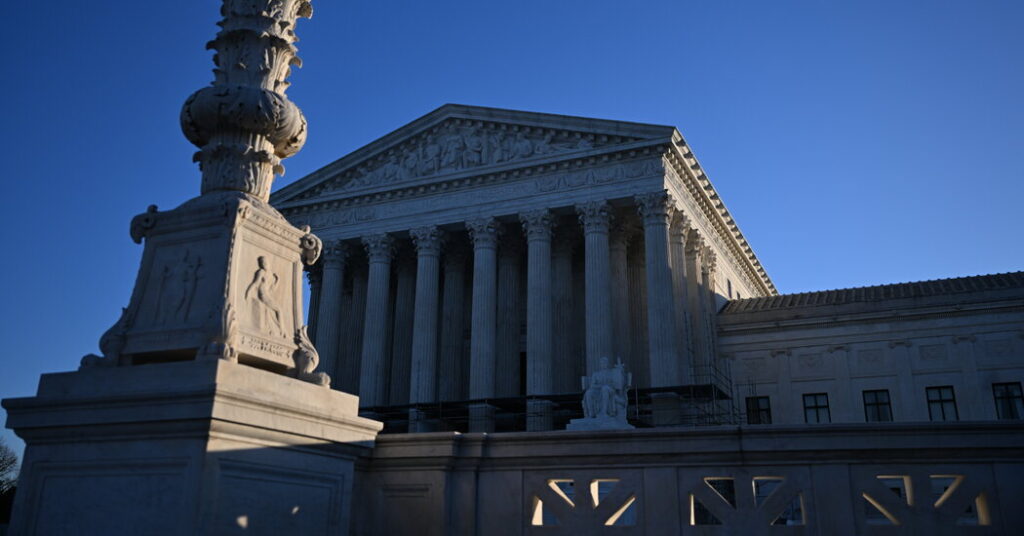
A divided Supreme Court on Monday allowed construction to continue on President Trump’s luxury White House ballroom, which has been steadily rising to replace the East Wing the president tore down last fall.
The justices said the preservationists who challenged the construction of the planned 90,000-square-foot ballroom did not have legal grounds known as standing to bring their lawsuit because they were not directly harmed by the project, estimated to cost $400 million.
The majority emphasized that its order was not addressing the legality of the project and instead the question of who could sue to try to block it. But in practical terms, the order was a significant setback to the most serious legal challenge to the project, meaning the president seems likely to be able to complete construction.
In an unusual lineup, Chief Justice John G. Roberts Jr. and the court’s three liberal justices disagreed with the majority, with the chief justice writing in a lengthy dissent that the White House is “an iconic American building whose symbolism and history are wrapped up in its architecture.”
Monday’s order reversed lower-court rulings that would have halted aboveground construction because the judges found that the administration had exceeded its authority by moving ahead with major changes to the White House campus without congressional approval.
The ballroom project, which includes a secure military bunker underneath, is just one way Mr. Trump has been aggressively remaking Washington during his second term. He has proposed building a 250-foot triumphal arch near Washington’s border with Arlington, Va. His allies have been pressing to inscribe his name on the John F. Kennedy Center for the Performing Arts even after a judge ordered it removed from the building.
But the ballroom has been particularly personal for Mr. Trump, who has for years said that the White House needed a larger space to host special guests without having to erect a tent on the South Lawn.
The order from the Supreme Court was the second time in less than two weeks that the court weighed in on the project. The first time, on Aug. 21, Chief Justice Roberts issued a one-sentence placeholder known as an administrative stay to buy his colleagues additional time to more fully consider the administration’s request to block the lower-court rulings against the president.
The chief justice handles emergency requests from the U.S. Court of Appeals for the District of Columbia Circuit and initially acted on his own. He did not provide any reasoning for the initial order, which also allowed construction to continue.
The new order represents the views of the full nine-member court.
The project has grown in scale in recent months as the president and his lawyers have shifted to emphasize the national security imperative of what they now refer to as the military/ballroom complex. It includes a major upgrade to the bunker beneath, built during World War II and known as the Presidential Emergency Operations Center.
“The Military/Ballroom Complex being built on the hallowed grounds of the White House, which is so vital for National Security, will be THE GREATEST OF ITS KIND!” the president posted on social media on Aug. 21.
The challenge to the project was brought by the National Trust for Historic Preservation, a nonprofit chartered by Congress to guard public buildings. The trust argued that a longtime member, Alison K. Hoagland, a District of Columbia resident and architectural historian, had been personally and professionally harmed by the destruction of one of the most prominent public buildings in the United States, which she has routinely walked past and reflected on in her work.
In a court filing, the preservationists said the president’s actions violated the Constitution and federal laws, which gave Congress the power to decide which structures can be built on federal property in Washington. They told the justices that the administration was essentially trying to outrun the courts by accelerating construction of the ballroom.
“Efforts to foil judicial review and arrogate Congress’s exclusive powers should not be rewarded” with an order from the court that would allow the administration to “complete a ballroom they lacked any authority to commence in the first place,” wrote the trust’s lawyers, led by Thaddeus A. Heuer.
The trust suggested that the justices could put the aboveground construction on hold and schedule quick oral arguments in October or November to review the case in-depth, through their traditional process rather than ruling immediately as a temporary emergency.
In March, Judge Richard J. Leon, who sits on the District Court in Washington, initially halted construction of the ballroom and rejected the administration’s claims. But he allowed work on the project to continue temporarily to allow for an appeal.
“While I take seriously the government’s concerns regarding the safety and security of the White House grounds and the president himself, the existence of a ‘large hole’ beside the White House is, of course, a problem of the president’s own making!” the judge wrote.
In August, the appeals court in Washington ruled 2 to 1 against the president in a lengthy opinion that said Congress has control over federal property and had not ceded its authority to the president to dramatically redesign the “People’s House” to “fit a particular president’s desires.”
The Trump administration quickly asked the Supreme Court to intervene, telling the justices that it was essentially too late to stop the project and that doing so would put the president and his family at risk. A team of 250 workers has pushed ahead with construction 20 hours a day, seven days a week, and it is 65 percent complete, according to the government’s court filings.
Mr. Trump had touted that the luxury space would be funded by private donations, but in June the administration transferred about $350 million in taxpayer money from the Secret Service for “security enhancements” to the ballroom and bunker.
The Secret Service has said that it plans to spend $220 million to “harden” the partially built ballroom against attack, including the installation of bulletproof glass, drone detection technology, chemical and other threat filters and detectors. The taxpayer-funded upgrades also include a $180 million visitor screening facility.
The post Supreme Court Allows Trump’s White House Ballroom Construction appeared first on New York Times.